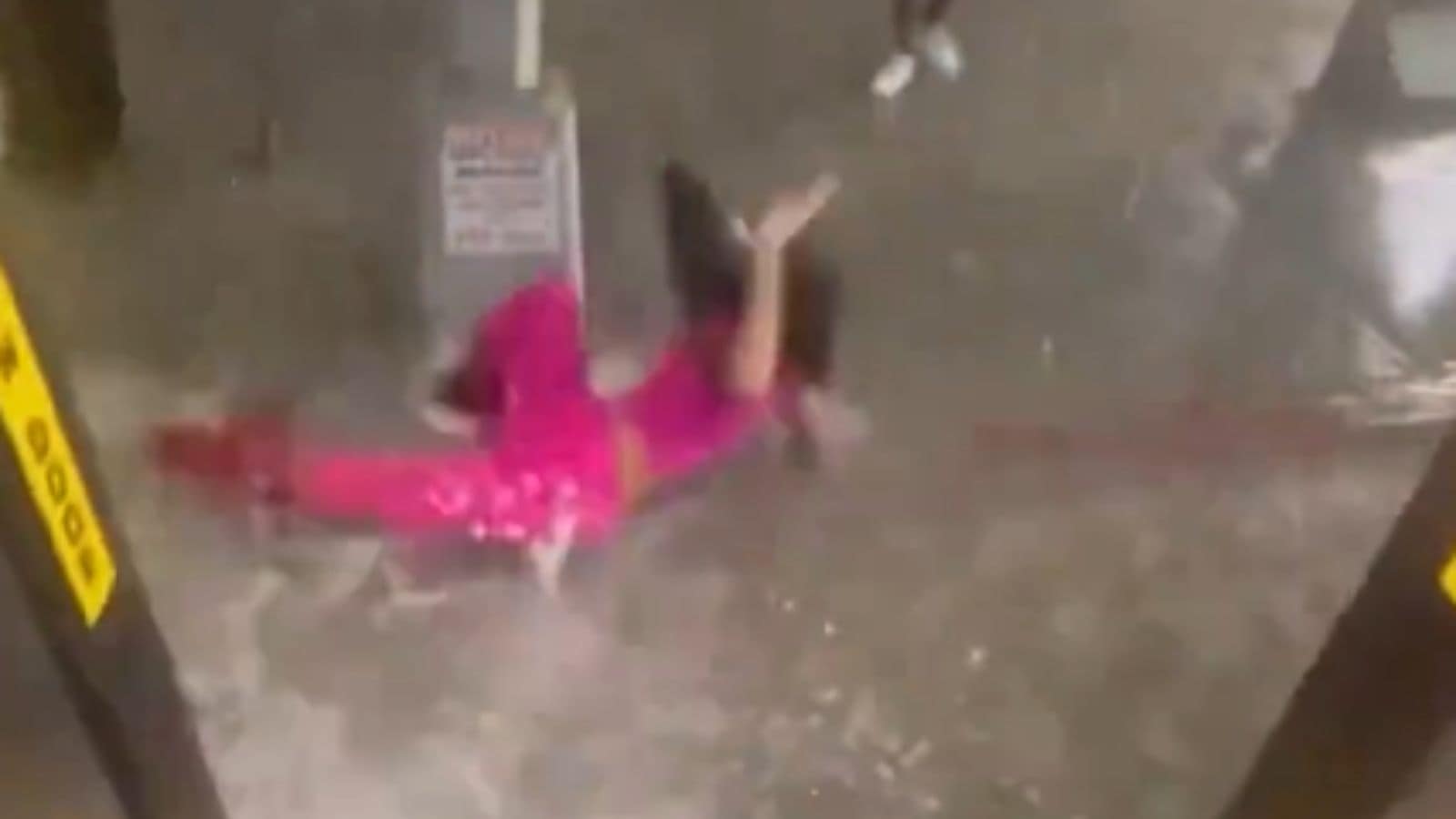
The real reason New York City parlayzed under this week’s torrential downpour is not a sudden, freakish shift in global weather patterns. It is math. When two inches of rain slam into the pavement in less than sixty minutes, a century-old engineering framework reaches its absolute physical limit, leaving millions of commuters to wade through the fallout of political inertia.
While viral videos of a woman swept away by currents in Queens and an off-duty firefighter punching through a vehicle's sunroof in Bed-Stuy captured global attention, they obscured the systemic mechanics of the failure. Mayor Zohran Mamdani traveled to the flood-ravaged neighborhood of Hollis to promise structural action, pointing toward long-term capital investments. Yet the grim reality remains that New York’s subways and roadways will continue to drown because the city is attempting to combat 21st-century cloudbursts with a drainage network built for the Gilded Age.
The Hard Physics of an Overwhelmed System
To understand why the Grand Central Parkway transforms into an impassable canal every time a severe thunderstorm rolls through, one must look at the diameter of the pipes buried beneath the asphalt. New York City’s 7,500-mile sewer network was largely optimized to handle a maximum of 1.5 to 2 inches of rain per hour.
When a storm exceeds that threshold, the system does not just slow down. It runs backwards.
[ Intense Rainfall ]
        |
        v
[ Saturated Street Pavement ]
        |
        v
[ Blocked Catch Basins ] ----> (Street-Level Flash Floods)
        |
        v
[ Maximum Underground Pipe Capacity Exceeded ]
        |
        v
[ Combined Sewer Overflow / Water Backs Up Into Basements & Subways ]
The concrete jungle offers no natural absorption. Water hitting the pavement rushes instantly toward the 150,000 catch basins lining the curbs. If those grates are obstructed by standard city litter, or if the sheer volume of water exceeds the intake velocity, the streets become immediate retention basins.
In low-lying pockets of Queens and Brooklyn, the crisis compounds. Queens Borough President Donovan Richards highlighted a brutal civil engineering catch-22. To stop the localized pooling, engineers must raise the physical elevation of the roadways. However, raising a street without simultaneously elevating the foundation of every adjacent residential property means creating a permanent funnel that drains directly into front doors and basement apartments.
The Ten Year Illusion of Cloudburst Infrastructure
In response to the public outcry, the Mamdani administration has leaned heavily on its signature Cloudburst projects. This initiative promises a series of localized, highly engineered urban sites designed to absorb, channel, and store excess stormwater for 24 to 48 hours before gradually releasing it back into the sewer grid.
The strategy is scientifically sound, utilizing porous asphalt, sunken rain gardens, and subterranean retention tanks. But the timeline is an existential threat to the city's current residents.
The administration’s rollout is explicitly framed as a 10-year capital plan.
A decade is an eternity when a family in Hollis is currently using a shop-vac to clear raw sewage from their basement for the third time in five years. The city recently announced a $108 million allocation to replace roughly 6,700 obsolete catch basins over the next ten years, supplemented by a $20 million purchase of specialized cleaning trucks.
The Scale Gap: Replacing 6,700 catch basins sounds monumental on a press release. In reality, it represents just 4.4% of the city's total storm drain inventory.
At the current projected pace of infrastructure modernization, the rate of accelerating climate volatility will outstrip the deployment of these upgraded systems. The city is upgrading its defense mechanisms linearly, while the threat is scaling exponentially.
Why the Subway Submerges
The metropolitan transit framework is fundamentally tied to the municipal drainage system. When the street-level sewers back up, gravity dictates that the excess water seeks the lowest available point. That point is invariably a subway stairwell or a ventilation grate.
The Limits of Pumping Power
The Metropolitan Transportation Authority (MTA) maintains an extensive internal network of hundreds of heavy-duty pump rooms buried deep within the transit tunnels. These pumps work constantly even on dry days to remove natural groundwater seepage. When street-level flash floods breach the stations, the pumps are quickly subverted by silt, garbage, and a volume of water they were never calibrated to displace.
Mechanical Vulnerabilities
- Signal Systems: Many routes still rely on legacy interlocking systems and track-side wiring that short-circuit the moment they are submerged in brackish water.
- Third Rail Exposure: Water depth reaching the height of the third rail forces immediate, sweeping power cutoffs across entire transit lines to prevent catastrophic electrical arcing.
This is why major arteries like the Cross-Island Expressway and key subway lines collapse simultaneously. It is a singular, interconnected hydraulic failure.
The Policy Disconnect
Politicians frequently frame these infrastructure failures as unprecedented anomalies. However, historical data and recent neighborhood testimonies reveal a highly predictable pattern of neglect that falls disproportionately on outer-borough immigrant and working-class enclaves.
For decades, capital allocation has favored high-visibility transit hubs and commercial corridors over the deep subterranean overhauls required in residential Queens and Brooklyn. While emergency response workers perform heroic rescues on flooded parkways, the long-term survival of these neighborhoods hinges on aggressive, accelerated capital spending that prioritizes climate adaptation over bureaucratic box-checking.
The city’s online reporting tools and 311 hotlines offer a mechanism to log property damage, but a digital log does nothing to alter underground hydrodynamics. Until the city treats its hidden drainage infrastructure with the same urgency as its visible real estate developments, the next heavy storm will yield the exact same viral footage, the exact same political vows of action, and the exact same underwater streets.