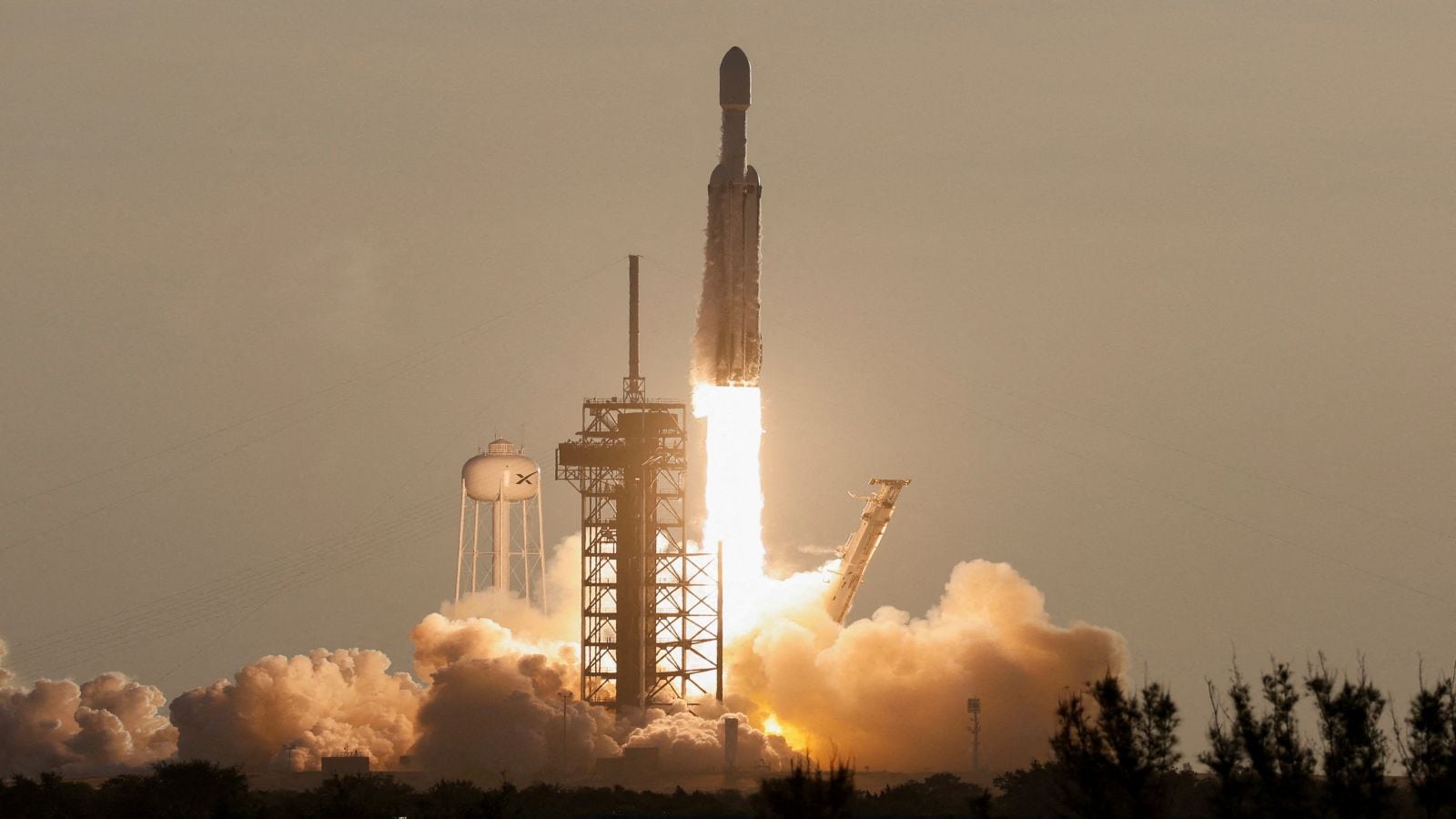
The ground shuddered beneath Kennedy Space Center as a SpaceX Falcon Heavy cleared the pad, carrying the Nancy Grace Roman Space Telescope toward the second Lagrange point, a million miles from Earth. Decades of planning, institutional budgeting battles, and engineering strain culminated in this singular morning liftoff. Yet the real work for the astrophysics community begins now, far away from the applause of the launch control room.
Named after NASA's first chief of astronomy and widely celebrated as the mother of Hubble, the observatory arrives with a specific mandate. It is built to map the cosmos on an unprecedented scale, targeting the invisible mechanics driving the expansion of the universe. While the James Webb Space Telescope peers deeply into narrow corridors of ancient starlight, Roman is designed to cast a wide net across the dark cosmos. For a different perspective, see: this related article.
The Architectural Shift in Wide-Field Astronomy
Traditional flagship observatories operate like high-powered sniper rifles. They provide extraordinary detail over microscopic patches of sky. Roman functions more like a wide-angle surveillance grid. Its primary instrument, a 300-megapixel wide-field camera, matches the infrared resolution of Hubble while capturing a field of view one hundred times larger.
This hardware configuration solves a persistent bottleneck in observational astronomy. Previously, researchers spent months stitching together hundreds of individual frames to build a coherent mosaic of a galaxy cluster. Roman records massive swaths of the sky in a single exposure. Similar analysis regarding this has been published by The Verge.
During its initial five-year primary mission, the telescope will survey billions of galaxies and track hundreds of thousands of exoplanets. To achieve this, engineers packed the housing with advanced focal plane arrays and thermal control loops. Every component works to minimize structural distortion in the harsh thermal vacuum of deep space.
+---------------------------+-----------------------------------------------+
| Observatory Component     | Primary Operational Goal                      |
+---------------------------+-----------------------------------------------+
| Wide-Field Instrument     | Surveys billions of galaxies and exoplanets   |
| Coronagraph Technology    | Direct imaging and spectra of exoplanets      |
| Falcon Heavy Launch Stack | Delivery vehicle to Sun-Earth L2 orbit        |
+---------------------------+-----------------------------------------------+
Confronting the Dark Energy Problem
Cosmologists face an embarrassing empirical gap. The ordinary matter making up stars, planets, and human bodies accounts for barely five percent of the mass-energy inventory of the universe. The rest consists of dark matter and dark energy, two placeholder terms for phenomena we can measure gravitationally but cannot touch or explain.
Dark energy acts as a cosmic gas pedal, accelerating the expansion of space across billions of light-years. To understand how it behaves, astronomers require statistical weight. They need measurements from millions of supernovae and the subtle warping of galaxy shapes known as weak gravitational lensing.
Roman will map these distortions across vast cosmic distances. By tracking how light bends around massive clusters of dark matter over time, the telescope provides the sheer volume of data necessary to test competing theoretical models. If dark energy is a constant property of space, or if it evolves dynamically, Roman’s multi-billion-pixel data streams should reveal the signature.
Exoplanet Census and the Search for Analogs
Beyond cosmology, the mission introduces a technological milestone for planetary science through its onboard coronagraph instrument. Detecting an exoplanet directly next to its host star is notoriously difficult due to the overwhelming glare of the star.
Think of trying to spot a firefly sitting inches away from a massive stadium floodlight miles down the dark road.
The coronagraph utilizes an intricate arrangement of masks, prisms, and deformable mirrors to cancel out stellar light. This hardware acts as a mechanical blinder, letting the faint light of orbiting planets pass through to the detectors. While tested as a technology demonstration rather than a primary science instrument, the coronagraph paves the way for future direct-imaging missions seeking chemical signatures of habitability on distant worlds.
Concurrently, Roman will execute a massive statistical census of exoplanets using gravitational microlensing. When a star passes in front of a background star, its gravity acts as a magnifying lens, bending light and revealing the presence of orbiting planets. This technique allows the telescope to detect cold, distant worlds that traditional transit methods miss entirely, including rogue planets drifting through interstellar space without a host star.
Financial Survival and Institutional Realities
The path to the launchpad was anything but guaranteed. Major science missions frequently encounter massive budget overruns and schedule slippage. Roman managed to avoid the worst of these pitfalls during its early phases, but it still weathered significant political crosswinds.
Shifting federal priorities and competition for funding within NASA nearly derailed the initiative mid-decade. Critics argued that the agency could not afford another flagship observatory while managing the operational costs of Webb and the development hurdles of future planetary missions. Support from the decadal survey process, combined with bipartisan congressional backing, ultimately preserved the budget, bringing total lifecycle costs to roughly $4.3 billion.
Now that the observatory is coasting toward the second Lagrange point, the technical challenges shift from structural engineering to data pipeline management. The influx of raw information will overwhelm traditional processing frameworks. NASA plans to stream the vast archives directly to public repositories without proprietary embargo periods.
Teams of researchers across institutions will pull from the same data pool simultaneously, democratizing access to cosmic cartography. Over the next several months, engineers will execute a methodical series of subsystem checkouts, mirror alignments, and thermal stabilizations. If those sequences proceed according to plan, the first tranche of deep-universe data will reach Earth early next year.