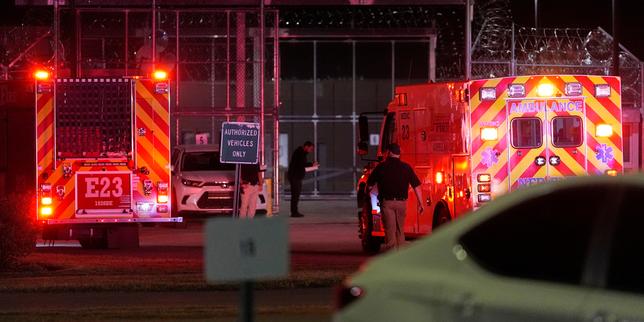
The death chamber at the Maximum Security Complex in Nashville was supposed to operate with absolute mechanical precision. When the state of Tennessee scheduled the execution of Christa Pike for September 30, 2026, corrections officials anticipated a routine lethal injection using pentobarbital. Instead, the procedure devolved into a prolonged systemic failure, leaving Pike unconscious on a hospital ventilator and plunging the state's capital punishment apparatus into a severe constitutional and operational crisis.
Pike, who spent over three decades on death row for the 1995 murder of fellow Job Corps student Colleen Slemmer, became the center of a national firestorm when state executioners could not properly secure an intravenous line. According to legal filings and witness accounts, prison personnel spent more than an hour poking and probing her arms with at least seven needles, warning onlookers that veins appeared to have ruptured before the drugs were even introduced. What followed was not a swift application of justice, but a breakdown of technical protocol that exposed deep vulnerabilities in how states administer capital punishment. Building on this idea, you can find more in: The Silence That Falls When Mekelle Changes Hands.
The Mechanics of a Protocol Breakdown
Lethal injection relies entirely on the premise of rapid, unobstructed vascular access. When an execution team fails to establish a primary central or peripheral line, the entire procedure is compromised. In Pike's case, witnesses observed her complaining of acute pain shortly after the initial dose of pentobarbital was administered, noting that her arm felt like it was about to burst. Rather than halting the procedure to troubleshoot or address a compromised vein, the protocol pushed forward.
Medical experts and defense attorneys later asserted that the pentobarbital failed to enter her bloodstream correctly. Instead, the chemical likely pooled in surrounding tissue, causing severe chemical burns, blistering, and intense localized trauma. Under Tennessee Department of Correction guidelines, if an inmate remains alive five minutes after the first injection, a second dose is mandated. Officials administered the backup dose while Pike was visibly reacting, moving, blinking, and breathing on the gurney. Observers at Reuters have provided expertise on this situation.
The execution chamber blinds were repeatedly closed and reopened as confusion mounted behind the glass. More than an hour after the process began, microphones captured her snoring before audio was abruptly cut. Emergency legal motions filed by public defenders eventually forced a transfer to an off-site hospital, where medical staff placed her on mechanical ventilation to clear the high concentration of barbiturates from her system.
The Secrecy Wall Around Execution Drugs
The fallout immediately shifted from the hospital room to the courtroom, where a fierce battle over transparency began. State attorneys moved aggressively to block Pike's legal team from inspecting, collecting, or chemically testing the leftover pentobarbital from the execution chamber. The rationale offered by the state Department of Correction centered on protecting supplier anonymity, citing state laws designed to shield compounding pharmacies and distributors from public exposure.
This legal maneuver highlights a pervasive paradox within modern capital punishment. States demand absolute trust in the safety, purity, and efficacy of execution drugs while simultaneously cloaking the procurement process in secrecy. When an execution goes wrong—as it did in Tennessee twice within a short window—independent oversight becomes nearly impossible because the physical evidence is shielded by statutory privilege. Legal scholars note that blocking independent drug analysis prevents courts from determining whether the failure stemmed from pharmacological degradation, improper storage, or human error by the execution team.
Political Aftershocks and Policy Reevaluations
The botched procedure forced immediate political intervention. Governor Bill Lee suspended all remaining executions for the year and ordered an independent review headed by a former federal prosecutor. Lawmakers from both sides of the aisle began questioning the viability of single-drug lethal injection protocols, with some conservative legislators openly advocating for alternative methods or a total reassessment of the state's capacity to carry out death sentences safely.
For the victims' families, the debacle compounded an already profound grief. May Martinez, the mother of Colleen Slemmer, expressed bitter frustration to reporters, noting that the botched procedure failed to deliver the definitive closure the judicial system originally promised. Meanwhile, Pike's defense attorneys utilized the physical and psychological toll of the failed procedure to petition for a sentence commutation to life imprisonment, arguing that subjecting an inmate to a prolonged, failed chemical trauma constitutes cruel and unusual punishment.
As Pike was discharged from the hospital back into the custody of the Debra K. Johnson Rehabilitation Center—her arms permanently scarred and discolored from chemical burns—the broader institution of capital punishment faced an uncomfortable reckoning. The incident demonstrated that the machinery of death, when executed by human hands under intense pressure, remains uniquely susceptible to catastrophic operational failure.