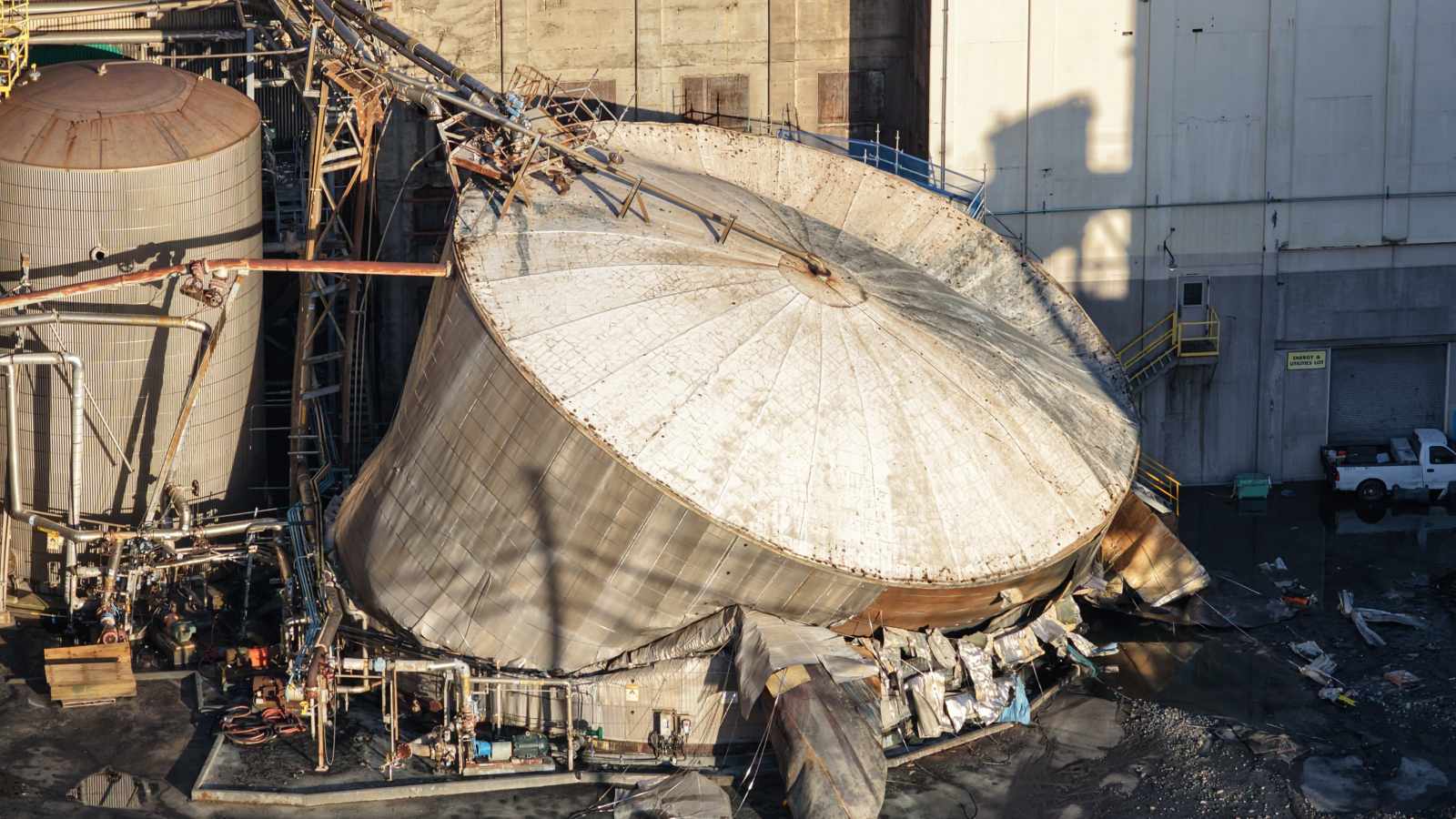
A catastrophic industrial disaster struck southwestern Washington on Tuesday morning when a massive chemical tank violently imploded at the Nippon Dynawave Packaging facility in Longview. One worker is confirmed dead, nine others remain missing with no hope of rescue, and nine more have been hospitalized with severe chemical burns and inhalation injuries. The incident occurred at 7:15 a.m. local time, instantly transforming a historic paper mill into what local fire officials describe as a mass casualty scene. A 900,000-gallon torrent of highly corrosive industrial liquid tore through the facility, structurally undermining nearby buildings and rendering the immediate area too hazardous for immediate recovery operations.
While initial mainstream coverage has focused heavily on the chaotic emergency response, the true story lies in the mechanics of industrial structural failures and the dangerous chemical processes inherent to modern paper production. This was not a sudden, unpredictable act of God. It was a structural failure involving a highly volatile, caustic substance known as white liquor, housed in an aging facility that dates back to 1953.
The Physics of an Industrial Collapse
To understand why the disaster was so lethal, one must understand the difference between an explosion and an implosion. An explosion pushes outward, venting energy into the open air. An implosion happens when the internal pressure of a vessel drops significantly below atmospheric pressure, causing the walls of the structure to violently collapse inward.
When a tank holding nearly a million gallons of liquid structural chemistry collapses inward, it creates a massive vacuum effect followed immediately by a catastrophic structural failure of the outer shell. The remaining liquid is not contained; it rushes outward in a tidal wave of corrosive force.
At the Nippon Dynawave plant, the tank was holding roughly 600,000 gallons of white liquor—roughly 60% of its total capacity—when the vacuum occurred. The sheer weight of the collapsing steel combined with the sudden displacement of hundreds of thousands of gallons of liquid flattened nearby structures, trapping workers before they could react. Emergency crews arriving on the scene encountered a twisted labyrinth of compromised metal and active chemical pools, forcing them to halt rescue operations until the remaining structures could be reinforced.
What is White Liquor and Why is It So Dangerous
The substance that flooded the Longview facility is not a standard industrial chemical. White liquor is a heavily alkaline solution used in the Kraft process of pulp production. It is a mixture consisting primarily of:
- Sodium hydroxide (caustic soda)
- Sodium sulfide
This chemical combination is engineered for a single purpose: to dissolve lignin, the organic glue that holds wood fibers together, allowing the plant to manufacture paper packaging products.
Because white liquor is designed to break down tough organic plant matter under extreme heat and pressure, its effect on human tissue is devastating. It dissolves proteins and fats via a process called saponification, meaning it literally turns living tissue into soap upon contact. This causes deep, liquefactive chemical burns that penetrate much further into human flesh than acid burns. Additionally, when agitated or mixed with organic materials during a rupture, the solution can release toxic gases, leading to severe respiratory tract damage upon inhalation. This explains why the surviving workers suffered life-threatening injuries and why first responders required extensive decontamination procedures before transport to regional hospitals.
Aging Infrastructure Meets Modern Production Demands
The Nippon Dynawave mill along the Columbia River has been a cornerstone of the Longview economy for over seventy years. It employs approximately 1,000 residents and supplies materials for everything from food cartons to paper plates. However, operating an industrial chemical facility built in the mid-20th century carries inherent structural risks.
Industrial storage tanks holding highly corrosive materials require rigorous, continuous maintenance. Over decades, the constant cycling of hot, caustic liquids wears thin the protective linings of steel tanks.
[Corrosive Chemical Wear] -> [Microscopic Wall Thinning] -> [Sudden Vacuum Event] -> [Total Structural Implosion]
If a venting valve malfunctions during the rapid draining or cooling of a tank, the internal air pressure drops. If the steel walls have been sufficiently thinned by decades of chemical exposure, the atmospheric pressure outside the tank—roughly 14.7 pounds per square inch—will crush the structure like an empty aluminum soda can. Investigators from the U.S. Chemical Safety Board and the Washington State Department of Labor & Industries will undoubtedly focus on the maintenance logs of this specific tank, tracking how often internal wall thickness evaluations were performed.
The Regulatory Gap in Industrial Safety
This tragedy occurs against a backdrop of increasing concerns over industrial chemical management in the United States. While agencies like the Environmental Protection Agency and OSHA maintain strict guidelines on chemical storage, enforcement is often reactive rather than proactive.
According to data compiled by environmental justice networks, more than 40 fatalities resulted from hazardous chemical incidents in industrial facilities between 2021 and late 2023 alone. The Longview disaster highlights a persistent regulatory blind spot: the oversight of aging storage infrastructure in legacy manufacturing towns.
Companies operating in historically industrial zones often benefit from grandfathered compliance clauses or deferred maintenance schedules due to the economic impact a total facility shutdown would cause to the local community. In Longview, a city of 38,000 built on the timber industry, the paper mill is an economic lifeline. This reality frequently complicates the relationship between municipal oversight, corporate accountability, and worker safety.
The Immediate Environmental and Economic Fallout
Beyond the tragic human toll, the collapse has triggered a localized environmental response. The state Ecology Department confirmed that hundreds of thousands of gallons of white liquor breached secondary containment barriers, flowing directly into a nearby drainage ditch.
While officials state there is no immediate toxic threat to the broader public or the city's drinking water, the containment of an alkaline spill of this magnitude is incredibly complex. Neutralizing thousands of gallons of sodium hydroxide requires precise chemical intervention to prevent the solution from migrating toward the Columbia River ecosystem, where it could cause massive damage to local aquatic life.
Economically, the facility faces an indefinite partial shutdown. The logistical chain for consumer paper goods will feel the ripple effects, but the immediate concern remains focused on the structural integrity of the rest of the site. Cowlitz Fire and Rescue Chief Scott Goldstein indicated that recovery teams are working through a delicate process: deciding whether to pump out the remaining 90,000 gallons of trapped fluid first or attempt to stabilize the crumbling metal ruins around it. Until that engineering puzzle is solved, the families of the nine missing workers are left waiting for answers that can only be found beneath thousands of tons of corrosive steel.