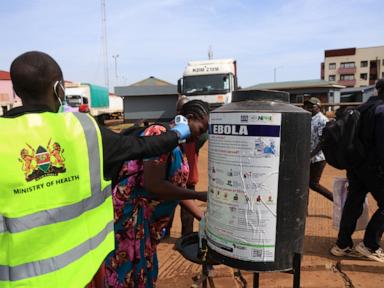
Kenya confirmed its third Ebola case in mid-October 2026 in a relative of the country's first patient, a 40-year-old man who died in Nairobi after traveling from the Democratic Republic of the Congo. That single household confirmation exposed a deeper reality beneath the headlines. A massive Bundibugyo virus outbreak that began in Ituri Province in April 2026 had already torn across the DRC, crossing borders and testing regional defenses far harder than routine border screenings ever could.
When a competitor outlet runs a short wire update on a third case in a relative, readers get a count. They miss the mechanics of how a traveler moves through three affected provinces in the DRC, crosses into Uganda, boards a flight to Kenya, gets picked up at the airport by family, and dies days later while epidemiologists race to map every hand he shook or room he entered.
I have covered infectious disease outbreaks and health security systems for more than two decades across three continents. Every time a viral hemorrhagic fever crosses a busy transit corridor, officials promise tight control. Reality is always messier.
How One Traveler Exposed East Africa's Transit Vulnerability
The index patient was a Kenyan citizen who had lived in the DRC for eleven years before traveling back through three Ebola-affected provinces. He entered neighboring Uganda on October 1, 2026, and arrived in Kenya on October 3. A relative met him at the airport and drove him to a hospital. By October 5, he tested positive for Bundibugyo ebolavirus and died the same day.
Confirmation of the third case—another relative—landed on October 16, 2026, just as the DRC outbreak expanded into an eighth province. That sequence matters because it shows where border controls actually break down. Thermal scanners and entry forms catch obvious fevers and honest declarations. They do not catch a passenger incubating a pathogen during regional transit, nor do they stop a family member from meeting a sick relative at arrivals and driving straight to a clinic.
Regional mobility is not an anomaly in East and Central Africa. It is daily life. Families span borders, traders move goods along highways and air routes, and patients seek care wherever trust or family support sits waiting.
- Cross-border kinship: Families frequently travel between eastern DRC, Uganda, and Kenya for work, funerals, and medical care, creating contact networks that span multiple jurisdictions.
- Incubation lag: Early symptoms of viral hemorrhagic fever resemble malaria, typhoid, or severe influenza, delaying isolation until viral loads climb.
- Clinic exposure: When an acutely ill traveler arrives at a hospital before staff suspect Ebola, triage desks and wards face immediate exposure risk.
Why Bundibugyo Virus Changes the Math
Most public memory of Ebola centers on Zaire ebolavirus, the species behind the 2014–2016 West African crisis and several major DRC flare-ups. Bundibugyo virus gets less attention in global preparedness debates, even though its impact in 2026 has been severe.
By early November 2026, cumulative confirmed cases of Bundibugyo virus disease in the DRC had passed 10,600 with roughly 5,198 deaths, a crude case-fatality ratio near 48.7%. Compared with the 2018 DRC Ebola outbreak—which took roughly 235 days to pass 1,000 confirmed cases—the 2026 outbreak crossed 1,000 confirmed cases in about 40 days.
Speed changes everything in outbreak response. Contact tracing relies on human memory and shoe-leather epidemiology. When cases multiply rapidly across multiple provinces, tracing teams fall behind, and every missed link becomes a spark for another cluster.
| Factor | Bundibugyo Virus in 2026 | Earlier Ebola Outbreak Benchmarks | Operational Consequence |
|---|---|---|---|
| Speed to 1,000 cases (DRC) | Reached within ~40 days of response activation | Took ~235 days in the 2018 DRC outbreak | Contact tracers face compression from day one |
| Targeted medical countermeasures | No approved vaccines or treatments specifically licensed for Bundibugyo; trials underway | Zaire ebolavirus has established licensed vaccines and monoclonal therapies | Clinicians lean heavily on supportive care and cross-protection research |
| Geographic footprint | Spread across eight DRC provinces plus cross-border importations to Uganda, Kenya, and Nigeria | Often concentrated in remote forest or localized zones early on | Multi-country coordination becomes mandatory rather than optional |
The lack of a Bundibugyo-specific licensed vaccine or targeted therapeutic creates a real operational bind. Researchers have examined cross-reactive antibody responses from licensed Ebola vaccines and expanded clinical trial efforts, including WHO recommendations in November 2026 to add two Bundibugyo vaccine candidates to trials. Still, clinicians on the ground cannot rely on a magic bullet. Survival depends on rapid isolation, fluid and electrolyte management, organ support, and strict infection prevention.
Quarantine Is a Shield, Not a Cure
In Kenya, health authorities identified roughly 135 contacts linked to the first patient and placed more than a hundred in quarantine. By October 20, 2026, the Kenyan cluster reached nine confirmed cases—four relatives and four healthcare workers—all connected to the index patient, with all secondary cases already in quarantine when diagnosed. A second death, a 65-year-old woman in quarantine in Nairobi, was reported in late October.
Catching secondary cases inside quarantine is a major public health win. It means contact tracers found those individuals before they mingled freely in markets, buses, or workplaces.
Yet quarantine carries sharp trade-offs that armchair analysts routinely gloss over. Quarantine is hard on households. People lose wages, children miss school, stigma creeps into neighborhoods, and fear can push contacts to hide symptoms if trust frays. Even when authorities provide food, medical checks, and clear communication, keeping dozens of people under observation for 21 days tests patience and logistics alike.
The Frontline Toll on Health Workers
Four healthcare workers in Kenya contracted the virus during the cluster. That number is a sobering reminder of how fragile hospital defenses remain when the first patient walks in unannounced.
- First-contact blind spots: Early-stage patients often present with non-specific fever and body aches before classic hemorrhagic signs appear.
- Equipment and workflow discipline: Donning and doffing personal protective equipment under heat and stress leaves zero margin for shortcuts.
- Psychological strain: Watching colleagues fall ill during a high-consequence outbreak compounds exhaustion across an entire ward.
A hypothetical example shows how easily an exposure happens. Suppose a relative drives a feverish traveler to a busy outpatient clinic late at night, and the patient initially reports routine travel fatigue rather than exposure to an active outbreak zone. Before isolation protocols trigger, multiple staff members and family attendants may share close quarters. Once confirmation comes back days later, those workers suddenly shift from caregivers to quarantined contacts.
Genomic Clues and Regional Blind Spots
Late October 2026 brought another critical piece of evidence. Scientists from Kenya, Nigeria, Uganda, and the DRC reported genomic sequencing linking cases in Kenya and Nigeria—where a traveler arriving from Uganda had also tested positive—to the same transmission chain originating in the DRC.
Genomic epidemiology acts like forensic ballistics for viruses. By comparing tiny mutations in viral RNA, laboratories can tell whether two cases belong to a known branch or point to an unmapped link. Linking the Kenya and Nigeria importations to the DRC chain raised the possibility that an undetected transmission chain could exist in Uganda, even after Uganda's earlier reported cases had tapered off months prior.
No single surveillance system sees everything. Border posts miss informal crossings, rural clinics face diagnostic bottlenecks, and conflict or insecurity in parts of the DRC disrupts access to hard-to-reach communities. When an outbreak runs for six months across vast terrain, gaps in one country's data can echo thousands of miles away.
What Containment Actually Requires Next
By mid-November 2026, Kenya discharged its last Ebola patient and entered the standard 42-day countdown toward declaring the cluster over, while rapid response teams stayed on alert and contacts completed their 21-day monitoring windows. Celebrating a patient going home is right. Treating the countdown as the finish line would be a mistake.
Real containment demands unglamorous, sustained work long after the headline count stops climbing.
- Cross-border data sharing: Health ministries and laboratories must share genomic sequences and contact alerts in real time rather than in silos.
- Triage readiness: Every hospital and clinic along major transit routes needs fast isolation rooms, reliable supplies, and drilled staff who treat unexplained fever with travel history as a priority alert.
- Community partnership: Safe and dignified burials, transparent briefings, and support for quarantined families keep communities cooperating instead of retreating into secrecy.
A single relative testing positive in Nairobi was never just a local statistic. It was a stress test of regional trust, clinical discipline, and cross-border vigilance in an interconnected corridor where one trip can carry a deadly virus across national lines in hours.