When a massive bulk carrier goes from normal sailing to completely underwater in just eight minutes, something catastrophic has gone terribly wrong.
That is the terrifying reality behind the sinking of the Panama-flagged MV Ocean Winner, which vanished roughly 230 nautical miles off the coast of Paradip, Odisha. Carrying over 72,000 tonnes of iron ore, the vessel sent out a distress signal before dropping off the radar, leaving rescue teams in a race against time. Out of 24 crew members onboard, 22 remain missing, triggering a massive joint operation by the Indian Coast Guard and the Indian Navy. For a different look, see: this related article.
If you are following this maritime disaster, you want to know what actually happened out on the water, who is leading the search, and what challenges the rescue teams face right now.
The Timeline of the Disaster
The sequence of events unfolded with brutal speed. MV Ocean Winner left Paradip Port on August 20, 2026, hauling a heavy load of iron ore fines destined for Singapore and eventually China. Related insight on this trend has been provided by The New York Times.
By Saturday, communication with the vessel broke down completely. The Maritime Rescue Coordination Centre (MRCC) in Sri Vijaya Puram sprang into action immediately after picking up distress alerts.
According to survivors and maritime tracking data, the ship didn't sink slowly over hours. It suffered a sudden, violent list—tilting heavily to one side—and vanished beneath the waves in less than ten minutes. That lightning-fast descent left almost no time for crew members to execute standard emergency abandon-ship procedures.
Who Was Onboard and Who Survived
The ship's manifest showed a multinational crew of 24:
- 20 Chinese nationals
- 3 citizens of Myanmar
- 1 Bangladeshi national
As the vessel went down, crew members managed to deploy life rafts. A commercial merchant vessel operating nearby, the MT Aisopos, was diverted through the International Safety Net to scour the area. The crew of the MT Aisopos managed to pull two survivors from separate life rafts.
Those two survivors are Chinese nationals. They were found in a state of shock but are currently receiving medical attention aboard a Coast Guard vessel as they head back to the mainland.
The Joint Search and Finding the Missing 22
Finding 22 people scattered across hundreds of miles of open ocean is a monumental challenge. The Indian Coast Guard and the Eastern Naval Command deployed heavy assets to locate the remaining sailors.
The Navy’s advanced P-8I long-range maritime reconnaissance aircraft has been sweeping the area from the air, spotting floating debris, oil slicks, and life rafts. Meanwhile, Coast Guard ships like the ICGS Varad, Anmol, and Vijit are conducting intensive surface searches.
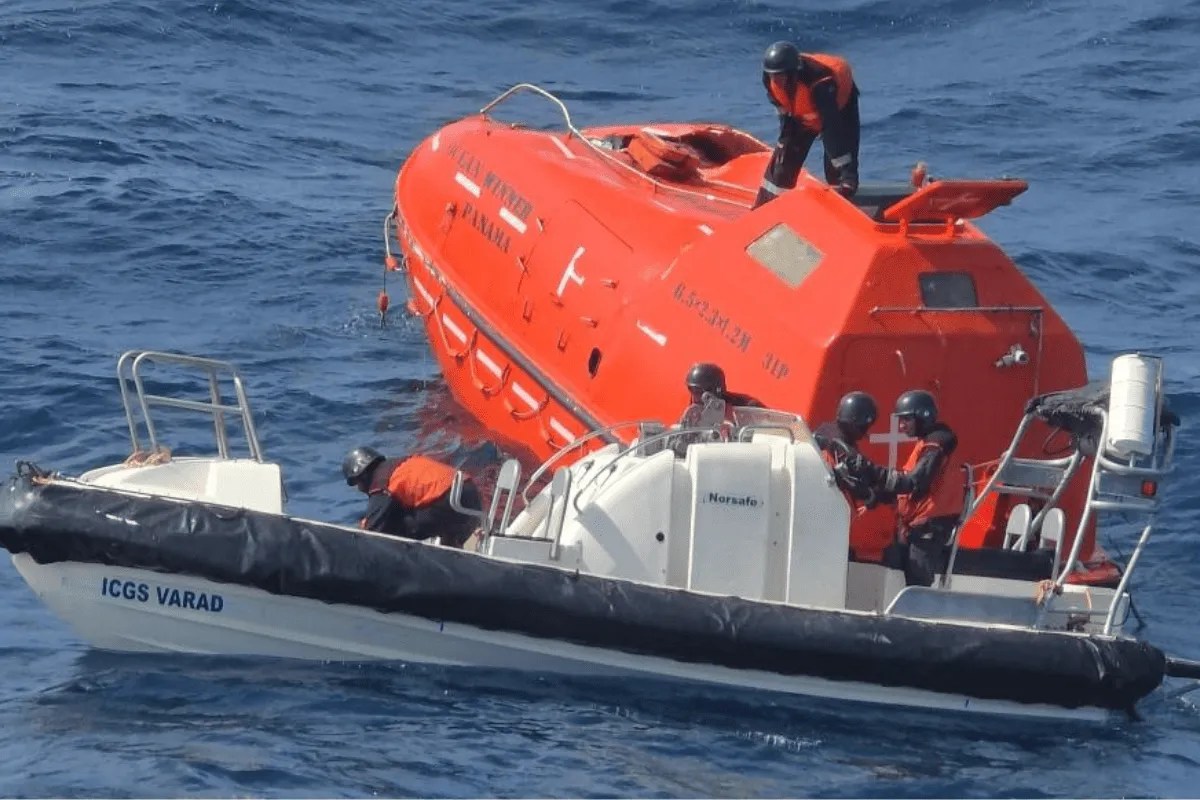
During aerial sweeps, the P-8I detected critical electronic signals, leading the ICGS Varad to recover an Emergency Position-Indicating Radio Beacon (EPIRB) and an empty lifebot belonging to the doomed vessel. International cooperation has also stepped up, with China's Maritime Search and Rescue Centre coordinating closely with Indian authorities and directing nearby commercial shipping lanes to keep a sharp lookout.
Why Did the Ship Sink So Fast?
Maritime experts point to the cargo itself as a primary suspect in sudden vessel destabilization. Carrying tens of thousands of tons of iron ore fines introduces serious structural risks if moisture management fails.
When bulk iron ore gets heavily saturated, it can undergo a process called liquefaction. The solid cargo shifts into a slurry-like fluid state, moving dynamically to one side of the hold with the roll of the waves. When that happens, a ship can lose its righting moment almost instantly, causing a sudden, unrecoverable list.
While official inquiries into the exact technical failure of MV Ocean Winner are still underway, the sheer speed of the sinking points directly to catastrophic cargo shift or a sudden hull breach in heavy seas.
For now, the focus remains entirely on the water. Rescue vessels continue their grid patterns across the choppy swells of the Bay of Bengal, hoping against hope to locate the remaining 22 crew members before time runs out.