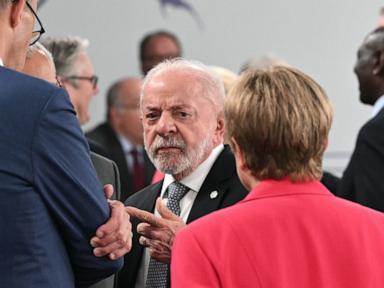
Brazilian President Luiz Inácio Lula da Silva drew a sharp line in the sand for Washington this week, warning U.S. President Donald Trump that Brazil's upcoming October presidential election is strictly domestic business. Speaking to reporters on the heels of a tense Group of Seven (G7) gathering in France, Lula reacted forcefully to Trump’s public criticisms of Brazil’s judiciary and his vocal support for the Bolsonaro political dynasty. The diplomatic friction underscores a deeper, unpublicized conflict over institutional sovereignty, economic warfare, and the shifting mechanics of democratic elections in the Americas.
What appears on the surface to be a standard war of words between a veteran leftist and a populist American president is actually the opening salvo of a new era of geopolitical interference.
The Subversion of Sovereignty
The immediate catalyst for the friction was the sentencing of former lawmaker Eduardo Bolsonaro, son of the former right-wing president Jair Bolsonaro, to more than four years in prison by Brazil's Supreme Court for coercion related to his father's coup trial. Trump wasted no time weaponizing the ruling, publicly lamenting the arrest of "Bolsonaro junior" and declaring Brazil a "little dangerous politically."
Lula’s response was calculated, blending folksy dismissal with hard national security reality. He noted that while Trump is entirely free to like whoever he pleases—observing dryly that "there is no accounting for taste"—the boundary stops at the ballot box.
The real battlefields are the automated systems that count the votes and the legislative halls where trade policy is forged. Trump has consistently cast doubt on Brazil's electronic voting infrastructure, comparing it unfavorably to systems in the U.S. Lula countered by offering to personally show the American president how the machines operate, calling paper ballots a relic of the last century.
Behind the technical debate lies a coordinated effort by the American right to undermine the perceived legitimacy of foreign judiciaries when those judiciaries target their ideological allies. Washington previously targeted Brazilian Supreme Court Justice Alexandre de Moraes with sanctions, citing politically motivated prosecutions of the Bolsonaro family. For Brasília, this represents an intolerable overreach—an attempt by a foreign superpower to dictate which domestic laws apply to its own citizens.
Tariffs and Cartels as Electoral Weapons
The tension is not merely rhetorical. It is backed by the asymmetric economic might of the United States.
The White House recently proposed a 25 percent tariff hike on Brazilian imports, a move that surprised analysts given the substantial trade surplus the U.S. enjoys with the South American nation. At the same time, the U.S. government designated Brazil’s two largest domestic drug-trafficking syndicates as foreign terrorist organizations.
On paper, targeting organized crime looks like standard security cooperation. In reality, it functions as an endorsement of Lula’s main presidential rival, Senator Flávio Bolsonaro, Jair’s eldest son.
The political right in Brazil has built its entire brand on law-and-order rhetoric. By designating these criminal factions as international terrorists, Washington handed Flávio Bolsonaro a massive narrative victory, allowing his campaign to argue that the current administration is soft on security while the U.S. has to step in to protect the hemisphere.
U.S.-Brazil Escalation Timeline (Recent Months)
│
├── U.S. sanctions imposed on Supreme Court Justice Alexandre de Moraes
├── Trump administration proposes 25% tariffs on Brazilian imports
├── Washington labels two major Brazilian gangs as Foreign Terrorist Organizations
└── Eduardo Bolsonaro sentenced; Trump denounces Brazil as "politically dangerous"
This brand of leverage puts Lula in an incredibly difficult position. If he protests the terrorist designation, he looks like he is shielding drug cartels. If he accepts it silently, he validates the opposition's claim that his government has lost control of the state.
The Flawed Architecture of Modern Deterrence
The current strategy employed by the Brazilian government relies heavily on a direct, personal communication channel between Lula and Trump. This approach is fundamentally fragile.
The bilateral relationship is frequently bottlenecked by hardline figures within the U.S. State Department, such as Secretary of State Marco Rubio, whom Lula has previously labeled a structural adversary to Latin American leftism. Relying on personal chemistry between two aging, deeply ideological leaders to maintain regional stability is a recipe for volatility.
Furthermore, the threat of economic sanctions and trade barriers creates a chilling effect on Brazil’s agricultural and export sectors. These business interests form the backbone of the country's GDP. When Washington squeezes the economic valve, the domestic business elite pressures Planalto Palace to capitulate, effectively allowing U.S. policy proposals to dictate internal political alignment.
A Defiant Tech Defense
To insulate the country from external narrative manipulation, Brazil is doubling down on its domestic technological sovereign control.
The country will continue utilizing its proprietary electronic voting network, resisting pressure to revert to paper systems that are more easily disrupted or contested by localized political actors. The electoral authority plans to implement stricter digital verification measures ahead of the October vote to neutralize foreign disinformation campaigns, regardless of whether those campaigns originate in Moscow, Beijing, or Washington.
Sovereignty is no longer won or lost solely on physical borders. It is maintained through the resilience of domestic institutions and the refusal to let economic coercion alter internal judicial outcomes. Brazil's message to the global community is clear: international partnerships are welcome, but the management of its democracy belongs exclusively to its own people.