A glueball is a hypothetical subatomic particle composed entirely of gluons, the force-carrying particles of the strong nuclear force, with no valence quarks inside it. For nearly fifty years, particle physics chased this ghost. The mathematical framework of Quantum Chromodynamics mandated its existence. Yet, experimental proof remained agonizingly out of reach until a Chinese-led international collaboration at the Beijing Electron Positron Collider turned a corner, offering the strongest evidence yet that pure force can bind into matter.
To understand why this achievement matters, one must look at how nature builds reality. Ordinary matter relies on bricks and mortar. Quarks act as the bricks, while gluons act as the mortar holding protons, neutrons, and standard mesons together. Photons, which mediate electromagnetism, are famously independent. Two flashlight beams cross paths without interacting because photons carry no electrical charge and ignore each other entirely.
Gluons operate differently. They carry the very color charge that they transmit. Because they experience the force they mediate, they attract one another. Theorists realized decades ago that this self-interaction should allow gluons to clump together independently. They could form bound states entirely devoid of quarks. A particle made entirely of pure binding energy.
Proving this concept in a laboratory setting proved exceptionally difficult. Particle colliders overflow with debris. When protons or electrons smash together at relativistic speeds, they generate a chaotic spray of standard quark-antiquark pairs. A glueball does not announce itself with a neon sign. It hides in plain sight, constantly mixing with ordinary mesons that share similar mass and quantum numbers. Disentangling a pure gluonic state from standard hadronic noise requires immense statistical power and extreme precision.
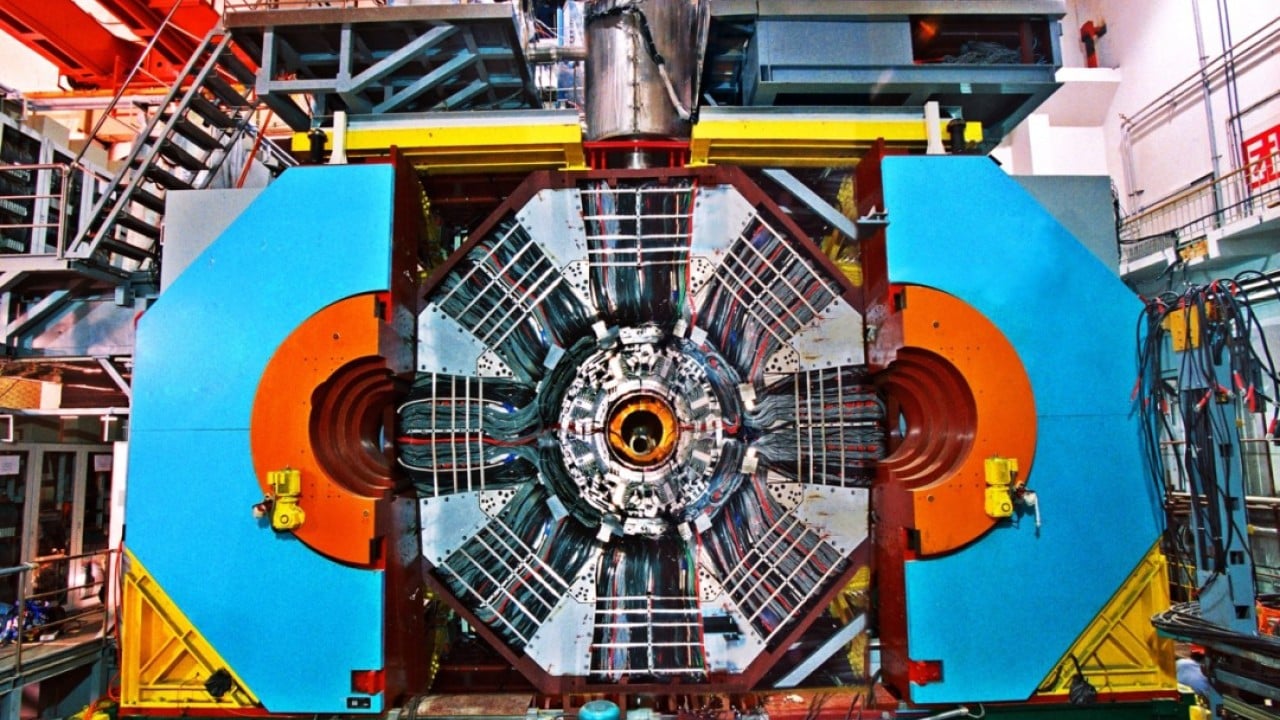
The breakthrough centered on an enigmatic particle designated as X(2370). First detected by the Beijing Spectrometer III (BESIII) collaboration in 2011, this signature lingered as an anomaly. Over the following decade and a half, the research team accumulated more than ten billion J/psi particle decay events. This dataset provided a pristine, gluon-rich laboratory environment.
By mapping the precise mass, production properties, and decay modes of the X(2370), the collaboration confirmed its quantum numbers matched the predictions for a pseudoscalar glueball. Furthermore, they established its flavor-singlet characteristic, ticking the final boxes required by lattice quantum chromodynamics calculations. It was no longer just an anomaly on a monitor. It was a fully characterized candidate that satisfied every theoretical constraint.
Skeptics remain watchful, as is standard practice in high-energy physics. Distinguishing between a pure glueball and a hybrid state where gluons mix heavily with standard quark matter requires exhaustive measurement. Physics does not deal in absolute certainties easily, and overlapping resonances often blur the lines. Yet the convergence of theoretical lattice predictions and empirical decay data turns a long shot into a credible reality.
This milestone validates the non-Abelian gauge structure underpinning the Standard Model. If gluons can form bound states, our comprehension of mass generation and confinement deepens significantly. The universe is not merely made of matter animated by forces. Under extreme conditions, force itself can become the matter.