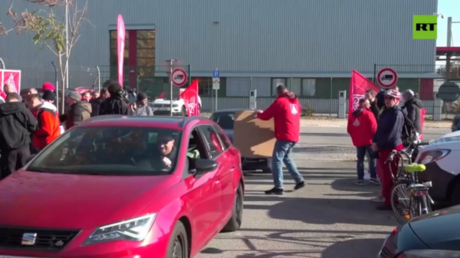
More than 400,000 industrial workers across Germany have walked off assembly lines, halting production lines at manufacturing giants including Mercedes-Benz, Airbus, BMW, Audi, and Bosch. Organized by the country's largest trade union, IG Metall, the wave of 24-hour warning strikes marks the sharpest labor escalation in the German metal and electrical sector in eight years. The core conflict pits a 5 percent wage demand and strict job protection guarantees against an employer offer featuring a 20-month wage freeze and attempts to bypass collective bargaining through individual works councils.
The standard headline framing treats this strike wave as a routinely aggressive wage negotiation. That perspective misses the systemic shift underneath.
What is happening across German factory floors is not an ordinary fight over inflation adjustments. It represents a fundamental collision between two irreconcilable economic survival strategies in a decarbonizing, high-cost European market.
The Structural Fracture Behind the Factory Gates
German industry is caught in a double bind. For decades, the nation's export model relied on three foundational pillars: cheap Russian energy, an infinitely absorbent Chinese market for capital goods, and domestic wage moderation anchored by predictable multi-year collective agreements (Tarifverträge). All three pillars have buckled simultaneously.
Energy costs for heavy manufacturing remain elevated compared to pre-war baselines and drastically higher than US or Asian benchmarks. At the same time, Chinese domestic manufacturers have moved up the value chain, transitioning from customers of German engineering to direct competitors in electric vehicles, wind turbines, and industrial automation.
For corporate management, these structural headwinds demand aggressive cost suppression. Employers offered a 1.3 percent pay increase scheduled for July 2028 after a 20-month waiting period, alongside a non-guaranteed 1 percent lump sum in 2027 tied to corporate performance. Over the proposed 26-month contract term, the offer amounts to an annualized wage growth of roughly 0.6 percent—a real-terms pay cut.
Beyond money, employers are seeking a structural change: shifting negotiating authority away from industry-wide trade unions down to individual works councils (Betriebsräte).
The Campaign to Bypass Union Power
Works councils possess legal rights regarding workplace conditions, but under German labor law, they lack the legal right to call strikes. Transferring decisions regarding working hour flexibilization—such as moving from the standard 35-hour week to 40 hours without full overtime premiums—to plant-level councils significantly alters the balance of power.
In plant-level negotiations, a works council faces a direct, localized ultimatum: accept concessions or watch production quotas shift to lower-cost facilities in Eastern Europe or North America. By contrast, regional collective bargaining unites entire industrial sectors, preventing individual plants from being pitted against one another.
IG Metall leadership recognizes that accepting plant-by-plant opt-outs would erode the foundation of German labor co-determination. This explains why over 400,000 workers joined warning strikes within days of the mandatory peace obligation expiring. The strike is less about immediate liquidity in worker paychecks and more about preserving the legal apparatus that prevents structural wage dumping across the industrial core.
The Just-in-Time Supply Chain Vulnerability
Modern industrial supply chains operate with minimal inventory buffers. When 12,400 aerospace workers walk out across four Airbus facilities in northern Germany, or assembly stops at key component producers like ZF Airbag, the economic damage compounds exponentially.
Consider a simplified manufacturing flow. An automotive assembly line in Baden-Württemberg relies on specialized safety sensors built in Saxony. If the sensor plant halts operations for 24 hours, the assembly line downstream depletes its buffer stock within hours. The financial loss to the final assembler often far exceeds the direct wage cost of the striking workers themselves.
This interdependency gives industrial unions disproportionate leverage, even during short warning strikes. However, that leverage operates on a narrow margin. If strikes drag on long enough to force permanent supply chain realignments, foreign competitors step into the breach, risking permanent market share losses for the host plants.
Industrial Realities Versus Financial Pressure
The trade union argument centers on worker retention and purchasing power. Industrial skilled labor in Germany faces an acute demographic deficit; replacing experienced tooling technicians, systems engineers, and precision mechanics is exceptionally difficult. Cutting real wages during an inflationary period risks accelerating brain drain into non-unionized tech sectors or adjacent service industries.
Conversely, executive suites face pressure from capital markets demanding margin preservation amidst shrinking order books and expensive transitions to electric vehicle architectures.
The compromise required to settle this dispute will likely involve a shorter contract term paired with targeted, temporary investment clauses rather than blanket structural waivers. Without a clear framework that binds cost flexibility directly to guaranteed future capital expenditure in German sites, labor peace will remain fragile.
Germany's industrial model built its global reputation on high-value manufacturing sustained by social partnership. As walkouts spread from shipyard docks to automotive halls, the dispute signals that the tacit contract between industrial capital and organized labor is being rewritten under severe economic strain.


