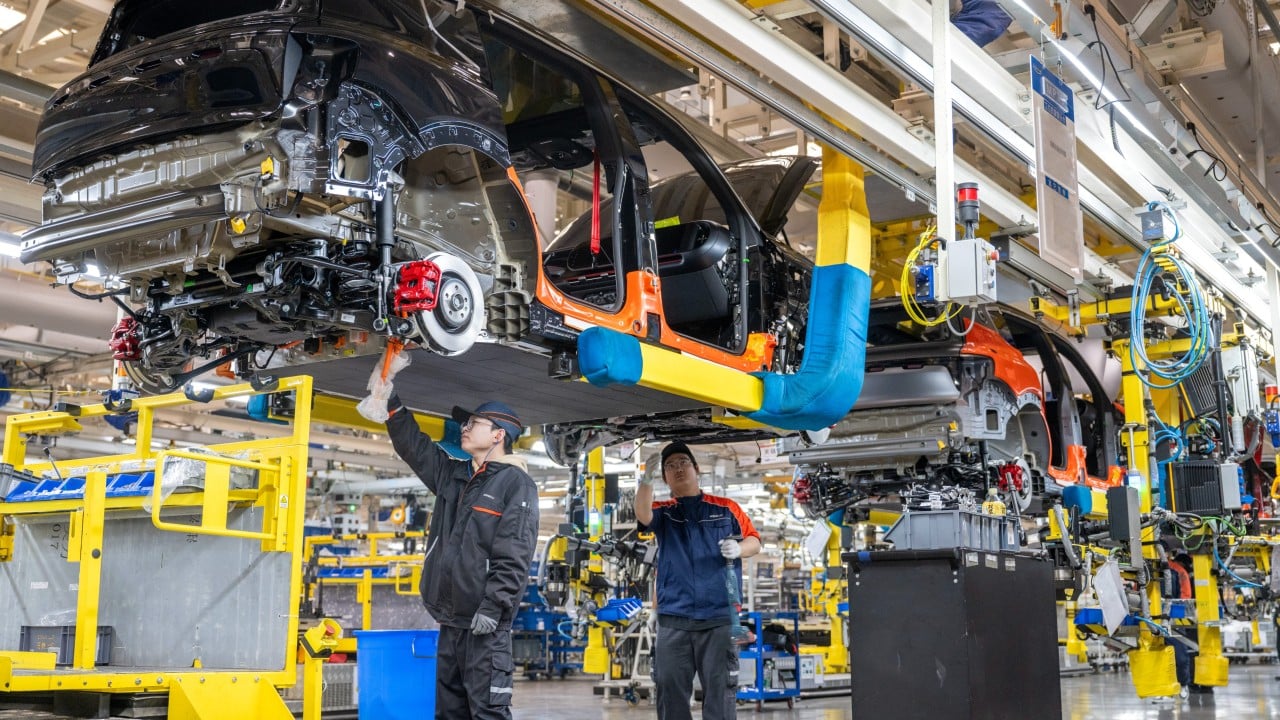
China has too many car factories, and the bill has finally come due. For years, the domestic automotive sector operated under a hyper-growth directive, fueled by local government subsidies, cheap credit, and an unshakeable belief that global markets would indefinitely absorb millions of new vehicles. That illusion has shattered. Today, the Chinese auto market faces a structural crisis where annual domestic demand sits around 25 million vehicles, yet factory floors are geared to pump out nearly 50 million.
Li Shufu, the billionaire founder and chairman of Zhejiang Geely Holding Group, is no longer pretending the internal math works. Driven by the mandates of his "Taizhou Declaration," Li has initiated a sweeping asset consolidation designed to systematically close, suspend, merge, or sell off redundant production facilities. This is not a simple corporate spring cleaning. It is a brutal, defensive retreat from a decade of chaotic brand proliferation that threatens to cannibalize the empire from within.
The restructuring centers on a massive unwinding of overlapping entities to shore up the group’s core listed platform, Geely Automobile Holdings. The most visible casualty of this consolidation is the independent identity of Lynk & Co, which has been structurally absorbed by premium electric vehicle maker Zeekr. Concurrently, Zeekr was quietly taken private and delisted from the New York Stock Exchange to bring it entirely under the parent company’s direct financial umbrella. By consolidating these warring internal factions, Geely is attempting to engineer a survival mechanism against a cutthroat domestic price war while attempting to circumvent punitive tariff walls erected by Washington and Brussels.
The Chaos of Brand Proliferation
To understand why Geely is aggressively slashing its footprint, one must look at how the empire was built. For years, Geely’s strategy resembled a venture capital fund rather than a traditional manufacturer. It accumulated a dizzying portfolio of distinct sub-brands, spin-offs, and joint ventures, including Volvo, Polestar, Lotus, Zeekr, Lynk & Co, and the mass-market Galaxy series.
This multi-brand blitz was initially hailed as a brilliant way to capture every conceivable consumer demographic. Instead, it created massive operational redundancies. Sister brands built independent sales channels, commissioned unique design languages, and worst of all, competed for the exact same pool of buyers.
The integration of Zeekr and Lynk & Co exposes the core of this failure. Lynk & Co was established in 2016 as a hip, millennial-focused joint venture with Volvo, bridging the gap between internal combustion and electrification. Yet when Zeekr debuted in 2021 as a pure electric luxury marque, its inaugural model—the Zeekr 001—shared an unmistakable visual DNA and platform architecture with Lynk & Co. The two brands were effectively operating out of different pockets of the same coat, spending separate R&D budgets to build vehicles that cannibalized each other’s showroom traffic.
Under the new operational architecture, the combined Zeekr Group takes a 51% controlling stake in Lynk & Co, with Geely Auto holding the remainder. The corporate goal is a stark reduction in overhead: R&D expenses are projected to drop by 10% to 20%, procurement and supply chain costs are expected to fall by 5% to 8%, and administrative support functions will be trimmed by up to 20%. The brands will still maintain separate marketing faces for now, but the underlying engineering, manufacturing pipelines, and software development are being welded together.
The Mathematical Trap of Idle Assembly Lines
Automotive manufacturing is a game of brutal fixed costs. Robot-dense stamping plants, paint shops, and assembly lines require immense capital investments that must be amortized over hundreds of thousands of units annually. A factory operating at 80% capacity can be highly profitable. A factory operating at 40% capacity is a financial black hole, burning cash through depreciation, property maintenance, and idle labor.
The massive capacity bubble across China means that out of the dozens of domestic manufacturers vying for market share, only a select few are consistently profitable. The rest are propped up by local municipal stakes or are burning through capital reserves. Geely's internal restructuring aims to push its global factory utilization rate up by a modest 3% to 5% through asset sharing.
Instead of breaking ground on new manufacturing facilities to support its aggressive international targets, Geely is halting capital expenditure on new domestic brick-and-mortar plants entirely. Growth is pivotable on asset optimization rather than asset creation.
The financial logic is simple. Rather than pouring billions into new infrastructure to penetrate foreign markets, Geely will lean into the existing, underutilized global footprint of its subsidiaries.
| Brand Entity | Pre-Restructuring Status | New Strategic Mandate |
|---|---|---|
| Geely Auto | Fragmented structure with overlapping sub-brands | Core listed holding platform; absorbs back-end operations |
| Zeekr | NYSE-listed, independent premium EV player | Delisted from NYSE; takes corporate control of Lynk & Co |
| Lynk & Co | Volvo-Geely JV focused on hybrids and premium sedans | Subsidiary of Zeekr; scaled down to small-to-mid vehicles |
| Volvo Cars | Independent manufacturing footprint in Europe/US | Shared factory resource to build Geely/Zeekr export models |
Bypassing the Tariff Walls
The restructuring is also a direct reaction to geopolitical shifts. Western markets are aggressively raising trade barriers against Chinese-made electric vehicles. The European Union's provisional tariffs and the United States' steep import levies have upended the economics of exporting vehicles built in Ningbo or Hangzhou.
To survive this hostile regulatory climate, Geely is weaponizing Volvo’s manufacturing footprint. Volvo possesses long-established, compliant assembly plants in Sweden, Belgium, and Slovakia, alongside an operational facility in South Carolina.
By utilizing these Western facilities to assemble vehicles for Zeekr and Lynk & Co, Geely plans to bypass the stiff tariffs applied to direct imports from China.
This strategy is not without friction. Sharing production lines between distinct automotive heritages is a logistical nightmare. A factory line optimized for Volvo’s safety-first, Swedish-engineered vehicle architectures cannot easily pivot to accommodate the radically different design methodologies, high-voltage battery enclosures, and digital-heavy setups of a Zeekr or a Lotus without substantial retooling costs.
Furthermore, Western labor costs are vastly higher than those in China, threatening to compress the fat profit margins that Chinese EV makers enjoy domestically.
Reversing the Validation Shortcuts
The race to dominate the electric vehicle market led to an industry-wide trend of compressing vehicle development cycles. Where traditional legacy automakers spent four to five years rigorously testing a new vehicle platform across extreme climates and simulated lifespans, some Chinese tech-led upstarts have attempted to push vehicles from digital rendering to commercial production in under 24 months.
Li Shufu has used this strategic pivot to launch an open critique against these engineering shortcuts, noting that automobiles are fundamentally linked to human life safety and cannot be treated like disposable smartphones. The aggressive drive to cut costs through consolidation is intended to give Geely the financial buffer needed to maintain rigorous, long-term R&D validation cycles rather than rushing half-baked software or unvetted battery architectures to market simply to survive the next quarter's price cuts.
Geely’s multi-billion-dollar joint ventures—such as its Horse powertrain initiative with Renault and Saudi Aramco, or its dedicated engineering hubs in Germany and the UK—are being leveraged to centralize foundational research. The objective is to build standardized, highly flexible vehicle architectures that can be utilized across all brands, allowing a single underlying platform to support everything from a mass-market hybrid hatchback to a premium electric performance SUV.
The Hard Reality Ahead
Consolidation looks clean on a corporate balance sheet, but executing it on the ground is highly disruptive. Eliminating redundant entities means closing down factories that local governments heavily subsidized to secure local jobs. Winding down overlapping divisions requires difficult political navigation within corporate hierarchies where brand CEOs have long enjoyed autonomous kingdoms.
If Geely fails to deeply integrate these supply chains, it will simply end up with fewer brands but the same underlying cost burdens. If it integrates too aggressively, it risks erasing the distinct brand identities that consumers actually want to buy, turning a premium marque like Zeekr into a badge-engineered variant of a mass-market Geely.
The restructuring of Geely is a clear signal that the initial, chaotic gold rush of the Chinese automotive expansion is over. Survival now dictates a relentless focus on capital discipline, factory utilization, and corporate governance. The companies that survive the coming decade will not be those that build the most factories, but those that figure out how to efficiently run the ones they already have.