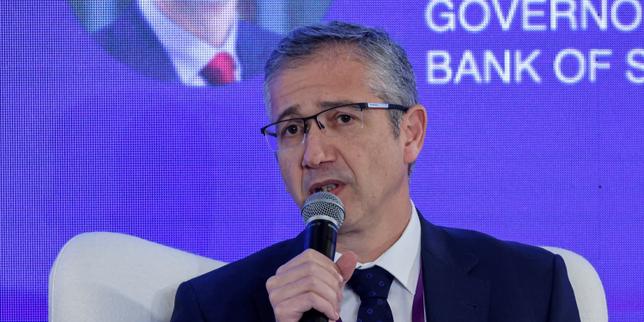
Berlin’s decision to nominate Princeton economist Markus Brunnermeier to the European Central Bank’s executive board was never an isolated personnel move. It was the opening gambit in a calculated Franco-German power play that locked in Spain’s Pablo Hernández de Cos as the next president of the European Central Bank, sidelined the Netherlands, and quietly redrew the ideological map of European monetary policy for the next decade.
For months, financial markets treated the succession of Christine Lagarde—who announced her early departure for February 7, 2027—as a straightforward horse race between northern monetary hawks and southern pragmatists. That framing missed the real game. In Brussels and Frankfurt, top jobs are rarely won on resumes alone. They are traded in multi-seat packages. By claiming the executive board seat traditionally linked to the powerful chief economist portfolio for Brunnermeier, Germany effectively forfeited its claim to the presidency, clearing the runway for Hernández de Cos with French backing. Building on this topic, you can find more in: United Airlines Did Not Have a Tech Outage (It Had a Strategy Failure).
Anatomy of a Multi-Seat Bargain
The arithmetic of the ECB’s six-member executive board leaves little room for coincidence. Three major vacancies were converging within a single six-month window. Isabel Schnabel, Germany’s outspoken hawk on the board, was set to depart on January 3, 2027, to take a senior post at the International Monetary Fund. Lagarde’s early exit followed in February. Then, Ireland’s Philip Lane would vacate the chief economist chair when his non-renewable term expired on May 31, 2027.
European capitals saw an opening to reset the entire top tier of Frankfurt’s decision-making machinery at once. Observers at Bloomberg have shared their thoughts on this matter.
When German Finance Minister Lars Klingbeil and Chancellor Friedrich Merz’s coalition cabinet formally put forward Brunnermeier in mid-November 2026, the signal to Paris and Madrid was unmistakable. Germany was not going to fight for the presidency. Instead, Berlin wanted control over the analytical engine of the central bank—the directorate that drafts interest rate proposals, builds macroeconomic models, and frames every policy debate before the 27-member Governing Council even enters the room.
France moved immediately to lock in its own piece of the puzzle. Paris threw its weight behind former Bank of France deputy governor and OECD chief economist Laurence Boone for the remaining executive board slot, positioning her to oversee market operations—the desk that executes bond purchases and manages the ECB’s massive balance sheet.
With Berlin taking the chief economist portfolio and Paris securing market operations, the presidency was left open for a consensus candidate acceptable to both capitals. Enter Pablo Hernández de Cos.
The Dutch government had spent months lobbying for Klaas Knot, the former president of De Nederlandsche Bank and a longtime favorite of northern fiscal conservatives. Yet once France and Germany aligned behind the Brunnermeier-Boone-Hernández de Cos triumvirate, Knot’s candidacy collapsed. By November 26, Dutch Prime Minister Rob Jetten had formally stood down his country’s opposition, allowing European Council President António Costa to announce unanimous eurozone backing for the three-person slate ahead of formal ratification in December.
Why Berlin Chose an Academic Outsider
To understand why Germany traded away a shot at the presidency for Markus Brunnermeier, you have to look at the intellectual scar tissue left on the Bundesbank over the past fifteen years.
Historically, German representatives on the ECB executive board—from Otmar Issing to Jürgen Stark, Sabine Lautenschläger, and Isabel Schnabel—have fought a rearguard battle against aggressive bond-buying programs and ultra-loose monetary policy. Often, they lost. When Berlin relied on rigid, orthodox central bankers, it found itself isolated in Frankfurt whenever a sovereign debt or pandemic crisis hit.
Brunnermeier represents a sharp strategic pivot. At 57, the Bavarian-born economist has spent decades at Princeton University rather than climbing the ranks of Frankfurt’s bureaucracy. He is not a traditional Bundesbank hardliner. Instead, he is one of the world’s foremost experts on financial frictions, liquidity spirals, and systemic risk. During the eurozone sovereign debt crisis, Brunnermeier co-authored proposals for European Safe Bonds—financial instruments designed to stabilize sovereign debt markets without full fiscal union.
That background makes him nearly impossible for southern European governments to dismiss as an ideological zealot. Yet inside Berlin, Klingbeil and Merz view him as fundamentally committed to price stability and rigorous institutional discipline.
In effect, Germany nominated an economist who speaks the mathematical language of modern macro-finance fluently enough to command respect across the Governing Council, while still guarding against fiscal dominance—the risk that a central bank ends up printing money simply to keep heavily indebted governments afloat.
The Chief Economist Advantage
Many outside observers assume the ECB president holds all the cards. That is a misunderstanding of how Frankfurt actually operates.
While the president chairs meetings, sets the public tone, and represents the eurozone globally, the chief economist controls the intellectual pipeline. Every six weeks, before the Governing Council votes on interest rates, the chief economist presents the staff macroeconomic projections and puts forward the baseline monetary policy recommendation.
If you control the baseline, you anchor the debate. Even when Governing Council hawks or doves push back, they are arguing against the framework laid out by the chief economist’s staff. By securing this seat for Brunnermeier, Germany ensures that inflation dynamics, balance sheet runoff, and financial stability risks are analyzed through a lens that prioritizes long-term currency credibility.
The Ascent of Pablo Hernández de Cos
If Brunnermeier is the intellectual architect in this new alignment, Pablo Hernández de Cos is the ultimate institutional operator.
When Hernández de Cos takes office on February 8, 2027—chairing his first rate-setting meeting on March 18—he will arrive with a resume tailored for crisis management. Unlike Christine Lagarde, a former lawyer and finance minister who entered Frankfurt without a formal economics background, Hernández de Cos is a central banker to his core.
He began his career in the research trenches of the Bank of Spain and the ECB itself before serving as governor of the Bank of Spain from 2018 to 2024. In July 2025, he took over as general manager of the Bank for International Settlements in Basel—the central bank for central banks.
His reputation among peers rests on three defining traits:
- Technical mastery without ideological rigidity. During his tenure on the Governing Council, Hernández de Cos consistently aligned with the consensus center. He supported Mario Draghi’s stimulus measures during the pre-pandemic stagnation, backed Lagarde’s emergency pandemic bond-buying in 2020, and then pivoted smoothly to support the ECB’s historic string of interest rate hikes when inflation surged in 2022 and 2023.
- Crisis-tested calm. He helped navigate Spain’s painful banking sector restructuring and sovereign debt tremors, giving him firsthand knowledge of how fast market panic can spread from peripheral bond markets to the core of the currency union.
- Diplomatic fluency. Northern central bankers never viewed him as a reckless spender. During his time in Madrid, he repeatedly warned the Spanish government about structural deficits and pension sustainability, earning grudging respect in Berlin and The Hague even as Spanish Prime Minister Pedro Sánchez championed his candidacy.
What Markets Are Missing About the New Trio
Wall Street and City of London analysts were quick to label the incoming leadership team—Hernández de Cos, Brunnermeier, and Boone—as a victory for monetary doves. That reading is overly simplistic and potentially dangerous for bond traders.
Yes, Hernández de Cos hails from southern Europe and shares Mario Draghi’s conviction that the ECB must deploy its full firepower to prevent sovereign debt fragmentation. And yes, Laurence Boone has argued forcefully in the past for tight coordination between fiscal and monetary policy during economic downturns.
However, pairing them with Markus Brunnermeier creates a deliberate system of internal checks and balances.
Consider how this trio will interact when the next financial shock hits. Suppose sovereign bond yields spike in a heavily indebted member state due to domestic political turmoil rather than an external economic shock. Under the ECB’s Transmission Protection Instrument, the central bank can buy unlimited amounts of a country’s bonds to stop unwarranted market contagion—provided that country is following sound fiscal rules.
In that scenario, Hernández de Cos would naturally look to protect the integrity of the eurozone, and Boone would manage the operational execution in bond markets. Yet Brunnermeier’s research has focused intensely on moral hazard—the danger that shielding governments from market discipline removes any incentive for them to fix broken budgets. His presence on the board guarantees fierce internal scrutiny over where legitimate market stabilization ends and illegal monetary financing begins.
The Unspoken Tension Ahead
Behind the polite diplomatic statements in Brussels lies a deeper structural dilemma that none of the three nominees can easily solve.
The European Central Bank enters 2027 caught between anemic economic growth, ballooning defense and green-transition spending demands across European capitals, and persistent geopolitical supply shocks. Lagarde’s early departure in February 2027—eight months before her official eight-year mandate was due to expire in October—was timed specifically to give her successor a clean runway before European political cycles shift again.
Yet a smooth handover does not erase the conflicting pressures awaiting Frankfurt.
Southern and western European economies, burdened by debt-to-GDP ratios well above 100 percent, desperately need lower borrowing costs and a forgiving central bank. Meanwhile, Germany’s own economic model is undergoing a painful industrial restructuring, making Berlin acutely sensitive to any erosion in the euro’s purchasing power or savings rates.
Furthermore, the Governing Council itself remains deeply fractured. Even with a cohesive executive board in Frankfurt, Hernández de Cos will still have to build majorities among 21 national central bank governors—a group where small Baltic and northern states frequently push back against big-country compromises.
The Franco-German grand bargain succeeded in avoiding a messy public stalemate over who runs the eurozone’s most powerful institution. It paired a pragmatic Spanish technocrat with a brilliant German theorist and a seasoned French policymaker. What remains untested is whether this carefully engineered equilibrium in Brussels will hold once the next real market storm hits Frankfurt.