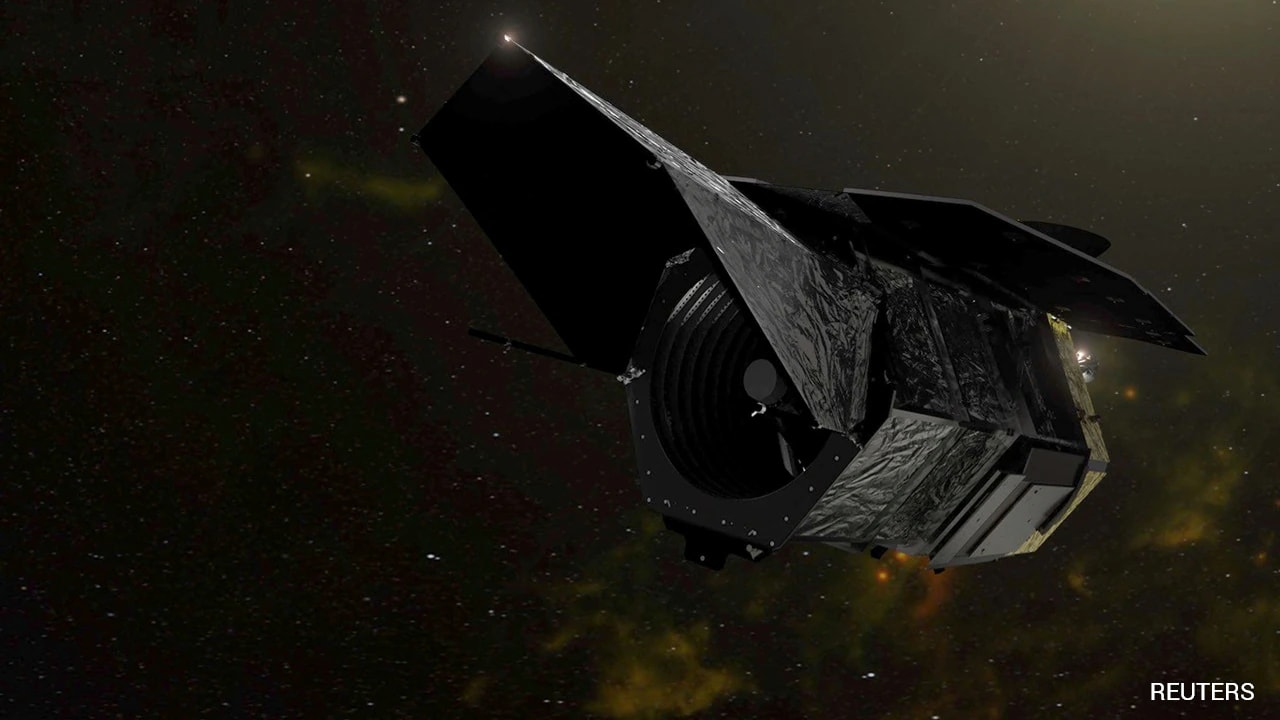
The Nancy Grace Roman Space Telescope represents a four billion dollar bet on the unseen forces tearing the cosmos apart. Set to launch atop a Falcon Heavy from Kennedy Space Center, this observatory carries the institutional trauma of its predecessor, the James Webb Space Telescope. Webb launched late, bled billions over budget, and kept generations of astronomers biting their nails. Roman took a different path. Engineers at NASA Goddard built this machine under strict financial and temporal constraints, managing to arrive at the launchpad ahead of schedule and within its designated envelope.
That efficiency feels almost miraculous in modern aerospace. Yet the hardware itself is only half the story.
Dark energy remains physics' most stubborn ghost. It pushes the universe apart at an accelerating rate, defying every standard model of particle physics and gravity. Traditional telescopes peer at narrow slivers of the sky, capturing postcard images of distant galaxies while missing the macro-scale behavior of space-time. Roman changes that dynamic entirely. Its Wide Field Instrument possesses a field of view one hundred times larger than that of the Hubble Space Telescope.
To visualize this difference, imagine looking at the night sky through a narrow straw. That was Hubble's view. Roman looks through a wide-angle cinema lens.
By mapping hundreds of millions of galaxies across vast cosmic distances, the telescope will track how dark energy has stretched the fabric of the universe over billions of years. It measures the subtle distortions of background starlight caused by intervening mass, an effect known as weak gravitational lensing. This statistical approach turns the entire sky into a laboratory.
Exoplanet hunting receives an equally dramatic upgrade. Past missions like Kepler and TESS found thousands of alien worlds by watching stars dim when a planet crossed their face. Roman shifts the methodology toward statistical volume and direct imaging through its onboard coronagraph technology. A hypothetical star system analyzed by Roman can yield census-level data on worlds orbiting far from their host suns, filling the gaps left by transit-only detection methods.
Behind the corporate-style milestone celebrations and agency press releases, however, lurks a quiet operational anxiety. The engineering workforce that successfully built Roman under budget is largely scattering. Funding volatility and shifting administrative priorities mean the institutional knowledge gained during this build risks dispersal across private industry and retirement. When institutional memory evaporates, the next flagship observatory starts from square one, repeating expensive mistakes that older veterans already solved.
Furthermore, the sheer volume of data streaming back from the Lagrange point 2 orbit will overwhelm traditional analysis pipelines. Roman will generate petabytes of information, creating an immediate bottleneck for researchers who must sift through billions of celestial objects. Algorithms and machine learning models will bear the brunt of this load, transforming raw photon counts into usable star maps and cosmological catalogs.
The rocket clears the tower, carrying the accumulated hopes of astrophysicists who have spent decades waiting for a clearer picture of cosmic acceleration. The instruments power on in the cold vacuum of space, ready to map the hidden architecture of reality.