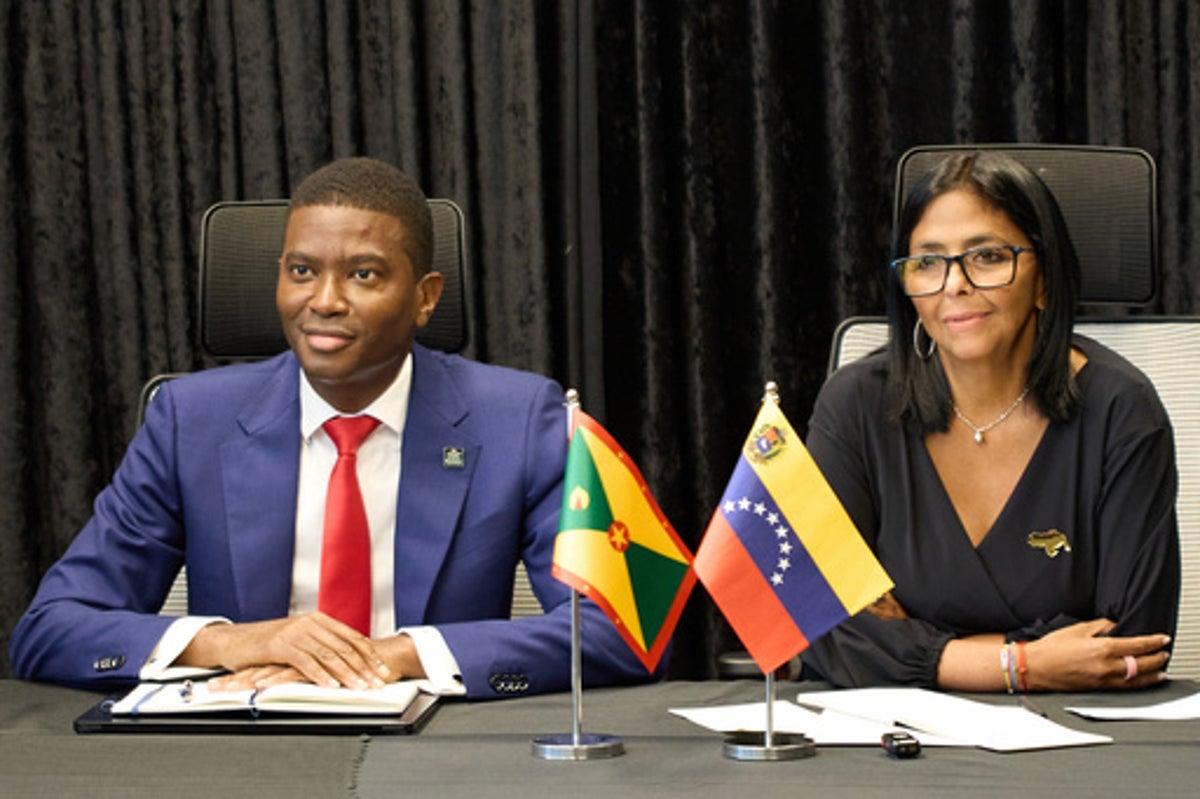
In the high-stakes theater of South American diplomacy, a small piece of jewelry has become the flashpoint for a potential territorial explosion. Delcy Rodríguez, the acting president of Venezuela, has begun appearing at international summits wearing a gold pin shaped like the Essequibo region—a resource-rich territory that currently belongs to Guyana but which Caracas claims as its own. This is not a mere fashion choice. It is a calculated signal of intent at a time when the Venezuelan government is scrambling to redefine its identity following the January capture of Nicolás Maduro by U.S. forces.
The "Essequibo Pin" has moved from a nationalist trinket to a central tool of statecraft. By wearing it during official visits to Caribbean nations like Barbados and Grenada, Rodríguez is forcing her neighbors into a diplomatic trap. If they host her while she wears the emblem, they risk appearing to tolerate Venezuela’s claim. If they protest, they offend a desperate, oil-rich neighbor that is currently being courted by the Trump administration in a surreal geopolitical pivot.
The Geography of a Grudge
The dispute centers on 61,000 square miles of dense jungle and offshore oil blocks. To Guyana, the Essequibo is two-thirds of its national territory, a legacy of an 1899 border ruling that Venezuela has spent a century trying to overturn. To Caracas, it is "Guayana Esequiba," a stolen province that represents the ultimate test of sovereign pride.
The stakes changed forever in 2015 when ExxonMobil discovered massive offshore oil reserves in the Stabroek Block. Suddenly, a sleepy territorial disagreement became a fight over one of the largest oil finds in modern history. Guyana is now the fastest-growing economy in the world, while Venezuela remains mired in a decades-long collapse. The pin on Rodríguez’s lapel is a reminder that the Venezuelan state has no intention of watching from the sidelines while its neighbor becomes an energy superpower.
Why the Pin Matters Now
Following the stunning nighttime raid that saw Nicolás Maduro extracted to New York to face drug trafficking charges, the "acting" government in Caracas needed a unifying symbol. They found it in the map. The Essequibo claim is one of the few issues that unites the fractured Venezuelan populace, transcending the bitter divide between Chavismo and the opposition.
By centering the Essequibo in her public image, Delcy Rodríguez is performing a delicate balancing act. She is simultaneously signaling to her domestic hardliners that she has not been "tamed" by her recent cooperation with U.S. Energy Secretary Chris Wright, while telling the international community that Venezuela’s territorial ambitions are non-negotiable. It is a nationalist shield against accusations of being a U.S. puppet.
The Caribbean Diplomatic Row
Guyanese President Irfaan Ali has reacted with predictable fury. He formally complained to Caricom, the Caribbean trade bloc, arguing that the pin asserts a claim that is currently being litigated in the International Court of Justice. Ali’s fear is rooted in the concept of "creeping normalcy." If Rodríguez can walk the halls of power in Bridgetown or St. George’s with a map of "Venezuela" that includes two-thirds of Guyana, the visual reality begins to outweigh the legal one.
Caricom leaders find themselves in an impossible position. Historically, they have supported Guyana’s territorial integrity. However, the Rodríguez government has recently begun dismantling the social programs and restrictive economic policies of the Maduro era, opening the door for a return of Venezuelan oil to the regional market. The promise of cheap fuel often speaks louder than the fine print of border treaties.
The Corporate Battlefield
Beyond the political posturing, the real war is being fought in boardrooms. The Essequibo region is home to some of the world’s most lucrative "frontier" oil exploration.
- ExxonMobil and Chevron: These giants have billions invested in Guyanese waters.
- The Venezuelan Pivot: Since taking over in January, Rodríguez has signaled a willingness to allow private capital back into the Venezuelan energy sector.
- The Contradiction: International investors are being asked to bet on a Venezuelan recovery while the head of state wears a symbol that threatens the very stability of the region’s oil infrastructure.
You cannot have it both ways. A country cannot attract "respectable" global investment while simultaneously threatening to annex the territory of its neighbor. Yet, Rodríguez seems to believe that the global hunger for crude will outweigh concerns over a gold pin and the maps it represents.
A Calculated Provocation
There is a psychological element to this strategy that is often overlooked. Jorge Rodríguez, the president’s brother and a trained psychiatrist, has long been the architect of the regime’s communication strategy. He understands that a physical symbol is more potent than a thousand-page legal brief. The pin is a constant, nagging reminder of a perceived historical injustice. It keeps the adversary on the defensive, forcing them to react to a piece of jewelry rather than focusing on the broader geopolitical transition.
The timing is also critical. As the United States formally recognized Rodríguez’s authority in March, the pin serves as a "sovereignty check." It tells Washington that while Caracas might be willing to talk about oil and intelligence cooperation, it will not be dictated to regarding its national borders.
The Risk of Miscalculation
The danger of this symbolic warfare is that it can easily escalate into a physical one. In recent years, Venezuela has sent gunboats to harass oil rigs in Guyanese waters. When a leader wears the map of a neighbor as a badge of office, the line between rhetoric and military intent becomes dangerously thin.
Guyana has no significant military to speak of. It relies entirely on international law and the protective umbrella of its allies. If the Rodríguez government decides that a nationalist victory in the Essequibo is the only way to solidify its shaky domestic legitimacy, a gold pin could become the precursor to a regional conflict that the Caribbean is wholly unprepared to handle.
The international community must look past the lapel. The pin is not a distraction; it is a declaration. As Venezuela attempts to re-enter the global economy, it is doing so with its territorial grievances front and center. Ignoring the symbol will not make the underlying ambition disappear.
Keep a close eye on the maps being printed in Caracas and the jewelry worn in the halls of Caricom. They are the early warning signs of a border shift that could change the energy map of the Western Hemisphere. The "new political moment" in Venezuela looks remarkably like the old one, just with better tailoring and a more focused sense of theater.