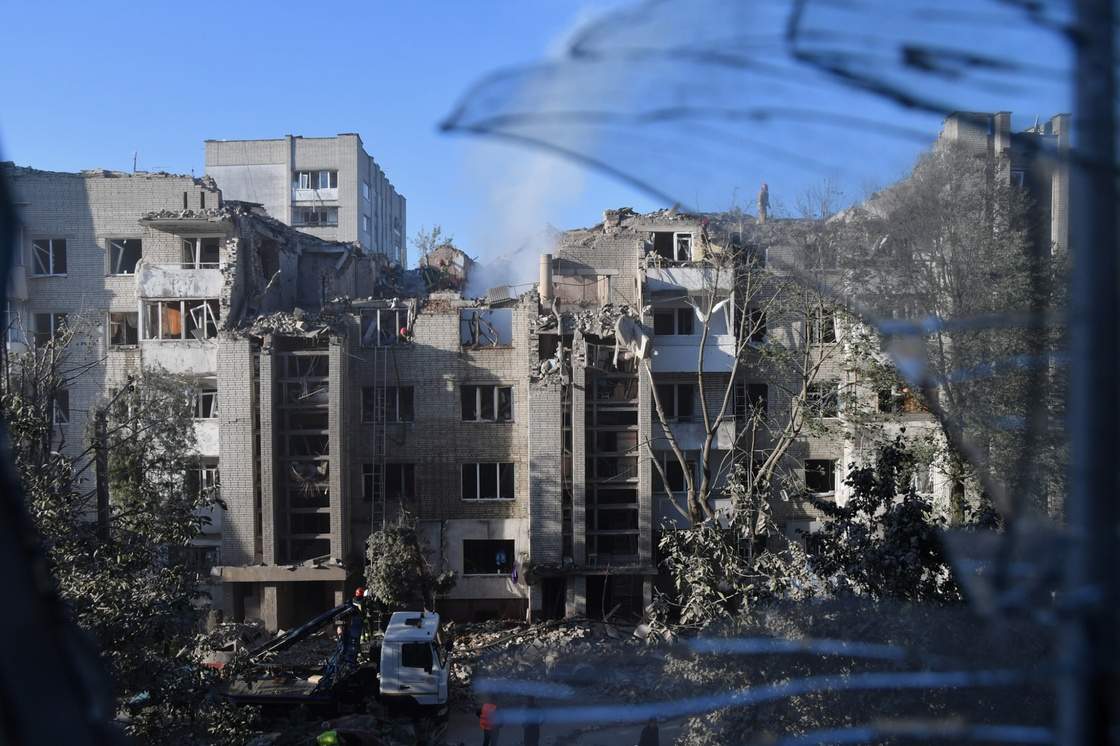
Massive missile barrages across Ukraine combined with an unverified stray projectile striking Polish soil to create a high-stakes standoff that tested the absolute limits of alliance deterrence.
War has its geometry, and every trajectory carries the weight of catastrophic escalation. When strategic aerial bombardments blanket Ukrainian civilian infrastructure, the shockwaves rarely stay contained within recognized borders. Decades of reporting from conflict zones teach a hard lesson. Munitions fail, guidance systems drift, and panic moves faster than diplomatic verification.
The Anatomy of a Cross-Border Strike
Air defense interceptors do not operate in sterile vacuum chambers. They chase ghosts across radar screens, firing counter-munitions into chaotic skies where friendly and hostile signatures blur together. When a stray projectile crossed into eastern Poland, killing citizens in a quiet farming community, the immediate reaction in Western capitals was a mixture of frozen dread and frantic intelligence gathering.
Article 5 of the North Atlantic Treaty stands as the bedrock of modern collective security. An armed attack against one member is an attack against all. Yet, applying that doctrine requires absolute certainty about who pulled the trigger, why the path deviated, and whether the act was deliberate or an errant technical failure.
Military analysts know that modern cruise missiles like the Kh-101 or Kalibr rely on complex inertial guidance systems backed by satellite navigation. Electronic warfare jamming deployed by defense forces routinely distorts these tracking mechanisms. A jammed signal turns a precision weapon into a flying hazard.
Intelligence agencies spent hours parsing radar telemetry, missile fragments, and satellite imagery to reconstruct the final moments of that flight path. The working assessment pointed toward an aging Ukrainian S-300 air defense interceptor launched in desperation to protect national airspace from incoming Russian salvos.
That distinction matters immensely in the calculus of war.
The Politics of Attribution
Admitting that a defensive system caused collateral damage on allied territory introduces acute operational dilemmas. Kyiv faced intense diplomatic pressure while managing a population enduring rolling blackouts and relentless artillery fire. Western leaders walked a tightrope between demonstrating unshakeable resolve against outside aggression and avoiding a direct military collision with a nuclear-armed power.
We have seen this script before. During historical standoffs, miscalculation remains the primary engine of unwanted escalation.
Why Air Defense Saturated Skies Are Ticking Clocks
The sheer volume of ordnance traded daily creates statistical inevitability. When hundreds of rockets and drones saturate a regional airspace, mechanical and human error multiplies exponentially.
- Guidance Drift: Prolonged electronic interference degrades onboard tracking accuracy.
- Interceptor Exhaustion: Overworked batteries fire counter-measures under extreme duress with minimal calibration time.
- Radar Clutter: Low-altitude flight paths hide behind terrain features, forcing split-second automated decisions.
Ground commanders operate under immense psychological pressure. The luxury of time does not exist when warning windows shrink to seconds.
The Fragile Architecture of Deterrence
Deterrence relies on perceived rationality. Both sides must believe that crossing specific red lines guarantees mutual ruin. But what happens when the red line gets crossed by accident?
During the initial hours following the impact in Poland, emergency consultations bypassed standard bureaucratic channels. Hotlines between military commands buzzed with urgency. Diplomats worked to lower the temperature before public outrage forced rigid political responses.
The incident exposed deep vulnerabilities in European air defense readiness. Eastern flank nations demanded expanded Patriot battery deployments and persistent airborne early warning coverage. Guarding the perimeter of an alliance sharing a border with an active warzone requires unprecedented vigilance.
We are living through a structural realignment of global security. The rules written after the Cold War are bending under the weight of conventional artillery, drone swarms, and hypersonic threats.
Every new strike package launched across the eastern European plains serves as a live-fire stress test for international institutions designed for a completely different era.
The border remains porous to mistakes. The margin for error is effectively zero.