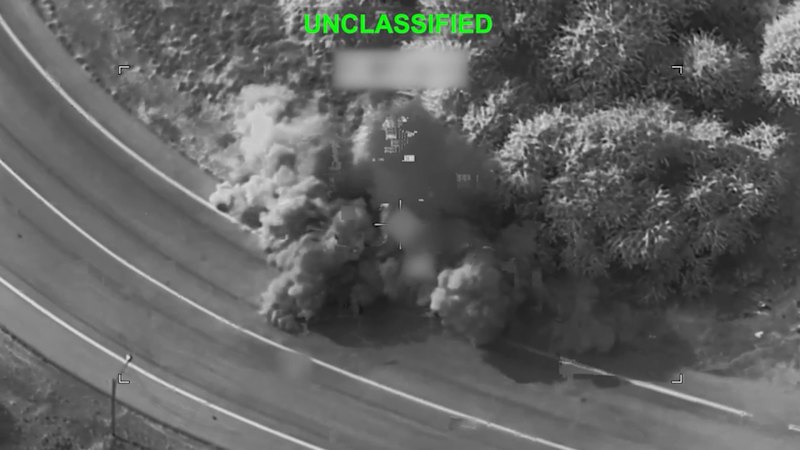
United States Central Command released combat footage documenting precision strikes across southern Iran, targeting missile installations, coastal radar networks, and naval assets around the Strait of Hormuz. The military action, which involved carrier-borne fighter jets, guided-missile destroyers, and uncrewed strike systems, signals a deliberate tactical escalation designed to enforce a naval blockade and secure vital maritime corridors. By striking sites at Bandar Abbas, Qeshm Island, and Bushehr, Washington aims to neutralize Iran’s capacity to harass commercial shipping, though retaliatory missile strikes against regional infrastructure underscore the heightened stakes of the confrontation.
The Strategy Behind the Infrared Lens
High-definition military release videos serve two distinct purposes. They demonstrate tactical capability to allies while delivering an unambiguous message to adversaries. The imagery broadcast by Central Command highlights strikes on coastal defense batteries, anti-ship missile sites, and uncrewed surface vehicle launch stations.
Military planners selected these specific targets to systematically degrade local command nodes. Striking early-warning radars blinds shore-based anti-ship installations, which reduces the threat to international tanker traffic navigating narrow sea lanes. The strikes also targeted small craft bases utilized by the Islamic Revolutionary Guard Corps Navy.
Deconstructing the released imagery reveals a multi-layered force package. Heavy ordnance hit fortified bunkers, while precision-guided munitions disabled mobile launcher platforms along the coastline.
Target Type                 Primary Asset Employed         Operational Objective
Coastal Defense Radars      AGM-88 HARM / Precision Bombs  Degrade early-warning coverage
Mobile Missile Launchers    Carrier Strike Group Aircraft   Neutralize anti-ship threat
Naval Base Facilities       Tomahawk Cruise Missiles        Disrupt small craft operations
Removing sensor nodes leaves secondary artillery installations reliant on line-of-sight tracking. That limitation severely degrades operational effectiveness against fast-moving maritime targets.
Beyond Tactical Demonstration
Releasing raw video feeds serves an explicit strategic narrative. Pentagon officials use verified combat footage to establish operational transparency and counter competing propaganda campaigns.
When combat footage is published rapidly, it restricts an adversary’s room to claim uninjured infrastructure or exaggerate civilian collateral damage. The tactical video functions as a public record of target discrimination.
Electronic warfare platforms played a heavy role before the kinetic strikes began. Airborne radar jamming platforms disrupted local communication channels, preventing defensive batteries from coordinating responses before incoming ordnance arrived.
Air Superiority and Maritime Blockades
Maintaining control over the Strait of Hormuz requires constant air presence combined with surface interception capabilities.
- Fighter aircraft conduct combat air patrols to suppress local air defense batteries.
- Surveillance drones maintain real-time tracking of mobile coastal launchers.
- Guided-missile destroyers enforce maritime exclusion zones against non-compliant vessels.
This combination creates a defensive barrier around commercial transit corridors. However, maintaining such an operational posture requires immense logistical resource expenditure over long durations.
Regional Counter-Moves and Collateral Friction
The Iranian military response followed established asymmetric doctrines. Rather than engaging naval strike groups directly in open water, regional forces launched salvos of ballistic missiles and attack drones toward bases hosting allied forces in neighboring Gulf nations.
Sirens sounded across urban centers in Bahrain and Kuwait as defense systems engaged incoming air threats. Air defense batteries intercepted multiple incoming targets, but the volume of fire demonstrated the persistent threat posed by distributed regional stockpiles.
Region / Base Location      Reported Activity               Defense Response
Bahrain (Fifth Fleet Base)  Ballistic Missile Fire          Interception / Shelter Alerts
Kuwait (Ali Al Salem)       Attack Drone Swarms             Air Defense Engagement
Jordan (Prince Hassan Base) Long-Range Projectiles          Point Defense Interceptions
These counter-strikes demonstrate the limits of air suppression alone. Mobile launchers hidden within rugged terrain or urban fringe zones remain difficult to detect and destroy prior to launch.
Economic Ripple Effects Across Maritime Corridors
The Strait of Hormuz sees roughly twenty percent of global petroleum trade pass through its waters daily. Any military activity immediately impacts shipping insurance rates and international energy markets.
Commercial vessel operators face skyrocketing war risk premiums when transit corridors become active combat zones. Some maritime freight carriers have halted transit altogether, choosing lengthier routes around Africa to avoid potential crossfire.
- War risk insurance premiums increase significantly within hours of reported strikes.
- Commercial shipping companies reroute vessels, adding ten to fourteen days to transit schedules.
- Supply chain delays compound global freight costs across industrial energy sectors.
When crude oil carriers alter course, global supply chains feel immediate pressure. Energy traders price in the threat of prolonged disruption, driving up futures contracts regardless of physical inventory levels.
The Problem with Prolonged Interdiction
Suppression operations require continuous operational intensity. Defensive systems must maintain high readiness rates to defeat incoming retaliatory strikes, which burns through interceptor inventories rapidly.
Precision munitions are expensive and take time to manufacture. Stockpiles of surface-to-air interceptors and stand-off attack missiles face depletion during extended multi-front engagements.
National defense budgets face severe strain when multi-million-dollar interceptors are used regularly to destroy low-cost attack drones. That cost imbalance favors asymmetric adversaries over long timeframes.
Geopolitical Friction Points
International reactions to the military campaign remain divided along predictable strategic lines. Allied nations emphasize the necessity of preserving free navigation through international waters, while rival powers warn against military escalation that threatens energy stability.
Diplomatic channels remain active behind the scenes despite official public statements. Neutral mediators attempt to negotiate operational boundaries to prevent total disruption of commercial oil exports.
The Limits of Containment
Military strikes can destroy physical launch platforms and coastal installations, but they rarely dismantle underlying strategic motivations. The cycle of strike and retaliation risks expanding beyond controlled parameters.
As long as coastal anti-ship assets remain operational along rugged coastlines, absolute security for commercial shipping remains impossible to guarantee through air power alone.
The tactical footage published by the Pentagon shows clear physical destruction of designated coastal targets. Yet the broader contest for maritime control depends on sustained operational endurance rather than individual tactical successes.
Exchanging heavy missile salvos across vital trade lanes exposes the fragility of global supply chains. Military power can clear immediate threats off a coast, but long-term regional stability requires structural resolutions that precision-guided weapons cannot deliver.