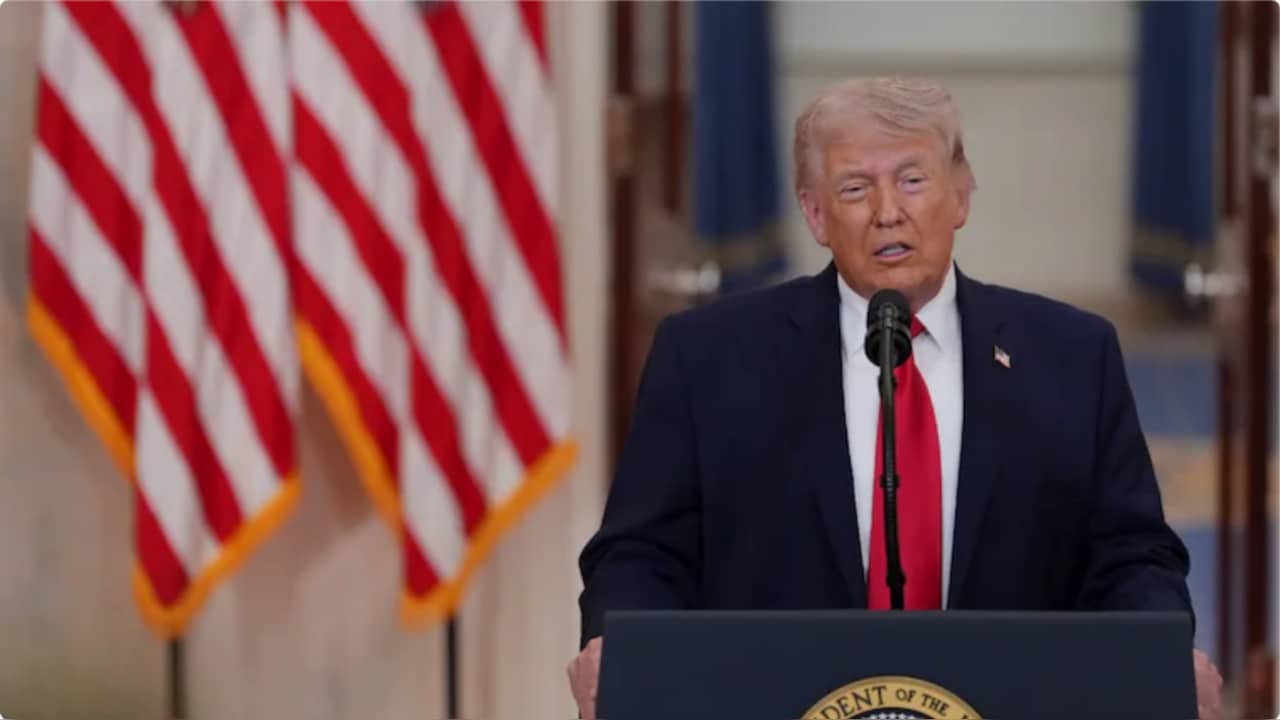
The White House briefing room felt like a time capsule on Thursday night, as President Donald Trump revived his oldest grievance with a new, geopolitical twist. Seeking to inject fresh urgency into a stalled legislative push for the SAVE America Act ahead of the upcoming midterm elections, Trump used a prime-time address to accuse Beijing of executing the largest election data breach in American history. The administration accompanied the speech with the abrupt declassification of hundreds of pages of intelligence files. Yet a rigorous forensic analysis of these documents reveals a stark disconnect between executive rhetoric and bureaucratic reality.
Instead of a smoking gun showing compromised voting machines or altered ballots, the newly public files expose a sophisticated but conventional foreign espionage operation targeting publicly accessible data, weaponized by the White House as domestic political leverage.
The primary claim animating Trump’s address centers on China's alleged acquisition of 220 million U.S. voter files. To the average voter, a foreign adversary harvesting hundreds of millions of personal profiles sounds like an existential breach of democratic sovereignty. To intelligence professionals and state election directors, it sounds like an expensive exercise in downloading public records.
The architectural vulnerability here is not a flaw in our cybersecurity. It is a feature of our transparency.
In the United States, voter registration rolls are legally mandated to be accessible to political campaigns, researchers, and public scrutinized bodies. States like Ohio and North Carolina publish these databases online for free. Other jurisdictions sell them for nominal fees to cover administrative overhead. These files contain exactly what Trump listed with dramatic emphasis: names, physical addresses, telephone numbers, and partisan affiliation.
Foreign state actors do not need to exploit zero-day vulnerabilities or bypass firewalls to map the American electorate. They merely need a corporate front company and a credit card.
To equate the scraping of public registries with the mechanical rigging of an election is a profound category error. Intelligence analysts draw a rigid line between traditional espionage—gathering intelligence to understand an adversary's internal dynamics—and active measures designed to alter an outcome.
Consider a practical analogy. Obtaining a university's complete student registry gives an outsider a comprehensive directory of who attends classes, where they live, and what they major in. It does not, under any circumstances, grant that outsider the administrative privileges required to log into the registrar's secure database and change a failing grade to an A.
The declassified CIA documents published on the White House website confirm this distinction. A July 2020 assessment noted that while Chinese cyber actors were actively probing political infrastructure, the intent was exploratory. The ultimate consensus of the National Intelligence Council, formalized in March 2021, explicitly concluded that Beijing did not deploy operational interference capable of manipulating vote counts or technical systems.
The Intelligence Declassification Trap
By selective presentation, the administration has fundamentally mischaracterized how raw intelligence is weighed against consensus conclusions. Intelligence gathering is messy. Analysts frequently debate intention, and dissenting footnotes are common in high-stakes assessments.
One of the newly unclassified CIA documents from August 2020 confirms that Beijing preferred Trump to lose his previous re-election bid, viewing his trade policies as unpredictable and destructive to long-term Chinese economic interests. However, the document notes that China chose to limit its operations to traditional diplomatic and public-facing economic pressure, explicitly stopping short of covert election interference.
More telling is what the White House choice of declassification omitted. The very same August 2020 threat assessment featured extensive sections detailing aggressive, active interference operations by Moscow designed to denigrate the Democratic ticket. Trump’s 25-minute address did not feature a single mention of Russia or Iran, focusing exclusively on China.
This selective emphasis highlights a broader strategy of policy convenience. Trump is scheduled to host Chinese President Xi Jinping at the White House in September, following an agreement in May to stabilize bilateral relations. Elevating an old intelligence dispute now serves a dual domestic purpose: it rationalizes low presidential approval ratings ahead of the midterms and provides a convenient rhetorical foil to pressure lawmakers on domestic voting legislation.
Machine Vulnerabilities and Observable Reality
The most damaging assertion in the prime-time address was that electronic voting machines and ballot-counting systems remain "vulnerable and easily compromised." It is an assertion that ignores the physical reality of how American elections are actually administered.
American voting infrastructure is hyper-decentralized, spread across thousands of independent county and municipal jurisdictions, each utilizing distinct hardware, software, and procedural controls. The vast majority of voting machines used across the country are entirely air-gapped, meaning they are physically disconnected from the internet. They cannot be hacked remotely from an office building in Beijing or Shanghai.
Furthermore, the physical audit trail has never been stronger. Roughly 95% of all ballots cast in modern American elections feature a verifiable paper record. If a sophisticated cyber adversary somehow managed to alter the digital tabulation software of an isolated local jurisdiction, the anomaly would be instantly exposed during the mandatory post-election hand-count audits that compare paper ballots against digital tallies.
The declassified documents do detail theoretical vulnerabilities in specific models of electronic ballot software. But the documents also reveal that the specific hardware scrutinized by intelligence agencies is largely not deployed within the United States. Presenting a theoretical laboratory vulnerability as an active, nationwide national security failure misleads the public on how secure their local polling places are.
The Midterm Strategy
The true target of Thursday's speech was not the Chinese Ministry of State Security. It was Capitol Hill. By framing foreign espionage as domestic voter fraud, the White House is seeking to force the passage of the SAVE America Act, a legislative package that would mandate in-person proof of citizenship to register to vote.
To support this domestic push, Trump cited a Department of Homeland Security review alleging that 278,000 noncitizens are currently registered on state voter rolls. Yet, in keeping with a long-standing pattern, the administration declined to publish the underlying data or methodology behind this specific figure.
Independent reviews of voter rolls frequently demonstrate that such grand totals are inflated by clerical errors, outdated records of individuals who have since naturalized, and common name mismatches. Forcing states to purge these rolls without rigorous, transparent verification processes risks disenfranchising hundreds of thousands of legally eligible American citizens.
The political calculation is transparent. By conflating foreign espionage with domestic administration, any future electoral losses can be blamed on external sabotage or internal weakness. It is a preemptive defensive strategy designed to insulate the administration from midterm fallout, executed at the direct expense of public trust in democratic institutions.
The real crisis facing American election security is not that our systems are easily rigged by foreign adversaries. The real crisis is that the constant, top-down assertion of vulnerability is systematically eroding the psychological foundation required for a democracy to function: the willingness of the losing side to accept the legitimacy of the result. When traditional espionage is spun as systemic fraud from the highest podium in the world, the damage to public confidence is far more severe than any operation Beijing could ever hope to execute.