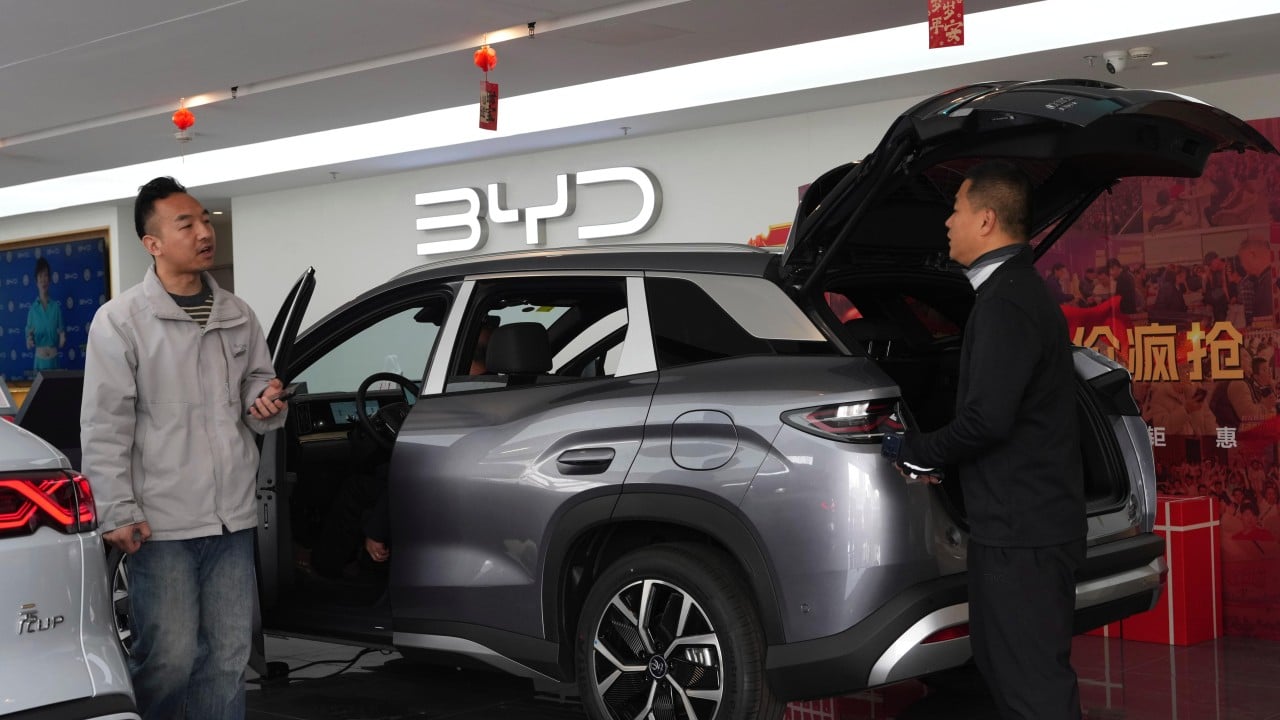
China’s electric vehicle adoption rate is projected to exceed 70 percent of new passenger car sales, permanently relegating internal combustion engine vehicles to a shrinking minority in the world's largest auto market. This structural shift is not merely a story about green technology winning over consumers. It is an aggressive, state-backed industrial realignment where falling overall car sales are being absorbed almost entirely by legacy petrol manufacturers, forcing foreign joint ventures into retreat while domestic battery giants consolidate power.
For decades, Western and Japanese automakers treated China as an endless profit engine. That era is dead. The numbers tell a brutal story of market cannibalization rather than pure expansion. Overall passenger vehicle demand in China has plateaued under the weight of a sluggish property sector and cautious consumer spending. When the pie stops growing, someone has to starve. In China, the starving parties are the legacy joint ventures that spent forty years building factories for Volkswagen, General Motors, Toyota, and Honda.
The Anatomy of a Market Cannibalization
To understand why petrol cars are taking the brunt of the downturn, you have to look at how Chinese consumers view automobiles today. In the West, an electric vehicle is still largely treated as an appliance with a different powertrain—a greener, quieter version of a traditional car. In China, the internal combustion engine is increasingly viewed the way consumers in the late 2000s viewed flip phones. It is obsolete hardware.
Once an industry crosses the 50 percent adoption mark—a milestone China cleared well ahead of schedule—the infrastructure math flips entirely. Gas stations do not disappear overnight, yet the economic incentive to expand or even maintain them evaporates. Meanwhile, charging networks densify in Tier 1 and Tier 2 cities, and battery-swapping stations turn five-minute refueling into a routine reality. When a consumer walks into a showroom in Shenzhen, Shanghai, or Chengdu, buying a purely petrol-powered vehicle no longer feels like a conservative choice. It feels like buying an asset with guaranteed depreciation and looming regulatory penalties.
The policy levers pulling this market forward are relentless. Local governments continue to restrict license plate quotas for internal combustion vehicles in major metropolises, creating an immediate financial penalty that can add tens of thousands of yuan to the upfront cost of a petrol car. At the same time, national trade-in subsidies explicitly favor new energy vehicles—a category that in China includes both pure battery electric vehicles (BEVs) and plug-in hybrids (PHEVs).
Why Plug-In Hybrids Are the Silent Executioners
Most Western commentary fixates on pure battery electric vehicles, missing the real weapon destroying the petrol market. Plug-in hybrids and extended-range electric vehicles (EREVs) are doing the heavy lifting in pushing adoption past 70 percent.
Consider the psychology of a middle-class buyer in a smaller, Tier 3 or Tier 4 Chinese city where winter temperatures drop and public charging is sparser. A pure EV still carries a sliver of range anxiety. A modern Chinese PHEV, however, offers 150 to 200 kilometers of pure electric range for daily commuting—meaning the owner rarely buys gasoline—paired with a small combustion generator that eliminates highway anxiety.
Chinese automakers like BYD, Li Auto, and Geely have priced these hybrids at or below the cost of comparable petrol models from Toyota or Volkswagen. When a buyer can get a larger, faster, software-heavy hybrid for the exact same sticker price as an entry-level petrol sedan, the legacy automaker has no counter-move.
The Supply Chain Death Spiral for Legacy Automakers
The collapse of petrol car volume triggers a classic manufacturing death spiral. Automotive assembly is a brutal game of fixed costs and economies of scale. An engine plant or a transmission factory requires high utilization rates just to break even.
When a legacy joint venture sees its annual sales drop by 20 or 30 percent in a single year, the cost per unit produced skyrockets. Those factories were built for a market that no longer exists. Foreign automakers are now stuck with massive, underutilized industrial footprints across eastern and central China, burdened by unionized or long-term workforces and municipal governments reluctant to allow mass layoffs.
In contrast, domestic champions control the vertical supply chain. Take battery manufacturing. China dominates global lithium refining, cathode production, and cell assembly. Because companies like CATL and BYD produce batteries at massive scale, cell prices have plummeted to historic lows. That cost deflation flows directly into vehicle sticker prices. Legacy automakers, buying batteries from third-party suppliers while still paying off the sunk costs of combustion engine R&D, simply cannot match the unit economics.
Let us look at a hypothetical example to see how this plays out on the factory floor. Imagine a joint-venture plant in Wuhan designed to build 300,000 petrol sedans annually. If demand drops to 140,000 units, the fixed overhead of stamping presses, paint shops, and engine machining lines gets spread across half as many cars. The manufacturer faces two choices: raise prices to protect margins and lose even more volume, or slash prices to keep the assembly lines moving and bleed cash on every vehicle sold. Over the past two years, foreign brands have been forced into the second option, triggering a devastating price war that has wiped out billions in operating profits.
The Software Divide Nobody Wants to Admit
Walk into a modern showroom in Beijing and the conversation rarely starts with horsepower, torque, or panel gaps. It starts with cockpit chips, voice assistants, and autonomous driving capabilities.
Legacy automakers spent a century perfecting mechanical engineering. They mastered fluid dynamics, metallurgy, and suspension geometry. None of those competencies differentiate a car in the modern Chinese market. Today, a vehicle is treated as a rolling consumer electronics device.
Domestic tech-infused automakers—including Huawei’s automotive alliances, Xiaomi, XPeng, and Nio—design vehicles around centralized computing architectures from the ground up. Over-the-air updates add major features every few months. Navigation systems integrate seamlessly with local super-apps, handling everything from parking payments to restaurant reservations via natural voice commands.
Foreign automakers tried to bolt software onto legacy electrical architectures, resulting in laggy screens and clunky interfaces. By the time Western and Japanese executives realized they needed to rewrite their entire software stacks, Chinese competitors were already three generations ahead. You cannot fix a software deficit with better German suspension tuning or Japanese reliability metrics when the customer base prioritizes digital integration above mechanical heritage.
The Myth of the Infinite Export Valve
As domestic petrol sales crater and EV adoption races toward 70 percent, conventional wisdom suggests Chinese automakers will simply export their excess capacity to the rest of the world. That assumption ignores a wall of geopolitical reality.
China certainly has massive overcapacity. Estimates routinely place total domestic auto manufacturing capacity north of 40 million units per year against domestic demand of roughly 25 to 30 million. Exporting five or six million vehicles annually provides a crucial release valve, particularly for petrol cars that can no longer be sold in Shanghai or Guangzhou and are instead shipped to Russia, Latin America, and the Middle East.
Yet that valve is narrowing. The United States has effectively sealed its market with 100 percent tariffs on Chinese EVs and strict bans on Chinese connected-vehicle software. The European Union has imposed substantial countervailing duties following anti-subsidy investigations. Emerging markets from Brazil to Turkey are erecting their own tariff barriers to protect nascent local manufacturing.
This means the brutal consolidation happening inside China cannot be fully exported away. Roughly 100 electric vehicle brands entered the Chinese market over the past decade. Fewer than fifteen will likely survive the next five years as independent entities. Even as adoption hits 70 percent, the domestic battlefield is a bloodbath where only the largest, most cash-rich conglomerates can survive razor-thin margins.
Hidden Vulnerabilities in the 70 Percent Milestone
Celebrating a 70 percent EV adoption rate as an unmitigated triumph overlooks serious structural strains building beneath the surface of the Chinese economy.
First, there is the fiscal hangover. For over a decade, municipal governments poured hundreds of billions of yuan into local EV startups through state-guided investment funds, cheap land grants, and direct consumer subsidies. Those local governments are now drowning in debt, battered by the collapse of land-sale revenues from the real estate crisis. The era of blank-check industrial policy is fading. Automakers that relied on provincial bailouts to survive operating losses are suddenly being cut loose.
Second, the power grid faces immense localized stress. While China builds ultra-high-voltage transmission lines and renewable generation capacity faster than any nation on earth, distribution networks in dense urban residential complexes were never designed for millions of residents plugging in high-draw chargers simultaneously at 7:00 PM. Managing peak load will require massive secondary investments in smart grid infrastructure and vehicle-to-grid (V2G) discharge technology—systems that remain expensive and complex to deploy at scale.
Third, the used-car market is broken. Internal combustion engines have predictable depreciation curves backed by decades of actuarial data. Electric vehicles do not. Because battery chemistry improves every eighteen months and manufacturers routinely slash new-car prices by 15 percent overnight, a two-year-old EV often loses more than half its value. Dealers refuse to hold used EV inventory without steep discounts, creating a bottleneck that eventually slows down new-car upgrade cycles.
What Happens to the Remaining 30 Percent
If EVs capture 70 percent of new sales, what happens to the remaining 30 percent? It does not disappear cleanly. Instead, it fragments into distinct, stubborn niches.
Commercial logistics, heavy hauling, and long-distance rural transport still lean heavily on diesel and petrol, though liquefied natural gas (LNG) trucks and battery-swapping heavy rigs are chipping away at those segments too. In China’s far northern provinces—Heilongjiang, Jilin, Inner Mongolia—winter temperatures regularly plunge to minus 30 degrees Celsius. At those extremes, lithium-ion battery chemistry suffers severe range degradation, and cabin heating drains packs rapidly. Consumers in those regions still view pure EVs with justifiable skepticism.
Furthermore, a massive fleet of roughly 300 million internal combustion vehicles already sits on Chinese roads. Even if new petrol car sales drop to 20 or 30 percent of annual volume, gasoline demand will decline gradually rather than falling off a cliff. Refineries are already shifting output away from motor fuels toward petrochemicals—plastics, synthetic fibers, and industrial feedstocks—to survive the long sunset of the internal combustion era.
For global automakers, however, a 30 percent slice of the Chinese market is not enough to sustain the sprawling corporate structures they built during the boom years. Joint ventures are already shuttering plants, trimming dealership networks, and writing down billions in stranded assets. Some are attempting a desperate pivot—licensing Chinese EV platforms from startups like XPeng or Leapmotor just to put their own badges on competitive hardware. It is a complete inversion of the 1990s model, where Chinese firms traded market access for foreign engineering. Today, Western giants are paying Chinese firms for the right to stay relevant in a market they once owned.