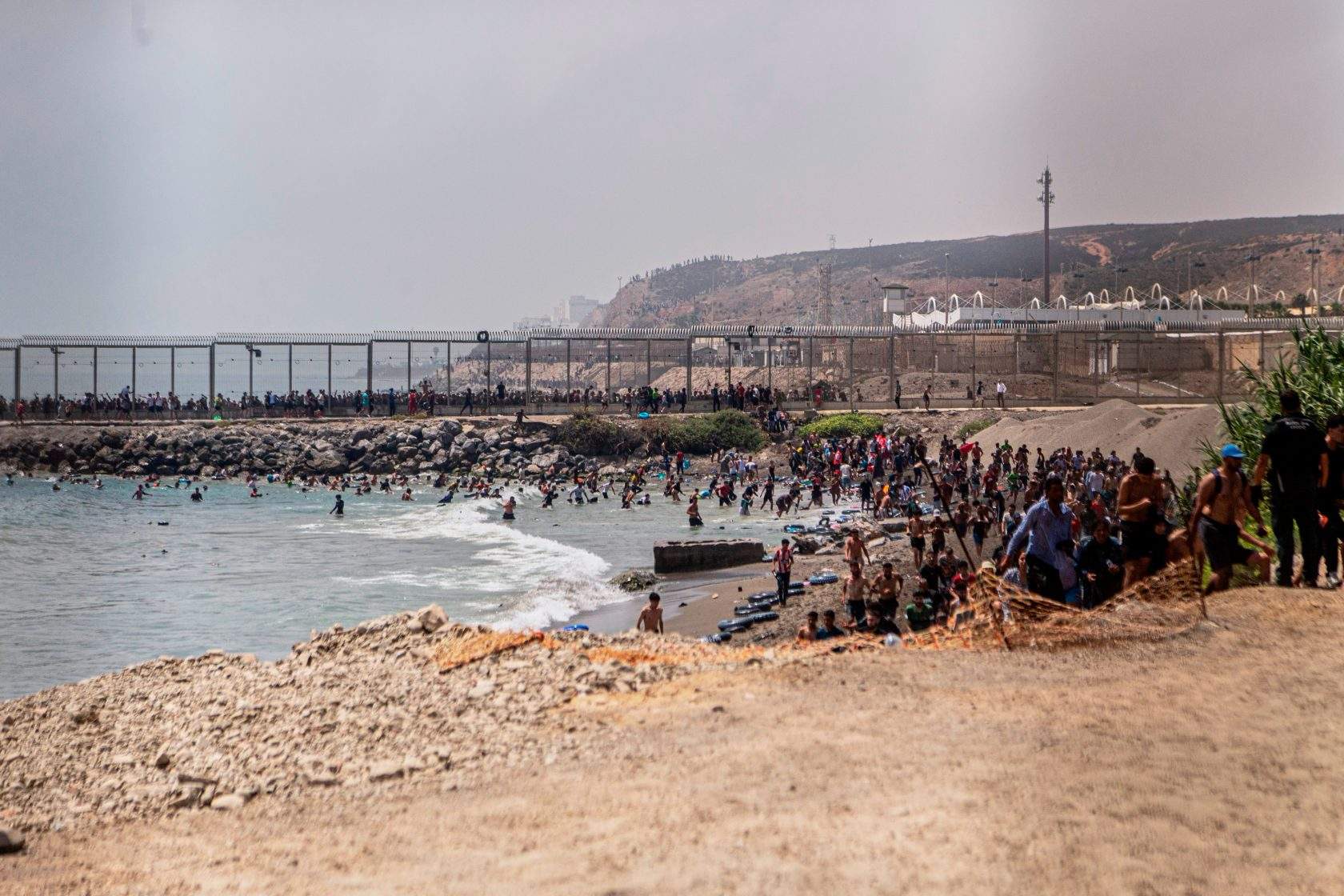
Thousands of migrants swam or scaled the fences into Spain's enclave of Ceuta from Morocco, triggering an immediate military deployment and a severe diplomatic standoff between Madrid and Rabat. The sudden surge exposed the fragile mechanics of Europe's southern frontier, where human desperation collides directly with geopolitical leverage.
Borders are rarely just lines on a map. They are pressurized valves. When pressure builds inside North Africa, Europe's Spanish enclaves act as the immediate release.
The Anatomy of a Sudden Surge
Ceuta is an anomaly. Together with Melilla, it represents the European Union's only land borders on the African continent. This geographic quirk turns a municipal boundary into a continental flashpoint.
The mechanics of the crossing defied conventional migration patterns. Thousands bypassed maritime routes entirely, choosing instead to swim around the Tarajal breakwater under the cover of fog or scale the six-meter double fences topped with razor wire. These were not slow, seasonal trickles. This was a mass movement, executed with a speed that overwhelmed local border infrastructure within hours.
Spain responded by invoking emergency protocols. The military was dispatched to the beaches, not for combat, but for containment and immediate deportations. Within forty-eight hours, thousands were sent back across the border. Yet, the speed of the expulsions did little to answer the underlying operational failure: how did thousands of people mobilize openly in Moroccan territory without intervention from local security forces?
Geography as a Political Instrument
To understand the crisis in Ceuta, look past the beaches and examine diplomatic channels. Migration across this frontier functions as a barometer of bilateral relations between Spain and Morocco.
When Rabat wants concessions—whether regarding fishing rights, agricultural trade, or European diplomatic stances on the disputed Western Sahara territory—the enforcement mechanisms at the border tend to soften. When relations stabilize, patrols tighten.
Intelligence analysts tracking Mediterranean security note a distinct pattern. Mass arrivals rarely occur in a political vacuum. Security forces on the Moroccan side maintain tight surveillance over coastal towns. An influx of this magnitude requires either active facilitation or deliberate negligence.
This transactional diplomacy turns human lives into negotiating chips. Migrants arriving at the fence are reacting to genuine economic despair and violence in their home countries, but their timing is frequently dictated by external pressures applied miles away in capital city boardrooms.
The Limits of Fortress Europe
Europe's strategy for Ceuta relies on physical barriers and financial outsourcing. Brussels provides funding to North African partners to intercept migrants before they ever reach the Mediterranean or Atlantic coasts.
This model contains a fundamental structural flaw. By making containment dependent on the political will of a third-party state, the European Union creates a single point of failure. If Rabat decides to look the other way, the fences and surveillance towers in Ceuta instantly become ornamental.
Furthermore, the militarization of the response changes the local reality. When soldiers patrol urban beaches, the normalization of a security state takes root. Residents of Ceuta live in a permanent state of suspended animation, acutely aware that their home is a geopolitical pressure gauge.
The economic model of the enclave suffers equally. Historically, Ceuta thrived on cross-border trade, with thousands of Moroccan day laborers and traders crossing daily to sustain local commerce. As borders harden into militarized zones, that economy suffocates. Smuggling fills the vacuum left by legal trade, creating a shadow economy that further destabilizes the region.
The Cost of Reactive Policy
Governments excel at crisis management and fail at structural prevention. Deploying the army to Ceuta provides a striking visual for evening news broadcasts, signaling strength and decisiveness to domestic voters. It solves nothing by sunrise.
The migrants who made it past the breakwater faced rapid expulsion, but others are already waiting in the hills above Fnideq. They watch, they plan, and they wait for the next diplomatic freeze between Spain and Morocco.
Until European migration policy moves past the illusion that a taller fence or a temporary troop deployment can override deep-seated geopolitical friction, Ceuta will remain vulnerable. Every diplomatic dispute will bring new crowds to the water. Every policy disagreement will be measured in footsteps on the sand.