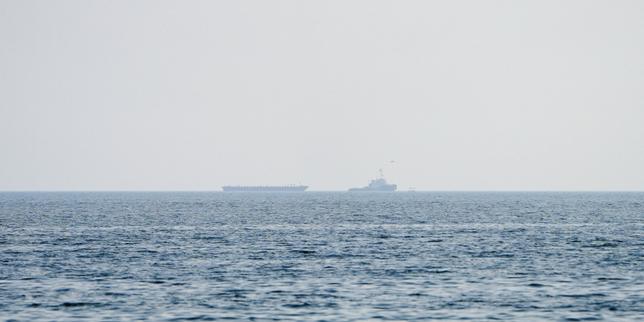
The United States military has escalated its maritime containment strategy by striking a commercial tanker accused of violating the active naval blockade around Iranian ports. This action marks a dangerous evolution in the Persian Gulf confrontation, shifting the operational posture from defensive escort missions to active interdiction and kinetic enforcement.
For months, shipping lines operating through the Strait of Hormuz have balanced thin profit margins against rising geopolitical risk. Now, the calculus has changed entirely. When Washington enforces a unilateral commercial quarantine through direct military strikes, the entire architecture of global energy transport trembles.
Naval blockades are rarely clean operations. They sit in a legal gray zone governed by international maritime law, rules of engagement, and the crude realities of raw power projection. To understand why an American warship fired upon a civilian-flagged vessel, we have to look past the immediate flashpoint and examine the logistics of enforcement, the economics of compliance, and the shadow war being fought below the radar of mainstream headlines.
The Mechanics of Maritime Containment
Enforcing a modern maritime blockade is a nightmare of identification, jurisdiction, and tracking. The oceans are vast, commercial registries are deliberately opaque, and vessels routinely engage in deceptive practices to mask their origins and destinations.
When intelligence services flag a vessel moving toward or away from an embargoed port, the response follows a rigid escalation ladder. First comes electronic hailing and visual verification. If a crew fails to respond or attempts evasive maneuvers, boarding teams are deployed via helicopter or fast interceptor craft.
However, boarding a hostile or non-compliant ship in contested waters carries immense tactical risk. Tankers are massive floating industrial complexes. Their steel hulls tower dozens of meters above the water, creating severe blind spots for boarding parties. A crew can easily lock down internal compartments, disable steering mechanisms, or scuttle the ship from within.
When physical boarding becomes untenable or too hazardous for special operations forces, military planners are left with few alternatives. They can disable the rudder using specialized munitions, or they can strike the vessel directly to deny its cargo to the adversary. The recent strike indicates that Washington has crossed that threshold. By targeting the vessel itself, the Pentagon sent an unmistakable message to shipowners, charterers, and insurers worldwide: compliance with the embargo is no longer optional.
The Shadow Fleet Economy
To understand why a vessel would risk running an American blockade, you have to follow the money. Over the past decade of international sanctions, a massive shadow fleet of aging tankers has emerged. These ships operate outside mainstream maritime insurance markets, often flying flags of convenience from small island nations with lax regulatory oversight.
They turn off their transponders, engage in ship-to-ship transfers under the cover of night, and falsify their port logs. The profits are astronomical. A single successful run carrying discounted crude from sanctioned terminals can net millions of dollars, easily offsetting the operational risk of seizure or destruction.
Insurance companies have tried to adapt by introducing strict geographic exclusion zones and demanding proof of beneficial ownership. Yet the capital behind these shadow operations is resilient. Shell companies registered in tax havens layer ownership structures so deeply that tracking the ultimate beneficiary is often impossible.
When the United States strikes a vessel participating in this illicit trade, it punctures the financial bubble sustaining the shadow fleet. Shipowners calculate risk based on probability. As long as the worst-case scenario was merely a temporary impoundment or a diplomatic reprimand, the trade-off made economic sense. A kinetic strike changes the math permanently. The cost of doing business now includes the very real possibility of total hull loss.
The Insurance Crisis and Supply Chain Fallout
The immediate casualty of this escalation is not just a single burning hull in the Gulf. It is the global maritime insurance market. Lloyd's of London and other major underwriting syndicates are rapidly recalculating risk profiles for the entire Middle East theater.
When marine underwriters deem a region too volatile, war-risk premiums skyrocket. Within hours of the strike, insurance quotes for voyages through the Gulf spiked dramatically. For an oil supertanker carrying millions of barrels of crude, a fraction of a percent increase in premium translates into hundreds of thousands of dollars per voyage.
Ship operators face an impossible choice. They can absorb the crushing insurance costs, pass them along to an already fragile global economy, or divert their vessels entirely around the Cape of Good Hope, adding weeks to transit times and burning millions of gallons of bunker fuel.
Global trade depends on predictability. Supply chains do not break because of a single missing shipment; they break when the cost of uncertainty exceeds the value of the goods being transported. When military forces begin kinetic interdictions against commercial shipping, predictability evaporates.
Legal Precedents and Strategic Hazards
From a legal standpoint, a blockade implemented outside a formal declaration of war exists in a precarious position under international maritime law. Traditionally, a blockade is an act of war designed to cut off all commerce with an enemy state. If the United States is not technically at war with Iran, the legal justification for sinking or striking a neutral-flagged commercial vessel rests on expanded interpretations of self-defense, collective security, and counter-proliferation mandates.
Other global powers are watching this precedent closely. If a major nation can unilaterally establish a maritime quarantine and enforce it with kinetic strikes against commercial traffic, the freedom of navigation principle that has underpinned global trade since the end of the Second World War is severely undermined.
Beijing, Tokyo, and European capitals understand the implications. If the Persian Gulf becomes a free-fire zone for blockade enforcement, similar tactics could easily be applied in other strategic chokepoints, from the Taiwan Strait to the South China Sea. The fragmentation of international maritime law paves the way for a fractured global commons where might makes right and commercial shipping becomes an arm of state conflict.
The Military Reality on the Water
Military planners face an intractable operational challenge in the region. Maintaining a persistent kinetic blockade requires vast naval assets. Aircraft carriers, guided-missile destroyers, and amphibious assault ships must remain on station indefinitely, straining maintenance schedules and burning through precision-guided munitions.
At the same time, asymmetric actors possess a terrifying array of cheap countermeasures. Low-cost loitering munitions, anti-ship ballistic missiles, and swarming attack craft can threaten multi-billion-dollar warships with impunity. Every time a warship engages a target, it expends interceptors that take months to manufacture and replace.
This asymmetry creates a dangerous strategic imbalance. The defender of the blockade must win every single engagement perfectly. The runner of the blockade only needs to succeed once to deliver its cargo or score a symbolic victory against a superpower.
As the smoke clears from the latest strike, the region edges closer to a precipice. The enforcement of the blockade has moved from the realm of diplomacy and economic pressure into the domain of direct kinetic violence. There are no clean exits from this trajectory, only escalating escalations where every action invites a harsher response, and the margin for error narrows with every tide.