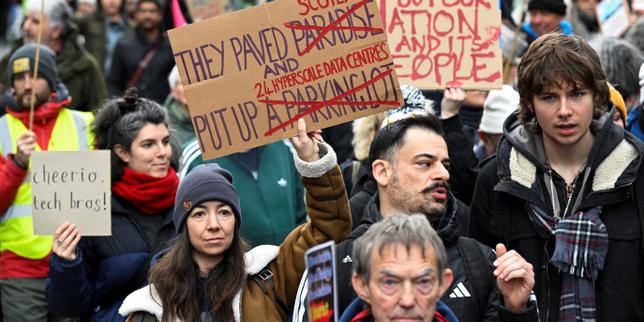
Amazon workers are pushing back against the company’s massive artificial intelligence expansion, and the battleground isn't just corporate offices—it is the physical infrastructure of the internet. Across corporate campuses and cloud operations, employees are organizing against the breakneck construction of energy-hungry data centers, citing severe climate hypocrisy, deteriorating working conditions, and the weaponization of cloud computing. While executives frame these server farms as the inevitable foundation of modern computing, a growing coalition of engineers, warehouse staff, and climate advocates inside the company argues that Amazon is mortgaging its environmental pledges and worker safety to win an arms race in generative AI.
The friction has been building for years. Now it has reached a boiling point.
For over a decade, Amazon Web Services operated as the quiet, hyper-profitable engine funding the retail giant’s razor-thin margins. Nobody outside of enterprise IT paid much attention to the windowless concrete bunkers housing millions of servers in Northern Virginia, Oregon, or Dublin. That era of invisibility is over. Artificial intelligence requires vastly more computational power than traditional cloud storage or web hosting, forcing Amazon to pour tens of billions of dollars into hyperscale data center campuses at an unprecedented pace.
The Anatomy of the Revolt
To understand why workers are drawing a line in the sand, you have to look at the convergence of three distinct grievances. Traditionally, tech workers complained about ethics and climate policy, while blue-collar logistics staff fought over wages, injury rates, and surveillance. The AI infrastructure boom has collapsed the distance between those two worlds.
First, there is the sheer environmental scale of the buildout. Training and running large language models requires continuous, high-density power. A single rack of AI servers can draw five to ten times the electricity of a standard cloud computing rack. To keep these machines from melting, facilities evaporate millions of gallons of fresh water daily for cooling, often in regions already experiencing severe drought.
Employees who helped draft or championed Amazon’s internal climate initiatives view this rapid expansion as a direct betrayal of the company's public commitments to reach net-zero carbon emissions by 2040. When corporate leadership delays the retirement of fossil-fuel power plants or signs massive long-term energy deals that strain local electrical grids, the engineers building the software feel complicit in accelerating environmental degradation.
Second, workers are challenging the end-use of this computational capacity. Hyperscale data centers do not exist in a political vacuum. As Amazon secures lucrative defense and intelligence contracts—providing the cloud backbone for military AI, border surveillance, and predictive policing—internal dissent has hardened. Employees are demanding transparency regarding how the algorithms running on Amazon hardware are deployed, arguing that building the infrastructure makes the workforce directly responsible for its real-world consequences.
Third, the human toll extends directly to the people building and maintaining the facilities, as well as the logistics workers downstream. Data center technicians face intense pressure to maintain near-zero downtime amidst rapid hardware retrofits, working long shifts in loud, thermally extreme environments. Simultaneously, warehouse employees see the exact same AI technologies being rolled out across fulfillment centers to tighten productivity quotas, automate disciplinary warnings, and compress human labor into algorithmic metrics.
Why Data Centers Became the Chokepoint
Labor organizing in the technology sector has historically struggled to find real points of pressure. White-collar strikes in Seattle or San Francisco rarely interrupt the immediate flow of revenue; code keeps running on the servers even when the programmers walk out for an afternoon.
Data centers change the equation entirely. They are physical, capital-intensive, and brittle.
A single hyperscale facility represents hundreds of millions of dollars in sunk capital, packed with specialized silicon that degrades in value every month it sits idle. If permitting is delayed by local community protests backed by insider whistleblowers, the financial bleed is immediate. If the specialized technicians who manage cooling systems, high-voltage power distribution, and server hardware slow down operations or unionize, the entire cloud ecosystem feels the tremor.
Workers have realized that the physical layer of AI is its most vulnerable flank. You cannot move a gigawatt-scale substation to the cloud. You cannot patch a broken cooling tower remotely. By targeting the expansion of data centers, internal organizers are connecting their labor struggles with external environmental groups, municipal water authorities, and local residents tired of living next to humming industrial complexes that raise their utility bills.
The Physics and Economics of the AI Bottleneck
To appreciate the stakes for Amazon leadership, look at the hardware reality. Standard cloud computing relies heavily on Central Processing Units (CPUs), which handle sequential tasks efficiently and run relatively cool. Modern AI workloads depend on Graphics Processing Units (GPUs) and custom accelerators—like Amazon’s own Trainium and Inferentia chips—which perform massive parallel calculations.
These chips run hot. Very hot.
Retrofitting older data centers to handle AI workloads is often impossible because the existing electrical switchgear cannot deliver enough power to the floor, and traditional air-cooling systems cannot pull heat away fast enough. Consequently, Amazon must build entirely new facilities from the ground up, engineered with liquid cooling loops and dedicated high-voltage substations.
Consider a hypothetical example to illustrate the scale. Imagine a mid-sized town of 50,000 households. A single new hyperscale AI campus can easily consume more continuous electricity than that entire municipality, operating at peak load twenty-four hours a day, seven days a week. Multiply that across dozens of planned sites globally, and the strain on regional power grids becomes undeniable.
From a business perspective, Amazon feels trapped in a classic prisoner's dilemma. Microsoft and Google are spending equally staggering sums on their own data center footprints. In the boardroom, the prevailing logic is existential—fail to build the capacity now, and Amazon Web Services risks losing its dominant market share in enterprise computing for the next twenty years. To executives, slowing down for environmental reviews or worker consultation looks like corporate suicide.
The Corporate Counter-Offensive
Amazon has not stood still while internal opposition mounts. The company’s response relies on a combination of aggressive public relations, regulatory lobbying, and tighter internal controls.
On the public front, Amazon heavily promotes its status as the world’s largest corporate purchaser of renewable energy. Company spokespeople routinely point to massive investments in wind and solar farms, as well as newer bets on small modular nuclear reactors, as proof that its AI growth can be decoupled from carbon emissions.
Critics inside and outside the company argue this accounting relies on creative math. Purchasing renewable energy credits in one state does not change the physical reality that a data center in another state is drawing base-load power from a coal or natural gas plant during peak evening hours when the wind isn't blowing. Grid operators in hubs like Northern Virginia have publicly warned that data center demand is outpacing the construction of new green generation, forcing utilities to keep aging fossil-fuel plants online longer than planned.
Internally, management has moved to restrict the digital town squares that once allowed employees to organize across departments. Internal Slack channels dedicated to climate action, labor conditions, and AI ethics have faced increased moderation, sudden archiving, or strict new communication guidelines. Return-to-office mandates have further disrupted informal organizing networks by pulling remote workers back into badge-monitored corporate buildings, making candid conversations harder to sustain without fear of retaliation.
What the Critics Miss About the AI Buildout
A rigorous analysis requires acknowledging the uncomfortable gray areas. While worker activists make compelling points about grid strain and corporate hypocrisy, the broader picture is rarely black and white.
First, shutting down or halting data center construction does not stop the global demand for computation; it often just shifts where that computation happens. If Amazon cannot build a facility in a strictly regulated jurisdiction with high environmental standards and a relatively clean grid, the workloads may migrate to regions with lax regulations, dirty power grids, and zero worker protections.
Second, not all AI workloads are frivolous chatbots or surveillance tools. The same server racks powering consumer generative AI also run protein-folding simulations for drug discovery, advanced climate modeling, and grid-optimization algorithms that actually help utilities integrate intermittent renewable energy. Treating the entire infrastructure buildout as uniformly destructive ignores the tangible scientific utility embedded within the cloud.
Third, the tech workforce itself is deeply divided. For every engineer organizing against data center expansion, there are dozens of colleagues whose careers, stock grants, and bonuses are directly tied to the success of Amazon's AI products. Many workers genuinely believe that advancing artificial intelligence is the defining engineering challenge of their generation, and they view internal resistance as a misguided attempt to halt technological progress.
The Legal and Regulatory Tightrope
As internal resistance spills over into public whistleblowing, Amazon faces a growing gauntlet of external scrutiny. Local zoning boards, once eager to hand out massive tax breaks to attract data center investments, are facing fierce pushback from constituents worried about noise pollution, diesel generator emissions, and depleted aquifers.
In several key markets, grid connections are now delayed by years rather than months. Utilities simply cannot build transmission lines fast enough to keep up with tech company requests. This physical bottleneck has inadvertently given worker coalitions more leverage; every regulatory delay caused by leaked internal environmental assessments or employee testimony at public hearings compounds the timeline pressure on AWS leadership.
Meanwhile, labor regulators are watching closely how Amazon handles dissenting employees. Past terminations of vocal internal critics led to high-profile settlements and ongoing scrutiny from the National Labor Relations Board. If Amazon cracks down too aggressively on engineers protesting data center policies, it risks triggering legal battles over protected concerted activity—the right of workers to band together to improve their working conditions and advocate on workplace-related issues.
How This Collision Reshapes the Tech Industry
The conflict inside Amazon is a preview of a broader reckoning across the entire technology sector. For decades, Silicon Valley operated under the illusion that software was weightless—an ethereal realm of pure code detached from physical limits, resource extraction, and industrial labor disputes.
Artificial intelligence has shattered that illusion. The cloud is made of concrete, copper, silicon, water, and human sweat.
As the financial bets grow larger, the tolerance for internal dissent inside major tech firms shrinks. Yet the very nature of this physical buildout creates new vulnerabilities that traditional software companies never had to manage. You can outsource customer support and automate code review, but you cannot easily replace the specialized engineers who keep high-voltage server farms from going dark, nor can you hide a million-square-foot industrial complex from the community next door.
Amazon’s leadership is betting that massive capital expenditure will secure its dominance in the AI era before regulatory limits or labor unrest can slow it down. The workers organizing across its offices and facilities are betting that the physical limits of the electrical grid, the planet's water supply, and human endurance will force a reckoning first. Neither side is backing down, and the outcome will determine who actually controls the foundational infrastructure of the twenty-first century.