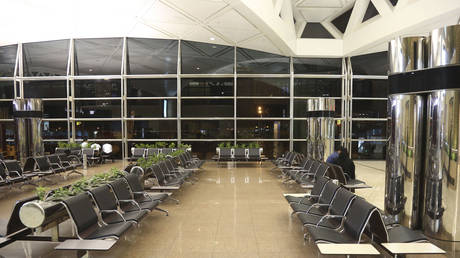
Yemen's Houthi movement has intensified a campaign of long-range ballistic missile and drone strikes targeting critical civil aviation infrastructure inside Saudi Arabia, bringing renewed urgency to the vulnerabilities facing the kingdom's airspace. Central hubs such as King Khalid International Airport in Riyadh and King Fahd International Airport in Dammam have repeatedly been drawn into the crosshairs of asymmetric escalations, forcing temporary airspace suspensions, flight reroutings, and heightened international risk assessments.
For years, Riyadh has marketed itself as an emerging epicenter for global trade, tourism, and massive foreign investment. That strategic vision relies entirely on an unbroken promise of safety. When commercial jets share the upper atmosphere with incoming cruise missiles and interceptor plumes, the psychological and economic toll expands far beyond the physical blast radius.
The Mechanics of Asymmetric Escalation
The mechanics behind these attacks reveal a shifting military reality. Traditional air defense architecture, including advanced Patriot battery arrays, remains remarkably effective at intercepting inbound threats. Yet, perfection is mathematically impossible in modern missile defense. When interceptors detonate incoming warheads at high altitudes over densely populated metropolitan areas or sprawling airport complexes, falling debris poses an immediate, lethal hazard to people and property on the ground.
Furthermore, the financial asymmetry of the conflict heavily favors the aggressor. Assembling and launching low-cost loitering munitions or basic cruise missiles costs a fraction of the multi-million-dollar interceptor rockets required to neutralize them. This persistent cost-infliction strategy places continuous operational stress on military supply chains and civilian authorities alike.
The strategy behind targeting primary aviation nodes is calculated. Airports are high-visibility, internationally scrutinized symbols of state competence and economic connectivity. Disrupting operations at King Khalid International Airport does not merely delay commercial passengers; it threatens supply chains, rattles investor confidence, and complicates the grand architectural timelines of multi-billion-dollar development projects meant to diversify the Saudi economy away from oil.
Regional Realities and the Shadow of Tehran
These cross-border strikes do not occur in a vacuum. They are directly tied to the broader regional power struggles spanning Yemen, the Red Sea corridor, and the Persian Gulf. Backed by Iran as part of its network of regional allies, the Houthi movement has acquired increasingly sophisticated guidance systems, propulsion technologies, and telemetry capabilities.
What began years ago as crude, short-range projectile exchanges have evolved into precision-guided strikes capable of traveling hundreds of miles across the Arabian Peninsula. This technological maturation means that cities once considered deep in the interior safe zones—including the capital—now exist on an active frontline.
Diplomatic channels have struggled to keep pace with the military escalation. International carriers and European aviation regulators have repeatedly extended airspace warnings and conflict-zone advisories across the Gulf, reflecting deep-seated anxiety among foreign operators. Insurers have adjusted risk premiums for flights touching down in the region, turning routine commercial scheduling into a complex calculus of risk management.
The Cost of Interception and Uncertainty
The public messaging from aviation authorities often emphasizes that danger has passed following successful defense operations. However, the reality on the ground involves recurring disruptions that test the patience of international travelers and multinational corporations.
When flights are halted or delayed due to incoming threats, the ripple effects hit regional tourism, business travel, and logistics networks. The ambition to host major global summits and attract millions of annual visitors requires absolute predictability. Every activation of air defense sirens over Riyadh introduces a dose of volatility that contradicts the image of total stability.
Addressing this vulnerability requires more than tactical interceptions. It demands an elusive political settlement in Yemen and a durable regional security framework that can curb the flow of advanced missile components into the hands of non-state actors. Until those diplomatic breakthroughs materialize, the skies over the Arabian Peninsula will remain a high-stakes arena where civilian infrastructure serves as leverage in a bitter geopolitical war.