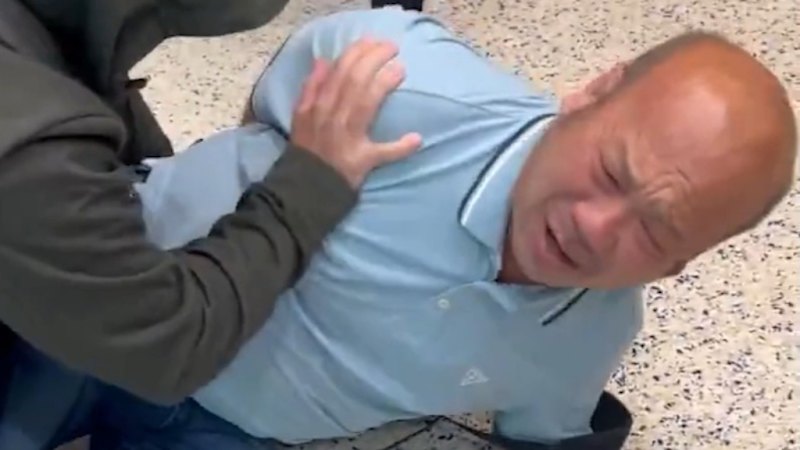
The violent enforcement of immigration laws reached a breaking point at Las Vegas's Harry Reid International Airport when plainclothes federal agents tackled and half-handcuffed a 57-year-old Australian tourist, Phu Nguyen, over a routine visa overstay. The botched operation ended with the agents fleeing the scene when bystanders filmed them, leaving Nguyen injured on the terminal floor with a single handcuff dangling from his wrist. Nguyen was arrested the following day at Los Angeles International Airport while trying to board a flight out of the country, exposing a chaotic enforcement strategy that prioritizes optics and aggression over basic logistical competence.
The Terminal Three Meltdown
The incident unfolded in plain view of hundreds of travelers inside Terminal 3. A man and a masked woman, both wearing civilian clothing and flashing no immediate identification, aggressively forced Nguyen to the ground. To onlookers, it did not look like a federal arrest. It looked like an abduction.
As Nguyen screamed for help, travelers did what the modern public does when witnessing state violence: they pulled out their phones and started recording. The reaction from the two Immigration and Customs Enforcement (ICE) agents was telling. Rather than calmly asserting their federal authority, explaining the situation, or showing a badge to de-escalate the crowd, the agents panicked. Realizing their faces and tactics were being captured on high-definition video, they dropped their restraint, turned, and walked away into the airport crowd.
They left behind a bewildered, terrified Australian national who was still locked into one half of a pair of government-issued handcuffs. When the Las Vegas Metropolitan Police arrived, they found a chaotic scene but no active federal agents. Local officers ran Nguyen's name, found absolutely no outstanding criminal warrants, and cut the federal handcuffs off his wrist. Local police then called ICE to ask what exactly just happened on their turf.
Tactical Incompetence Meeting Border Absurdity
The administrative reality of a visa overstay rarely matches the theatrical violence displayed in Las Vegas. Overstaying a visa is a civil violation, not a criminal felony. Millions of international visitors inadvertently overstay their administrative window due to flight cancellations, medical emergencies, or simple mathematical errors regarding their authorized duration of stay.
The profound irony of the Nguyen case lies in where the enforcement occurred. Nguyen was at an international airport terminal. He was already in the process of leaving the United States.
Federal immigration authorities chose to expend operational resources, deploy plainclothes agents, and instigate a physical altercation inside a crowded transportation hub to stop a man who was already self-deporting. When the Las Vegas operation imploded under the scrutiny of bystander smartphones, ICE simply waited less than 24 hours to catch him at his connecting flight at LAX. If the ultimate goal of immigration enforcement is the removal of non-citizens who have overstayed their legal welcome, the system worked backwards. It violently interrupted a departure, failed to secure the individual, created a public safety hazard, and then processed the departure anyway in a neighboring state.
The Threat to International Tourism and Legal Protections
The blowback was immediate, and it came from the highest levels of Nevada's political infrastructure. U.S. Senator Jacky Rosen publicly condemned the agency, stating that ICE continues to act with impunity, scaring tourists and damaging the state's tourism-driven economy. The Nevada Latino Legislative Caucus and the Asian American Native Hawaiian Pacific Islander Caucus immediately demanded a transparent investigation into why federal agents are operating like a rogue militia inside local infrastructure.
The economic anxiety is real. International tourism relies heavily on the perception of safety and predictability. When an ally's citizen is tackled by masked, unidentifiable individuals for a civil infraction, it sends a chilling message to high-spending international travelers.
Furthermore, the operational detachment between federal immigration enforcement and local police departments creates severe liability. Local police departments spend decades building community trust. That trust is instantly evaporated when plainclothes federal officers create a riotous scene in a local airport, leave a civilian chained, and force local cops to clean up the legal and physical aftermath.
Tracking the Systemic Rot
This is not an isolated procedural hiccup. It is the natural consequence of an agency that operates with minimal external oversight and a culture that favors physical dominance over administrative efficiency. The fact that the agents fled the moment cameras appeared proves they knew their conduct could not withstand public scrutiny.
When a federal agency operates under the assumption that every overstay requires a tactical takedown, it loses the ability to distinguish between a genuine national security threat and a 57-year-old tourist trying to fly home to Australia. The Department of Homeland Security has shielded the identity of the agents involved, but the video evidence remains immortalized online. True accountability will require more than just political press releases; it will require a complete overhaul of how and where civil immigration warrants are executed. Until federal oversight committees strip these field offices of their tactical theater, international airports will remain unpredictable flashpoints for state-sponsored chaos.