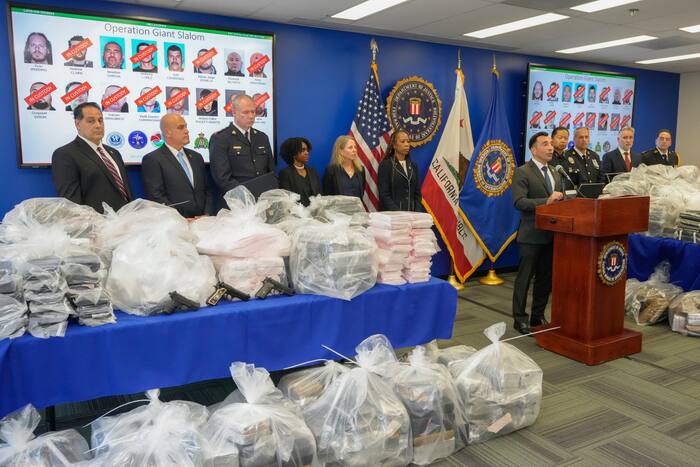
Federal prosecutors in the United States have formally accused a sitting Mexican federal judge of accepting a $2 million bribe to obstruct an international drug trafficking investigation and shield cartel operatives from extradition. The indictment, unsealed in federal court, exposes a direct collision between American extraterritorial enforcement and the structural vulnerabilities of the Mexican judiciary. Rather than treating this as an isolated lapse in personal ethics, legal analysts and veteran narcotics investigators view the charges as a symptom of a deeper systemic struggle over who truly controls the legal chokepoints of the transnational drug trade.
The money moved quietly. Getting the ruling out of a high-security courtroom required a level of institutional access that street-level cartel enforcers simply cannot buy on their own.
The Mechanics of a Two-Million-Dollar Ruling
To understand how a single judge can stall an international narcotics case, you have to look at the amparo system in Mexico. Originally designed as a constitutional safeguard to protect citizens from government overreach, the writ of amparo functions similarly to a sweeping injunction. In the hands of well-financed cartel defense teams, it becomes a procedural shield capable of freezing extradition orders, unfreezing seized bank accounts, and invalidating arrest warrants for years at a time.
According to court filings, the accused magistrate allegedly accepted the $2 million payout in exchange for issuing favorable rulings that effectively neutralized a high-priority extradition request sought by the U.S. Department of Justice. The payment was not handed over in a single duffel bag at a border crossing. Prosecutors allege the funds were routed through a layered network of shell companies, real estate holding firms, and offshore accounts designed to obscure the origin of the cash before it reached the judge's extended family.
When a judge grants an indefinite suspension against extradition, the physical transfer of a cartel leader to American soil stops cold. U.S. marshals cannot cross the border to retrieve a suspect while a federal amparo remains active. For a transnational criminal organization moving tens of millions of dollars in synthetic opioids and cocaine every month, $2 million is a routine operational expense—an insurance policy that buys time, preserves leadership continuity, and allows supply chains to adapt.
Why Washington Brought the Case to a U.S. Courtroom
For decades, the unspoken diplomatic rule between Washington and Mexico City was simple: the United States prosecuted the traffickers, and Mexico policed its own judges. That arrangement has steadily eroded. The decision by American prosecutors to indict a Mexican judicial official directly in a U.S. district court signals a profound breakdown in cross-border institutional trust.
Under the Foreign Narcotics Kingpin Designation Act and federal money laundering statutes, the Department of Justice claims jurisdiction whenever illicit drug proceeds touch the U.S. financial system or when actions abroad directly obstruct ongoing American criminal prosecutions. If a bribe is wired through a correspondent bank in New York, or if the ruling prevents the extradition of a defendant indicted in Texas or California, U.S. prosecutors argue the crime has a direct domestic nexus.
This approach bypasses the domestic political paralysis in Mexico, where judicial corruption cases frequently stall inside internal oversight bodies. The Federal Judicature Council (Consejo de la Judicatura Federal) is tasked with disciplining federal judges, yet critics have long pointed out that the council operates with minimal public transparency. Suspensions are rare. Criminal referrals are rarer still. By building the case through cooperating witnesses, intercepted communications, and financial records gathered by the Drug Enforcement Administration and Homeland Security Investigations, Washington effectively took the disciplinary gavel out of Mexico City's hands.
The Extradition Bottleneck
Extradition remains the single most feared weapon in the American counter-narcotics arsenal. Cartel leaders routinely maintain operational control from inside maximum-security prisons in Mexico, bribing guards, smuggling in encrypted phones, and issuing orders through visiting attorneys. Once a defendant steps off a DEA plane onto a tarmac in New York, Chicago, or Alexandria, Virginia, that leverage evaporates.
American federal prisons impose strict Special Administrative Measures (SAMs) on high-level narco-traffickers, cutting off communication with the outside world and isolating them from their criminal networks. Facing decades in solitary confinement without access to their wealth, cartel bosses are far more likely to flip and cooperate with federal prosecutors. Every delayed extradition protects not just the individual defendant, but every politician, police commander, and business associate on that cartel's payroll.
The Anatomy of Judicial Vulnerability
It is easy to paint a corrupt magistrate as a greedy outlier, but seasoned observers of the Mexican legal system know the reality is far more coercive. Judges handling high-profile organized crime dockets operate under constant, existential pressure. They are caught between the rule of law and the brutal pragmatism of plata o plomo—silver or lead.
Consider a hypothetical scenario that plays out regularly in federal court districts across northern and central Mexico. A newly appointed district judge is assigned a complex money laundering and trafficking file involving a major regional syndicate. Within weeks, intermediaries approach the judge's family members—not with threats at first, but with an offer to pay off a mortgage or fund a child's private education abroad. If the judge refuses, the tone shifts. Photographs of the judge's daily commute appear on a burner phone. The message is unmistakable: take the money and sign the procedural delay, or risk the lives of everyone in your household.
Security details provided by the Mexican state are often inconsistent, underfunded, or compromised from within. A judge's armored vehicle means little if the driver reports the magistrate's schedule to a local cartel lookout. In that environment, institutional integrity requires a level of personal martyrdom that few public officials anywhere in the world are prepared to sustain.
The Structural Clash Over Judicial Reform
The U.S. indictment lands at a volatile moment for Mexico's legal architecture. Sweeping constitutional reforms aimed at overhauling the Mexican judiciary—including proposals to replace appointed federal judges with candidates chosen by popular election—have triggered fierce debate across North America.
Proponents of radical restructuring argue that the current system is an entrenched, nepotistic guild that protects elite interests and sells justice to the highest bidder. They point to cases like this $2 million bribery scandal as proof that internal self-regulation has failed completely. From their perspective, tearing down the existing appointment process is the only way to break the collusion between judges and organized crime.
Opponents, including bar associations, international legal observers, and business groups, warn that popular elections will accomplish the exact opposite. Running a campaign requires money, media access, and territorial organization. In regions where criminal syndicates already dictate local politics and fund municipal candidates, an elected judiciary risks becoming directly beholden to cartel financiers. Instead of bribing a judge after the fact, traffickers could simply bankroll their preferred magistrate's campaign from the start.
What Happens When Bilateral Trust Collapses
The diplomatic fallout from indicting a sitting foreign judge extends far beyond a single courtroom. When U.S. federal agents build secret cases against Mexican officials without notifying their counterparts in Mexico City, intelligence sharing dries up.
- Operational delays: Joint task forces rely on real-time vetting and shared wiretap data, both of which stall when agencies suspect leaks at the highest levels.
- Sovereignty friction: Mexican officials routinely view unilateral U.S. prosecutions of domestic actors as an infringement on national sovereignty, prompting retaliatory restrictions on DEA agents operating within Mexico.
- Defense challenges: Cartel lawyers use allegations of bilateral misconduct to challenge the admissibility of evidence in both jurisdictions, dragging trials out for years.
Despite these diplomatic hazards, federal prosecutors in the United States have shown little willingness to back down. Over the past decade, the DOJ has steadily expanded its net, bringing charges against former Mexican cabinet secretaries, state governors, military generals, and now federal magistrates. The legal strategy is consistent: follow the dollar, establish a U.S. financial touchpoint, and let a federal jury decide.
The Paper Trail That Broke the Case
Modern bribery investigations rarely hinge on a single eyewitness. Defense attorneys can tear apart the credibility of a cooperating cartel informant in front of a jury, painting them as a desperate criminal lying to shave decades off their own prison sentence. To make a case against a high-ranking foreign judge stick, federal prosecutors have to corroborate every word with hard financial forensics.
In cross-border corruption cases, the paper trail almost always leaves a footprint in the American banking system because the U.S. dollar remains the reserve currency of global narcotics trafficking. Even when bribes are initially paid in pesos or bulk cash inside Mexico, converting that wealth into legitimate assets—luxury apartments in Miami, commercial properties in Texas, or investment accounts in New York—requires passing through financial institutions subject to strict Bank Secrecy Act reporting rules.
Compliance algorithms at major banks flag unusual wire patterns, shell company transfers, and third-party real estate purchases that do not match a public official's declared salary. Once Homeland Security Investigations or the IRS Criminal Investigation division obtains a subpoena for those records, the cooperating witness's testimony transforms from an unverified accusation into an annotated timeline. Every meeting matches a wire transfer. Every court ruling aligns with an asset purchase.
A Precedent With No Easy Exit
If the accused judge is eventually extradited to the United States—a legal battle that will ironically play out through the very same Mexican court system now under scrutiny—the resulting trial will put the inner workings of Mexico's federal bench on public display. Even if the judge never sets foot in an American courtroom, the indictment alone functions as a permanent exile. U.S. visas are revoked, overseas assets are frozen by the Treasury Department's Office of Foreign Assets Control, and any international travel carries the immediate risk of arrest via an Interpol Red Notice.
The message from Washington to the Mexican bench is blunt. The robe no longer guarantees immunity at the border, and the same financial networks that move cartel profits north are now being used to map judicial corruption south. Until both governments confront the reality that cartel money buys influence faster than bilateral treaties can regulate it, the battle over drug trafficking will continue to be fought not in the streets, but in the quiet, procedural margins of the courtroom.