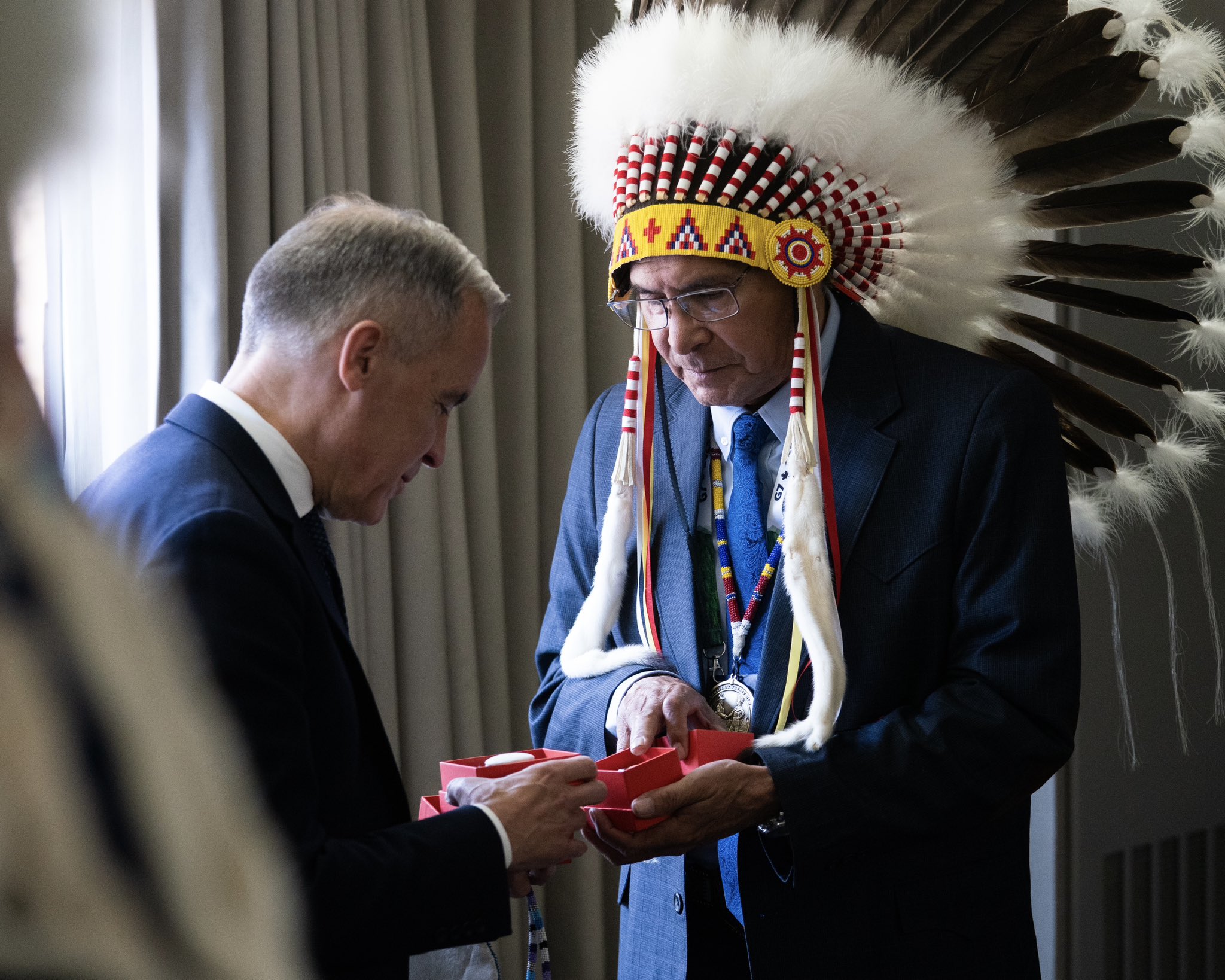
The Canadian infrastructure deficit, currently estimated in the hundreds of billions, has moved from a budgetary concern to a geopolitical bottleneck. Mark Carney’s "build fast" mandate—a policy shift designed to bypass the multi-decade stagnation of Canadian capital projects—rests on the assumption that speed is a neutral economic good. This assumption collapses when it intersects with the evolving legal and economic reality of Indigenous Title. The friction is not merely ideological; it is a structural misalignment between the Internal Rate of Return (IRR) sought by institutional investors and the Intergenerational Equity Model required by First Nations.
To understand the division within Indigenous communities regarding this "build fast" push, one must move beyond the binary of "pro-development" versus "environmentalist" and instead analyze the three distinct economic pillars that dictate how a community interacts with federal infrastructure acceleration.
The Tri-Pillar Framework of Indigenous Project Engagement
The divergence in Indigenous responses to accelerated development is driven by the specific economic positioning of the Nation in question. We can categorize these into three distinct archetypes:
- Equity-Ready Partners: Communities with established development corporations (DevCorps) that possess the balance sheets to take direct equity stakes. For these Nations, Carney’s "build fast" push represents a reduction in the "cost of delay," which traditionally erodes the Net Present Value (NPV) of their investments.
- Rights-Protective Sovereigntists: Nations whose primary asset is the ecological integrity of their territory. Speed is viewed here as a tactical weapon used by the Crown to truncate the "Duty to Consult," effectively devaluing their legal leverage before it can be exercised.
- Capacity-Constrained Gatekeepers: Communities that support the principle of development but lack the technical or legal infrastructure to review complex environmental assessments on an accelerated timeline. For them, "fast" is synonymous with "uninformed."
The Cost Function of Regulatory Acceleration
When the federal government proposes to "streamline" permitting, it is essentially transferring the risk of unforeseen environmental or social externalities from the project proponent to the local landholder. In a standard capital model, time is a cost. In the Indigenous legal model, time is the mechanism through which Free, Prior, and Informed Consent (FPIC) is validated.
Removing 12 to 24 months from a regulatory cycle reduces the "carry cost" for a firm like Brookfield or a pension fund, but it creates a "diligence deficit" for a First Nation. If a community cannot conduct its own independent technical review because the federal window has shrunk, the project enters a state of legal fragility. This fragility manifests as future injunctions, which are far more expensive than a slower initial approval process.
The Logical Fallacy of the Ownership-as-Acquiescence Model
A significant portion of the Carney strategy hinges on Indigenous equity ownership. The logic suggests that if a Nation owns 10% to 20% of a pipeline, transmission line, or mine, they will naturally favor speed. This logic fails to account for the Asymmetric Risk Profile of Indigenous shareholders.
A standard institutional investor can diversify their portfolio. If one project fails or causes ecological damage, they hedge. A First Nation cannot diversify its territory. If a "fast-tracked" project results in a tailings pond failure or a disrupted watershed, the economic loss is total and permanent. Therefore, the Indigenous "hurdle rate" for a project includes an Existential Risk Premium that federal planners consistently omit from their calculations.
This creates a paradox:
- The government wants speed to attract global capital.
- Global capital wants certainty.
- Certainty in Canada is only possible through deep, often slow, Indigenous alignment.
- Therefore, "fast" processes often lead to "slow" outcomes through litigation.
The Infrastructure Bank and the Debt-Equity Gap
The Canada Infrastructure Bank (CIB) has attempted to bridge this gap through the Indigenous Equity Account. However, the mechanism of these loans remains tied to federal priorities. The division among Indigenous leaders often centers on the Terms of Debt.
National leaders who critique the Carney approach point to the fact that Indigenous "ownership" is frequently financed through high-interest loans backstopped by the project’s own cash flow. This is "synthetic equity." It gives the appearance of ownership without the actual control or the immediate dividend flow required to fund community services like housing or water treatment.
The divide is between those who accept synthetic equity as a "foot in the door" and those who view it as a sophisticated form of debt-peonage that forces the Nation to prioritize project debt servicing over territorial stewardship.
The Mechanism of Legal Leverage Decay
The "build fast" rhetoric risks signaling to the judiciary that the "public interest" in economic growth should outweigh the "specific interest" of Indigenous Title. This shifts the balance in the Sparrow and Tsilhqot'in frameworks. If the federal government successfully redefines "public interest" to mean "rapid decarbonization through critical mineral extraction," it creates a legal pincer movement against Nations who wish to say no.
This creates a secondary division: Inter-Nation Resource Competition. When one Nation agrees to a fast-tracked corridor, it often creates a "fait accompli" for the neighboring Nation. The infrastructure is already at their doorstep, reducing their bargaining power. This is not "division" in the sense of a simple disagreement; it is a structural competitive pressure introduced by federal policy.
Structural Bottlenecks in the "Build Fast" Logic
The Carney proposal misses three critical operational bottlenecks that no amount of legislative "streamlining" can resolve:
- Technical Capacity Scarcity: There is a finite number of Indigenous-led environmental consulting firms and legal teams. Forcing twenty major projects through the pipe simultaneously ensures that many Nations will be under-represented during the most critical phases of design.
- The Cumulative Effects Problem: Fast-tracking evaluates projects in isolation. Indigenous logic evaluates them cumulatively. A single mine may be acceptable; four mines in the same watershed within five years is a systemic collapse. Accelerated permitting traditionally struggles to model these compounding variables.
- The Revenue Sharing Ceiling: Federal and provincial governments remain hesitant to share "Royalty Rents." They prefer "Benefit Agreements." This distinction is vital. Royalties are a right; benefits are a contract. The push for speed usually prioritizes contract signing over the harder, slower work of legislative royalty reform.
Strategic Friction Points in Capital Allocation
For a strategy consultant looking at the Canadian landscape, the Carney "build fast" push introduces a new type of Regulatory Basis Risk. Investors who buy into the "accelerated" timeline may find themselves holding stranded assets if the Supreme Court of Canada determines that the acceleration violated the "Honour of the Crown."
The division among Indigenous peoples is a rational response to this risk. Some see an opportunity to capitalize on the urgency to extract maximum concessions (The Opportunistic Pivot). Others see a coordinated attempt to settle land claims "on the cheap" by forcing decisions before the full value of the resources is known (The Defensive Hold).
The Path to Operational Certainty
The only way to achieve the speed Carney desires without deepening the Indigenous divide is to decouple Early-Stage Diligence from Project Execution.
This requires a fundamental shift in the sequencing of infrastructure:
- Pre-negotiated Corridors: Instead of project-by-project battles, the Crown must negotiate multi-use infrastructure corridors with Nations before a proponent is even selected.
- Independent Technical Funding: Removing the proponent from the funding of Indigenous review. When a company pays for the Nation's lawyers, the perception of bias is inescapable.
- Equity Floor Mandates: Moving beyond 10% minority stakes to 51% Indigenous-led joint ventures where the Nation controls the "Stop/Go" switch.
The current federal strategy attempts to buy speed with debt. A more robust strategy buys speed with Power. Until the "build fast" mandate includes the transfer of jurisdictional authority over the permitting process itself to Indigenous authorities, the "division" will remain an insurmountable barrier to Canadian productivity.
The move is not to ask Indigenous Nations to move faster; it is to give them the keys to the engine so they have a reason to step on the gas.