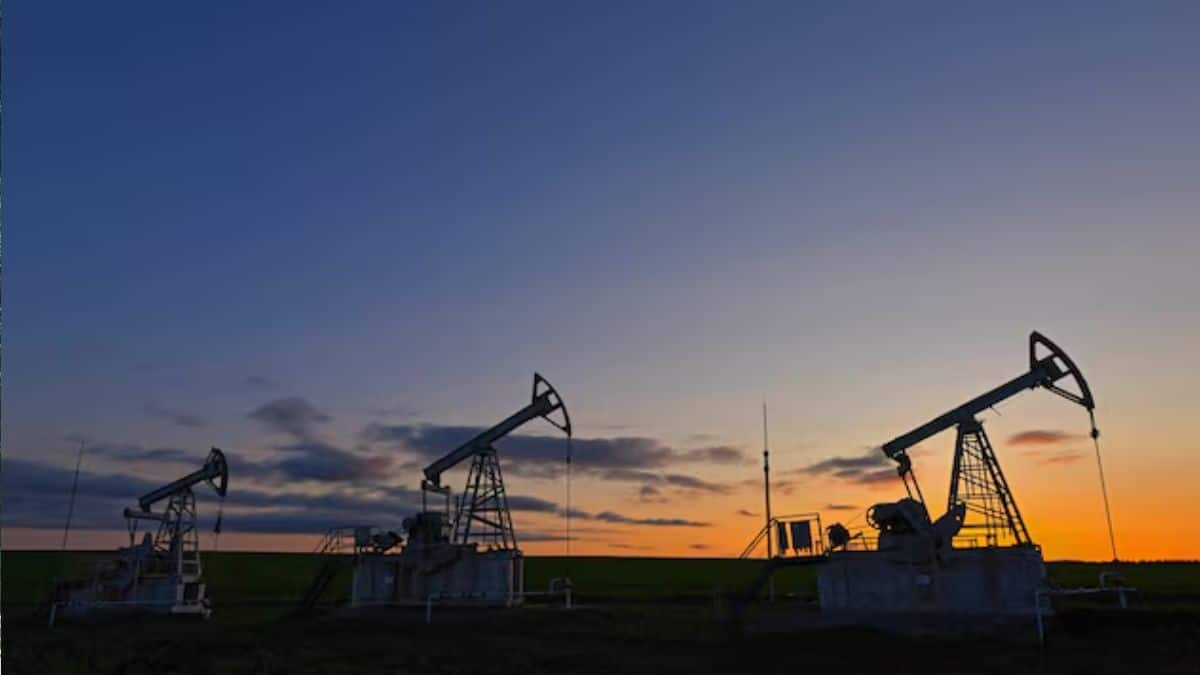
The math of Indian governance changes the moment a barrel of Brent crude crosses the $90 threshold. When it hits $100, the spreadsheets in the North Block don't just shift—they bleed. Current projections indicate that sustained triple-digit oil prices could drain roughly ₹30,000 crore from the national exchequer every single month. This is not merely a budgetary fluctuation; it is a structural threat to India's fiscal deficit targets and the stability of the rupee. As Middle Eastern geopolitical friction escalates from skirmishes to potential systemic disruptions, India finds itself in a familiar, agonizing squeeze between domestic inflation and global volatility.
India imports over 85% of its crude oil requirements. This dependency makes the nation’s economy an involuntary passenger on the roller coaster of West Asian politics. When Brent crude surges, the government faces a binary choice that both leads to political or economic pain. They can either pass the cost to the consumer, sparking inflationary fires that hurt the common citizen, or they can absorb the blow by cutting excise duties, which creates a massive hole in the budget. At $100 a barrel, that hole becomes a canyon.
The Crushing Weight of Under Recoveries
The term "under-recovery" is a polite bureaucratic way of describing a financial disaster. It occurs when state-run Oil Marketing Companies (OMCs) sell fuel at prices lower than the international cost. While the government has technically deregulated petrol and diesel prices, the reality is far more controlled. During election cycles or periods of extreme volatility, prices at the pump remain frozen.
If the government mandates that OMCs hold prices steady while global crude sits at $100, the monthly loss of ₹30,000 crore isn't just a number on a page. It represents capital that cannot be spent on highways, semiconductors, or social safety nets. We are seeing a massive transfer of wealth from India's developmental future to the oil-producing nations of the OPEC+ bloc.
The ripple effect on the rupee is equally devastating. As oil prices climb, India's demand for dollars to pay for that oil increases. This puts downward pressure on the rupee. A weaker rupee, in turn, makes oil even more expensive to import. It is a feedback loop that the Reserve Bank of India (RBI) must fight by burning through foreign exchange reserves or raising interest rates, both of which stifle economic growth.
The Russian Discount Illusion
For the past two years, India managed to insulate itself from the worst of the global energy crisis by pivoting to discounted Russian crude. At its peak, Russian oil accounted for nearly 40% of India's imports, often coming in at $15 to $20 below the Brent benchmark. This was the "secret sauce" that kept Indian inflation manageable while the rest of the world struggled.
That cushion is evaporating.
Western sanctions are tightening around the "shadow fleet" of tankers that transport Russian oil. Concurrently, the discounts are narrowing as Russia finds more efficient ways to bypass the G7 price caps. India is now being forced back into the traditional Middle Eastern markets where prices are transparently high and non-negotiable. The safety net has been pulled away just as the tightrope is beginning to shake.
Geopolitical Chokepoints and the Strait of Hormuz
The current crisis in the Middle East is not just about the price of a barrel; it is about the security of the supply chain. Approximately one-fifth of the world’s total oil consumption passes through the Strait of Hormuz. If the conflict between regional powers escalates to the point of maritime blockades, the price of oil won't just hit $100—it could catapult to $130 or $150 in a matter of days.
India’s Strategic Petroleum Reserves (SPR) are a vital but insufficient defense. Current reserves can power the country for roughly nine days. While there are plans to expand this capacity, the infrastructure lags behind the urgency of the threat. In a true supply disruption, India would be forced to compete in a frantic global spot market, paying any price necessary to keep the lights on and the trucks moving.
The Fiscal Deficit Tightrope
The government has set a target to bring the fiscal deficit down to 4.5% of GDP by 2025-26. A sustained $100 oil price makes this target nearly impossible to achieve without drastic measures.
- Subsidy Bloat: Higher fuel prices lead to higher fertilizer costs, as natural gas is a primary feedstock. This necessitates a surge in fertilizer subsidies to protect the agricultural sector.
- Revenue Loss: If the government cuts excise duty to keep petrol prices stable, it loses a primary source of tax revenue.
- Capital Expenditure Cuts: To keep the deficit in check, the government often trims "Capex"—the very spending that drives long-term economic growth.
The Inflationary Tax on the Poor
Inflation in India is essentially a tax on the poor. When diesel prices rise, the cost of transporting vegetables, grains, and consumer goods rises in tandem. This is "imported inflation," and it is largely outside the control of domestic monetary policy. The RBI can raise the repo rate until the economy slows to a crawl, but that won't make a barrel of oil in Riyadh any cheaper.
The political stakes are just as high as the economic ones. High inflation is a historically reliable way to lose an election in India. This reality forces the government into short-term maneuvers—like price freezes—that create long-term structural debt. It is a cycle of crisis management that prevents the country from ever fully decoupling its destiny from the whims of oil ministers in distant capitals.
The Myth of Rapid Decarbonization
There is a frequent argument that India can "green" its way out of this crisis. While the expansion of solar and wind capacity is impressive, it does very little to solve the immediate oil problem. India’s transport sector, particularly heavy trucking and long-haul logistics, remains firmly tethered to diesel. Electric vehicle adoption in the passenger segment is growing, but it is a drop in the bucket compared to the millions of internal combustion engines added to the roads every year.
Hydrogen and biofuels are promising, but they are decades away from the scale required to replace crude oil. For the foreseeable future, India is a hydrocarbon-based economy. Denying this reality only makes the country more vulnerable when the next price spike hits.
The Institutional Failure of Energy Diplomacy
India has long attempted to use its status as a massive consumer to negotiate "Asian Premiums" out of existence. The logic was simple: as a major buyer, India should get better rates. Instead, the opposite has often happened, with Asian buyers paying more than their Western counterparts.
The failure to secure long-term, fixed-price contracts during the periods of low oil prices in 2020 and 2021 remains a glaring missed opportunity. By relying so heavily on the spot market and short-term deals, India has left itself exposed to every twitch of the geopolitical needle.
The ₹30,000 crore monthly bill is the price of that exposure. It is the cost of a nation that has grown its economy faster than its energy security. Until India can fundamentally shift its energy mix or secure its supply lines through more aggressive and creative diplomacy, it will remain a hostage to the $100 barrel.
Every time a drone flies over a refinery in the Middle East, the budget in New Delhi begins to crumble. The only way out is a brutal, honest reassessment of how the nation fuels its growth, starting with the admission that the current model is a ticking fiscal time bomb.
Examine the impact of current excise duty structures on state-level inflation metrics to see how the burden is being distributed across different regions of the country.