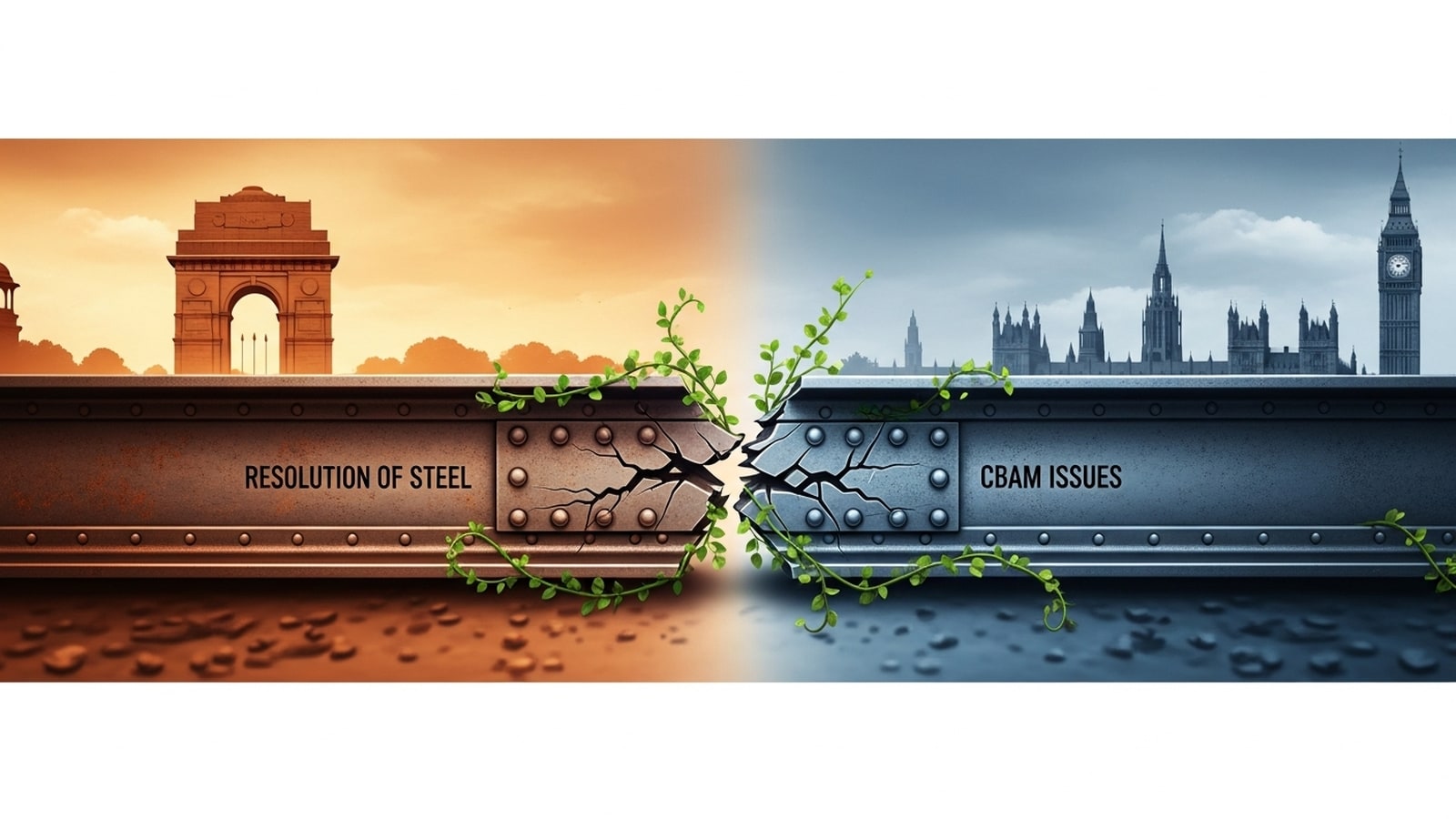
The financial press is currently regurgitating a comforting narrative: India and the United Kingdom are just a few rounds of talks away from a historic Free Trade Agreement (FTA). Bureaucrats whisper to reporters about "clarifying pending issues" like the UK’s carbon tax and India’s steel levies. They paint a picture of two nations carefully tuning a complex machine, preparing to press the start button once the final nuts and bolts are tightened.
It is a fantasy. Read more on a similar subject: this related article.
The belief that the India-UK FTA is delayed merely by technicalities like the Carbon Border Adjustment Mechanism (CBAM) or reciprocal steel tariffs misses the fundamental structural disconnect between these two economies. I have spent years analyzing trade flows and advising multinational firms on cross-border supply chains. If there is one thing I have learned from watching millions of dollars evaporate in poorly conceived market entries, it is this: trade deals do not stall because of line-item disputes. They stall because the core incentives of the negotiating parties are diametrically opposed.
The current talks are not a prelude to a breakthrough. They are a performative exercise in delaying the inevitable realization that this agreement, in any meaningful form, is dead on arrival. Further analysis by Business Insider delves into comparable views on the subject.
The CBAM Delusion: Why Carbon Taxes Are Not a Negotiating Chip
Mainstream coverage treats the UK’s upcoming carbon border tax as a hurdle that negotiators can leap over with enough diplomatic goodwill. The prevailing assumption is that India can extract an exemption for its steel and aluminum exporters, or that the UK will offer a transitional grace period to keep New Delhi happy.
This view ignores how modern trade policy actually functions.
The UK’s carbon tax framework is not a temporary political bargaining chip; it is an existential economic shield. As European nations and the UK enforce strict domestic net-zero mandates, their domestic heavy industries face soaring compliance costs. If British steel producers must pay a premium to operate cleanly, the government cannot allow cheap, high-emission steel from traditional Indian blast furnaces to undercut the domestic market. Doing so would trigger immediate industrial collapse at home.
Therefore, the UK cannot grant India a meaningful exemption without dismantling its entire domestic environmental and industrial strategy.
Let us look at the mechanics. Indian steel manufacturing relies heavily on coal-based energy pathways. The carbon intensity of Indian steel is significantly higher than the global average. Under any rigorous carbon border tax, Indian steel imports face steep penalties. To bypass this, some commentators suggest a dual-tariff system or preferential quotas.
Imagine a scenario where the UK creates a special loophole for Indian metal. Immediately, every other major trading partner—from the United States to Japan—would demand equal treatment under World Trade Organization (WTO) non-discrimination rules. The UK cannot bend the rules for New Delhi without breaking its commitments to the rest of the world. The carbon tax is not a friction point to be ironed out; it is an immovable wall.
The Visas For Tariffs Trap
The lazy consensus suggests a simple, transactional trade-off: India lowers its sky-high tariffs on British Scotch whisky and automobiles, and the UK relaxes its immigration rules to allow more Indian IT professionals and students easy entry.
This quid pro quo is completely unviable.
First, consider the UK domestic political landscape. No matter which political party holds power in Westminster, the overarching electoral mandate has consistently demanded a reduction in net migration. Promising a significant influx of foreign workers as part of a trade deal is political suicide for any British prime minister.
Second, the assumption that slashing India's 150% tariff on British whisky will create a massive economic windfall is based on flawed market analysis. While it is true that India is the world's largest consumer of whiskey, the vast majority of that consumption is low-cost, domestically produced molasses-based spirits. Lowering tariffs on premium Scotch will undoubtedly boost profits for a handful of multinational beverage conglomerates, but it will not shift the macroeconomic needle for the UK. It does not create manufacturing jobs in the British Midlands; it merely increases the margins on luxury consumption for India’s urban elite.
The UK wants deep access to India’s financial services, legal sectors, and digital economy. India wants physical mobility for its human capital. These two assets are fundamentally asymmetric. You cannot balance a trade ledger by exchanging a reduction in duties on physical cargo for the long-term migration of human beings.
Dismantling the Myth of Shared Interests
When looking at the queries surrounding these trade talks, the public constantly asks variations of: "How will the India-UK FTA boost GDP?" or "Which sectors will win the most?"
These questions assume a baseline compatibility that simply does not exist. The economic architectures of India and the UK are pushing in completely opposite directions.
- India’s Focus: New Delhi is aggressively pursuing import substitution and domestic manufacturing through initiatives like Production Linked Incentive (PLI) schemes. The goal is to build self-reliance, protect domestic industries from foreign competition, and create millions of factory jobs for a massive youth population.
- The UK’s Focus: London operates as a high-value services exporter and a consumption-driven economy. Its competitive advantage lies in intellectual property, life sciences, and high-end financial engineering.
An FTA requires one party to open its markets to the strengths of the other. For India, opening up its services sector to foreign firms threatens the growth of its domestic corporate giants. For the UK, opening up its agricultural or manufacturing sectors to lower-cost emerging market producers threatens its remaining domestic industrial base.
When you strip away the photo-ops and the joint communiqués, you are left with two protectionist impulses disguised as globalist ambitions. India wants to export goods and people while restricting service imports; the UK wants to export services and capital while restricting the movement of people and carbon-intensive goods.
The Cost of the Compromise
What happens when an unstoppable political desire for a headline meets an immovable economic reality? You get a hollowed-out agreement.
If a treaty is signed in the coming months, it will not be the comprehensive, sweeping economic partnership that was promised. Instead, it will be a watered-down, face-saving document that kicks every difficult decision down the road. They will carve out the carbon tax. They will exclude meaningful immigration reform. They will maintain complex rules of origin to protect sensitive domestic industries.
I have watched corporate boards plan entire five-year capital expenditure strategies based on the promise of impending FTAs, only to see those promises dissolve into a bureaucratic mess of regulatory compliance. Signing a weak agreement is often worse than signing no agreement at all. It creates a false sense of security, leading businesses to misallocate resources into markets that remain structurally hostile to foreign competition.
Stop waiting for a trade deal to unlock new market opportunities between London and New Delhi. The structural barriers are not bugs in the negotiation process; they are features of the modern global economy. If your business model depends on a historic reduction in tariffs or a sudden liberalization of cross-border services between these two nations, you need a new business model.
The deal is a ghost. Stop chasing it.