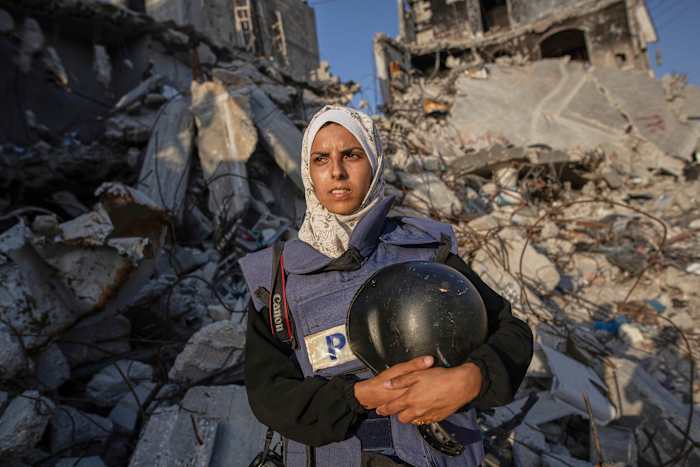
One year has passed since an Israeli strike tore through a hospital complex, leaving a trail of death that included journalists embedded in the medical zone. Twelve months of silence followed. No court has issued indictments. No independent military tribunal has published findings that satisfy international legal observers. No commander has faced public disciplinary action. This institutional paralysis is not an administrative oversight. It is a calculated structural vacuum designed to protect military operations from judicial friction.
When a press vest becomes a target rather than a shield, the calculus of modern conflict shifts. Reporters covering armed conflict rely on protected status under international humanitarian law. Article 79 of Additional Protocol I to the Geneva Conventions explicitly defines journalists as civilians, provided they take no action adversely affecting their status. Yet, when strikes hit medical facilities and media personnel simultaneously, the accountability mechanism breaks down before it even starts.
The Anatomy of Institutional Impunity
Military investigations into friendly fire or controversial strikes rarely produce external transparency. Armies investigate themselves. The internal review process functions as a closed loop. Evidence collected by field units is processed through legal departments whose primary duty is institutional defense rather than impartial discovery.
Consider the standard trajectory of an inquiry into a high-casualty strike in a dense urban theater. The initial response relies on operational secrecy. Communications are classified under the blanket of national security. Days blur into weeks. By the time preliminary findings emerge, public attention has fractured across new crises. The investigative momentum evaporates.
This pattern repeats across multiple jurisdictions and varied conflicts. Accountability requires external pressure, independent forensic reconstruction, and unhindered access to command logs. None of these elements are present in active war zones where access is restricted by military gatekeepers. International bodies like the International Criminal Court face severe jurisdictional hurdles, political vetoes, and a lack of physical enforcement mechanisms. Without boots on the ground to secure ballistic fragments, interview surviving witnesses, and subpoena operational orders, investigations remain toothless exercises in documentation.
Shifting Standards of Proof
The evidentiary threshold required to prove a war crime has grown exponentially higher in the digital age, yet paradoxically harder to enforce. Every strike generates a flood of open-source intelligence. Satellite imagery captures thermal signatures, crater depths, and structural collapse patterns within hours. Smartphone videos upload to social media platforms instantly, providing granular visual confirmation of casualties, uniforms, and equipment.
Despite this data deluge, military spokespersons maintain a standard of plausible deniability that easily deflects preliminary criticism. The standard defense invokes the presence of dual-use infrastructure or alleged combatant activity within proximity of protected zones. Under international law, a hospital or a press enclave can lose its protected status if used for military purposes, but the burden of proof rests on the attacking force to demonstrate effective advance warning and proportionality.
Proportionality remains the most elastic concept in operational law. How many civilian casualties are deemed acceptable to neutralize a mid-level tactical asset? Military lawyers calculate these equations behind closed doors, weighing collateral damage against military necessity. Without public access to those internal calculations, external watchdogs are left guessing at the variables used in the algorithm.
Independent media organizations have tried to fill the void. Collaborative investigations by forensic architecture groups and consortiums of journalists piece together radar data, weapon fragments, and trajectory analysis. They routinely demonstrate that claims of precise targeting or unavoidable collateral damage do not align with physical evidence. Still, forensic truth does not automatically translate into legal consequence. Prosecutors need intent, command responsibility, and a chain of custody for evidence that survives the friction of battlefield destruction.
The Chilling Effect on Frontline Reporting
The absence of accountability produces an immediate chilling effect on the information ecosystem. When journalists see their colleagues killed in areas designated as safe zones—such as hospitals, designated humanitarian corridors, or press tents—the risk calculation changes fundamentally.
Insurance premiums for hostile environment reporting skyrocket. Media outlets pull back foreign correspondents, increasingly relying on local freelancers who face compounded risks without institutional backing or evacuation guarantees. Local journalists bear the brunt of the mortality rate. They cannot catch a flight out when the front line shifts. They live inside the theater of operations twenty-four hours a day.
When those local reporters are silenced—whether through targeted strikes, indiscriminate bombardments, or intimidation—the window into human suffering narrows. Propaganda fills the vacuum. Official narratives from state actors and armed groups go unchallenged because the independent witnesses on the ground have been eliminated or driven underground.
The suppression of information serves a tactical purpose. Controlling the narrative is as vital to modern military doctrine as controlling territory. By raising the cost of independent verification, belligerents ensure that the story told is the one that serves their strategic interests.
Breaking the Cycle of Silence
Expecting military institutions to police their own conduct in the middle of an active campaign is a structural impossibility. True deterrence requires external mechanisms that bypass domestic political protections. Universal jurisdiction laws, specialized international tribunals, and economic sanctions targeted at units implicated in systemic violations offer theoretical pathways, but they lack consistent political will.
Governments that supply arms and diplomatic cover to offending states are complicit in maintaining the wall of impunity. As long as strategic alliances outweigh legal obligations under the Geneva Conventions, investigations will stall, reports will gather dust, and accountability will remain an empty promise.
The anniversary of a strike on a hospital housing journalists passes not with justice, but with a renewed warning to those who remain. The pen is only mightier than the sword if the hand holding it is permitted to survive.