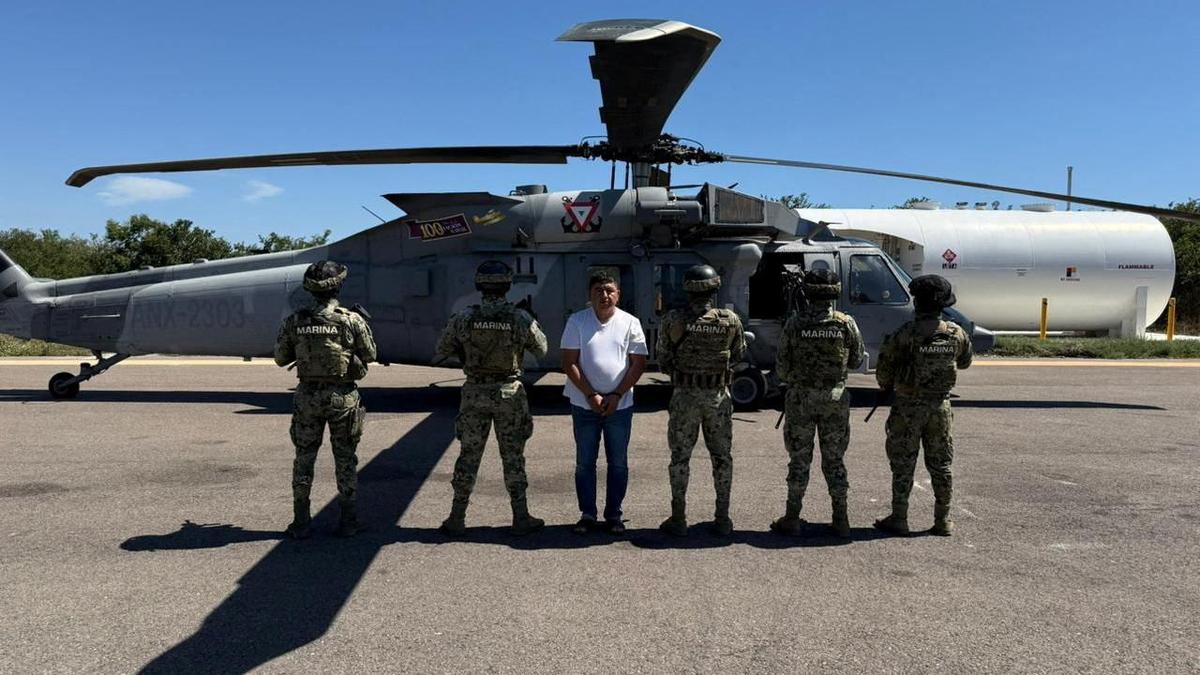
The sight of Audias Flores Silva, known as "El Jardinero," emerging from a dirt hole in the state of Nayarit is a tableau that defines the current era of Mexican security operations. For the average observer, the image of this high-ranking Jalisco New Generation Cartel commander being dragged into custody feels like a singular, decisive victory. It is a win for the Mexican military. It is a win for the U.S. intelligence apparatus that provided the coordinates. It is, by all outward metrics, a checkmark on a list of high-value targets that security forces have been pursuing for years. Yet, for those of us who have spent decades tracking the shifting power dynamics of transnational crime, this arrest serves as a reminder that the war against cartels remains a game of attrition that the state is fundamentally ill-equipped to win.
The capture of Flores Silva, coming only two months after the killing of Nemesio "El Mencho" Oseguera Cervantes, marks the most significant leadership vacuum in the history of the Jalisco New Generation Cartel. When Oseguera Cervantes died in the firefight in Tapalpa this past February, many analysts expected the organization to collapse under the weight of its own internal pressure. Instead, the cartel displayed a capability for coordinated, nationwide violence that stunned the political class in Mexico City. The burning of businesses, the blockading of highways, and the calculated targeting of infrastructure were not the actions of a dying entity. They were the muscle spasms of a massive, decentralized organism that does not require a single head to continue functioning.
To understand why the arrest of El Jardinero will likely fail to stabilize the country, one must first recognize the structure of the organization he served. Unlike the traditional, hierarchical cartels of the 1990s—where the fall of the boss meant the dissolution of the empire—the Jalisco New Generation Cartel operates more like a franchise. It is a collection of autonomous or semi-autonomous cells, each controlling specific trafficking corridors, laboratories, and extortion networks. These commanders do not report to a central office with a rigid chain of command. They pay tribute for the brand, the logistical support, and the protection it affords. If you remove the leader, the cell remains. If you remove the commander, the lieutenant steps into the gap. The drug trade in North America is driven by demand, and as long as that demand exists, the supply chain will adjust itself to fill the vacancy.
The current administration, led by President Claudia Sheinbaum, has pivoted sharply away from the non-confrontational security rhetoric that defined her predecessor’s term. There is a new, heavier hand at the wheel. The military deployment seen in Nayarit—involving reconnaissance aircraft, helicopters, and hundreds of troops—is the new standard. It is a show of force designed to project power and satisfy a domestic and international audience demanding results. However, this reliance on kinetic military operations comes with a hidden, mounting cost that the government is hesitant to acknowledge.
Every time the state opts for a high-profile raid, it invites an immediate, violent response from the cartel. When El Mencho fell, the death toll from the ensuing riots and retaliatory attacks reached seventy people, including members of the National Guard. These are not merely statistics; they represent the reality of what happens when a state attempts to decapitate a criminal entity without dismantling its financial and operational foundation. The cartel uses the state's own aggression to prove its continued relevance. By forcing the military to treat them as an existential threat that requires national guard deployments and aerial support, the cartel elevates its own profile. It demonstrates to the population that the government, for all its firepower, cannot guarantee safety on a city block, let alone across a state.
The involvement of U.S. intelligence in these operations adds another layer of complexity. Under the second Trump administration, the pressure on Mexico to show results has intensified. The U.S. government views these captures through a lens of extradition and interdiction, pushing for a "maximum pressure" approach that prioritizes the removal of leaders to slow the flow of fentanyl and other narcotics. This alignment creates a political incentive for the Mexican government to pursue these high-value targets, even if the strategic value of such arrests is questionable. It is a performance of security that satisfies short-term political needs in Washington and Mexico City, but ignores the long-term reality of the criminal infrastructure.
Look at the history of the last thirty years of the drug war. We saw the same cycle with the Medellín Cartel, the Cali Cartel, the Zetas, and the Sinaloa Cartel. In every instance, the removal of the top leader led to a period of increased violence as rivals scrambled to claim the territory. The vacuum creates a marketplace for chaos. With the death of El Mencho and the subsequent capture of El Jardinero, the Jalisco New Generation Cartel is now facing an internal reckoning. There are dozens of other commanders across the country who have their own armed wings and their own established routes. These figures do not necessarily answer to the same set of rules, and the lack of a clear successor who commands the respect of the entire network will almost certainly result in splintering.
The danger of this fragmentation cannot be overstated. A single, large cartel is predictable. It has a centralized set of interests and a known method of negotiating with the state. When that organization breaks apart, the resulting smaller groups are often far more volatile. They lack the resources to maintain long-term stability, so they resort to more aggressive extortion, kidnapping, and human trafficking to fund their existence. They are also less disciplined, meaning they are more likely to engage in conflicts that directly harm the civilian population. The government may have effectively neutralized two top figures, but in doing so, it may have traded a manageable predator for a dozen desperate, unpredictable ones.
Furthermore, the focus on the kingpin strategy ignores the evolution of the business model. Modern criminal networks are no longer solely dependent on trafficking narcotics across the border. They have diversified into extortion, fuel theft, agricultural control, and the infiltration of legal industries. When the military focuses its energy on the capture of a man in a ditch, they are not disrupting the local economy that the cartel has already captured. They are not addressing the corruption in local police forces that allow these groups to operate with impunity. They are not fixing the judicial system that sees the vast majority of crimes in Mexico go unsolved. Without addressing these systemic issues, the removal of one or two leaders is merely pruning the leaves of a weed while the roots remain firmly embedded in the soil.
There is also the question of the upcoming international events that Mexico is set to host. The pressure to secure the country, to present a facade of control, is driving the government to these aggressive, high-risk operations. The concern, however, is that this pressure forces the state to act prematurely. By rushing these operations to achieve a win before a deadline, the state risks failing to secure the intelligence or the logistical support necessary to truly cripple the network, instead settling for a dramatic arrest that provides a good photo opportunity but yields little tactical intelligence.
The military has become the primary instrument of state policy, and this shift has consequences that will resonate for years. When the armed forces are the only tool available to solve a social and criminal problem, the state inevitably begins to look more like the entity it is fighting. The lines blur between law enforcement, domestic intelligence, and military combat. The civilian institutions that are necessary for long-term stability—the courts, the police, the local governance structures—are bypassed or weakened. In the long run, this creates a situation where the state relies on the military not just for security, but for the basic administration of the country, a position that no democracy should ever find itself in.
The capture of El Jardinero is a testament to the tactical proficiency of Mexico's special forces. They planned the operation, tracked the target, and executed the arrest without a single casualty on their side. This is an undeniable professional achievement. But tactical proficiency is not the same as strategic success. The arrest has happened. The press conferences have been held. The U.S. ambassador has issued a statement of praise. But tonight, in Nayarit and across the vast, porous territory that the Jalisco cartel still claims, the machinery of the drug trade continues to hum.
The shipments of narcotics will continue to move across the border because the market demand is absolute. The local extortion schemes will continue because the local police are either compromised or outgunned. The cartel cells will continue to operate because they are incentivized by the enormous profits that the illicit trade provides. The state has removed a figurehead, but it has not removed the incentive structure that allowed that figurehead to rise in the first place.
As the government celebrates this latest arrest, the real questions remain unanswered. How long before another commander steps forward to take the place of El Jardinero? How will the state respond when the inevitable violence that follows this arrest reaches the border regions? And at what point does the cost of this military-led strategy outweigh the benefits? We have seen this film before, and we know how it ends. The music stops, the credits roll, and the actors change, but the script remains identical. The state continues to chase the leaders, and the cartels continue to evolve, adapt, and expand into the vacuum that the state inadvertently creates. True security will not be found in the capture of any single individual, no matter how high his bounty or how notorious his reputation. It will be found in the slow, grinding, and deeply unglamorous work of building institutions that can function in the absence of a strongman, whether that strongman is a president or a drug kingpin. Until that work begins in earnest, these arrests will remain nothing more than temporary disruptions in a business that has proven itself remarkably resilient to the intervention of the state.
The next few months will likely see a spike in violence, a predictable reaction to the loss of a major commander. The government will deploy more troops, more helicopters, and more surveillance to contain the fallout. The news cycle will move on to the next major headline. And in the mountains and the coastal towns, the new leadership of the cartel will begin the process of rebuilding, adjusting their logistics, and strengthening their grip on the territory. The state has won the battle, but the war, by its very design, continues without end. The cycle is self-perpetuating, and it is a reality that no amount of military success can mask.