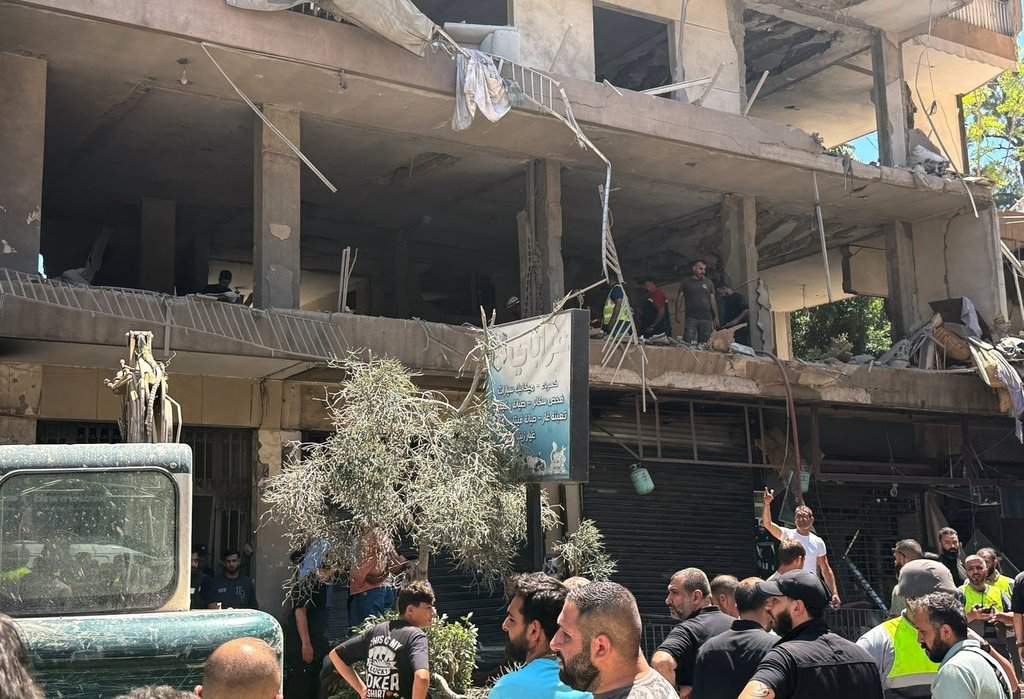
The televised narrative of an imminent, historic peace deal between Washington and Tehran collapsed under the weight of precision-guided munitions over Beirut. While global markets surged on the back of statements from Washington predicting the immediate reopening of the Strait of Hormuz, the smoke rising from the Ghobeiry neighborhood of Beirut’s southern suburbs revealed a far more complex geopolitical reality. The strikes, which killed three people and wounded six others in the Hezbollah stronghold known as Dahiyeh, were not a mere localized skirmish. They represent a fundamental structural flaw in the diplomatic architecture being built by international mediators.
The primary flaw is the assumption that regional conflicts can be settled through a grand bargain between superpowers while ignoring the tactical imperatives of the actors on the ground. Israel maintains that its strikes were a direct response to three suspected Hezbollah drones launched into northern territory earlier in the day. However, looking deeper into the strategic timelines reveals that these military actions are a calculated defiance of the diplomatic track.
For months, negotiators have attempted to separate the conflict into distinct operational files, treating the stabilization of Lebanon and the maritime security of the Persian Gulf as interconnected but ultimately negotiable chips. The reality on the ground resists this neat categorization. By striking the Lebanese capital at the precise moment a draft memorandum of understanding was nearing completion, Israel has effectively signaled that its core security doctrine cannot be vetoed by diplomatic arrangements made in Washington or Islamabad.
The Strategic Disconnect in the Grand Bargain
The proposed framework for the agreement relies on a two-stage stabilization process that looks seamless on paper but fails to account for structural realities on the ground. According to diplomatic briefers, the initial phase requires a comprehensive halt to hostilities across all fronts, the lifting of the maritime blockade, and the immediate resumption of international shipping through the Strait of Hormuz. The second phase is designed to tackle the technical details of Iran's nuclear program over a rigid sixty-day window.
Iran has consistently maintained that a total cessation of hostilities in Lebanon is a non-negotiable prerequisite for any broader agreement. This insistence is rooted in the survival of its primary proxy network. Hezbollah, despite losing significant infrastructure, command centers, and over a thousand fighters since the escalation began in March, remains the crown jewel of Iran’s forward-defense strategy. For Tehran, an agreement that leaves Hezbollah vulnerable to continued Israeli degradation while dismantling its own enriched uranium stockpiles is a strategic non-starter.
Conversely, the current leadership in Jerusalem operates under a completely different set of calculations. The Israeli defense establishment views the temporary lulls in fighting not as foundations for permanent peace, but as dangerous windows during which hostile forces can re-arm and reconstitute their capabilities. The collapse of previous ceasefire arrangements underscores this deep-seated institutional distrust.
The Operational Reality of the Dahiyeh Doctrine
To understand why the latest strikes occurred on the eve of a major diplomatic breakthrough, one must analyze the military philosophy driving Israeli decision-making. Far-right elements within the coalition cabinet explicitly framed the bombardment as a direct test of what is known as the Dahiyeh Doctrine. This strategy dictates the use of asymmetric, disproportionate force against civilian and paramilitary infrastructure in hostile territory to create a level of deterrence that outweighs any perceived benefits of insurgent cross-border fire.
- Enforcement of Red Lines: The current Israeli military posture establishes that any projectile fire directed at northern Israeli communities will result in immediate, high-impact retaliation against command centers in the heart of Beirut.
- Decoupling from Washington: By launching operations despite explicit requests from international allies to spare the Lebanese capital, the Israeli military leadership demonstrates that it will prioritize local defense objectives over global diplomatic timelines.
- The Litani River Objective: The strategic ambition extends far beyond simple deterrence. Ground operations involving five military divisions have focused heavily on cutting off southern Lebanon from the rest of the country by destroying critical transit infrastructure, with the ultimate goal of permanently pushing hostile forces north of the Litani River.
This operational reality means that while diplomats discuss the fine print of sanction relief and the unfreezing of assets, the physical map of the region is being violently redrawn. The destruction of logistics networks, financial institutions linked to insurgent financing, and civilian transport hubs creates a long-term humanitarian and strategic vacuum that cannot be easily remedied by a signed piece of paper.
The Shipping Toll Illusion
A major selling point of the proposed agreement publicized by international leaders is the immediate normalization of global energy corridors. The war has effectively paralyzed oil and natural gas shipments from the Persian Gulf, sending shockwaves through the global economy. The promise of an open Strait of Hormuz is the primary carrot being used to bring Western powers to the table.
Yet, the technical readouts of the memorandum of understanding expose a massive disconnect in how this opening is defined. Iranian officials have publically stated that while they will allow safe passage for civilian vessels, they intend to implement a system of "service fees" for ships transiting the strait. This administrative rebranding is viewed by Western maritime authorities as an attempt to institutionalize a state-sponsored protection racket under the guise of sovereign channel management.
"The strait is under Iranian and Omani sovereignty, and both countries will collect fees after the memorandum of understanding." — Senior Iranian diplomatic readout.
This position directly contradicts the stated objective of international mediators, who have repeatedly insisted that the strait must remain completely free, open, and clear of any unilateral Iranian oversight or taxation. The existence of such a fundamental disagreement on the primary economic driver of the peace deal shows how fragile the current diplomatic framework truly is. It suggests that even if an initial signature is secured, the technical-level talks scheduled to follow are highly likely to stall on basic issues of international law and maritime freedom.
The Fragility of a Sixty Day Window
The structural core of the agreement—the sixty-day period dedicated to addressing the nuclear issue—is built on a foundation of profound strategic ambiguity. The plan envisions the systematic removal or down-blending of highly enriched uranium currently entombed under heavily damaged nuclear facilities.
This process presents extraordinary technical and verification challenges. A senior administration official briefing reporters on the condition of anonymity admitted that the precise international mechanisms required to oversee, secure, and transport this material have not yet been agreed upon. Sixty days is an exceptionally brief period to execute some of the most complex disarmament procedures in modern history, especially when both sides retain an intense level of mutual suspicion.
Iran is highly motivated to front-load the economic benefits of the deal. By demanding early access to frozen assets and an immediate easing of the economic blockade during the initial phase, Tehran seeks to maximize its financial recovery before the difficult negotiations over its nuclear infrastructure even begin. If Iran successfully secures these economic concessions early in the process, the leverage held by Western negotiators during the subsequent nuclear talks will be severely diminished. This reality has not escaped the attention of decision-makers in Jerusalem, who view the phased structure of the deal as a tactical maneuver by Iran to buy time, rebuild its economy, and protect its regional proxy networks from further degradation.
The sudden strikes on Beirut are a symptom of a deeper, systemic failure to align the political desires of international leaders with the non-negotiable security requirements of the states and factions holding the weapons. Until the structural realities of the Dahiyeh Doctrine and the unyielding security calculations of the regional actors are directly addressed, any diplomatic document signed on the global stage will remain a temporary pause rather than a permanent settlement.