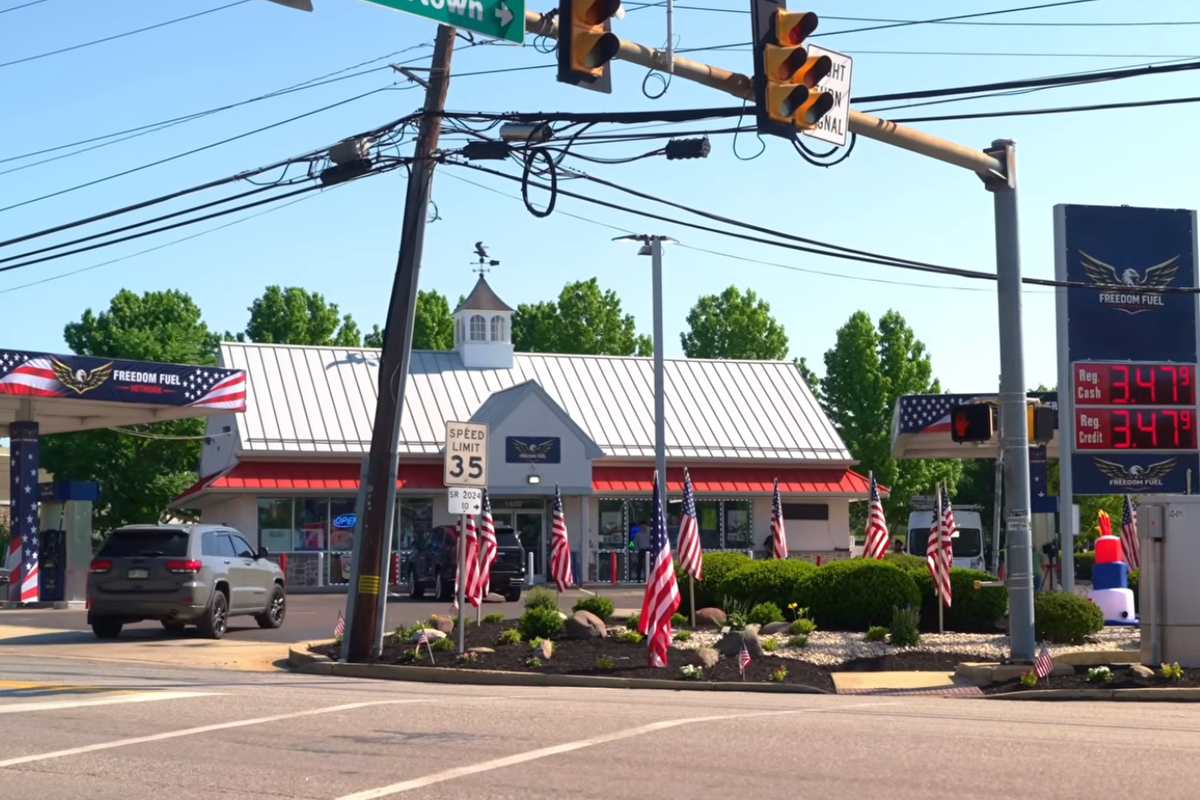
The White House rollout of the nation's first Freedom Fuel station in Philadelphia, offering gasoline at $3.47 a gallon, was engineered to be a populist victory lap. Social media accounts broadcasted footage of drivers thanking the administration for providing financial relief at the pump. The specific price point, $3.47, serves as an explicit homage to the nation's 47th president. Yet, beneath the political theater lies a stark economic reality. When the current administration took office, the national average for a gallon of regular gasoline sat at $2.99. Celebrating a price that is nearly fifty cents higher than the baseline inherited less than two years ago reveals the deep friction between political optics and structural economics.
The disconnect highlights a broader tension in modern political communication, where symbolic gestures are deployed to mask stubborn macroeconomic trends. While a price of $3.47 offers minor, localized relief against Pennsylvania’s current state average of $3.98, it represents an artificial oasis rather than a systemic cure. The administration's attempts to claim credit for temporary dips in highly volatile commodity markets ignore the global supply chains and geopolitical factors that truly dictate what consumers pay to fill their tanks.
The Disconnect Between Optics and Analytics
The Freedom Fuel network operates as a private entity encompassing roughly two dozen stations across Pennsylvania and New Jersey. White House officials have clarified that the administration does not directly subsidize or maintain financial stakes in these locations. Instead, the lower price point is achieved through independent operators voluntarily compressing their profit margins to hit the target figure.
This mechanism exposes the fundamental limitation of the initiative. A handful of regional gas stations absorbing lower margins cannot alter the underlying cost of crude oil, which drives roughly half of the retail price of gasoline. The remaining costs are dictated by refining expenses, distribution logistics, and state taxes.
- Crude Oil Costs: Driven entirely by global supply, demand, and OPEC decisions.
- Refining Margins: Subject to domestic refinery capacity and seasonal maintenance shutdowns.
- Taxes and Logistics: Fixed overheads that local station branding cannot influence.
By framing a localized, low-margin business strategy as a direct presidential achievement, the rollout relies on a short-term memory of energy costs. A real-world look at retail fuel prices over the last two years underscores this shift.
| Timeframe | National Average Price per Gallon |
|---|---|
| Inauguration Day | $2.99 |
| Current National Average | $3.85 |
| Freedom Fuel Promotional Price | $3.47 |
Geopolitics Trumps Policy at the Pump
Domestic policy measures rarely possess the immediate leverage over fuel prices that political rhetoric suggests. Recent history illustrates that regional instability and trade route disruptions dictate retail costs far more effectively than executive messaging. The upward trajectory of domestic gas prices over the past year is rooted firmly in ongoing tensions surrounding the Strait of Hormuz, which have repeatedly choked global oil supplies and forced domestic refiners to pay a premium for crude inputs.
When shipping lanes are threatened or global production targets are cut, the impact on domestic pumps is almost immediate. The administration's recent legislative and diplomatic efforts cannot easily override these macroeconomic forces. Consequently, using a single regional station to signal a victory over inflation ignores the broader, unyielding realities of the global energy market.
Independent franchise operators who adopt the promotional branding are experimenting with volume over margin. They hope that undercutting nearby competitors will drive enough foot traffic into their attached convenience stores—where profit margins are significantly higher than those on fuel—to offset the losses sustained at the pump. It is a classic retail strategy repackaged as national energy policy.
The ultimate trajectory of consumer fuel costs will not be decided by promotional rollouts or symbolic pricing structures. It will be determined in oil production facilities, global shipping corridors, and international diplomatic chambers. Until those structural pressures ease, a localized discount remains a calculated exception to a costly rule.