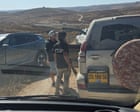
The dust in the South Hebron hills does not settle; it hangs in the air, a fine, chalky grit that coats the throat and blurs the horizon. On a blistering Wednesday afternoon in the West Bank, that dust tasted like iron.
Inside a rented van, a delegation of Americans sat watching the dirt road ahead dissolve into a blockade of flesh, steel, and unyielding hostility. Outside, the village of Khirbet Zanuta lay in ruins. The school was shattered. The homes were hollowed out, abandoned by Palestinian families who had fled after a succession of midnight raids. It was a monument to erasure, and the Americans had come to document it. You might also find this connected coverage useful: The Illusion of the Hormuz Truce and the Certainty of War.
Instead, they became part of the scenery.
A group of young men, barely out of their teens, blocked the path. They wore civilian clothes, but they carried American-made M4 assault rifles. Their faces were fixed with the terrifying grin of absolute impunity. They began kicking the tires of the van. They laughed, whipped out smartphones, and filmed the passengers, mocking them in a language of pure dominance. As extensively documented in recent articles by NPR, the effects are significant.
Among those trapped inside was Ro Khanna. He is not merely a traveler; he is a sitting United States Congressman from California, an elected official representing Silicon Valley, a man accustomed to the quiet deference of Capitol Hill corridors.
Powerlessness is a foreign concept when you carry a blue diplomatic passport. Until it isn't.
For twenty minutes, the group sat in the sweltering heat, listening to the thud of boots against their vehicle. The psychological weight of an assault rifle pointed at your windshield changes the geometry of a room, even a vehicular one. The adrenaline spike was sharp. The fear was real.
Then came the relief. Or so they thought.
Four Israeli soldiers, clad in the official uniform of the Israel Defense Forces, materialized through the haze. In any standard geopolitical playbook, the arrival of a state military means the restoration of order, especially when an ally’s statesman is involved.
But the playbook in the West Bank has different rules.
The soldiers did not disperse the armed civilians. They did not demand to know why American citizens were being held against their will on a public road. Instead, they walked over to the settlers, chatted with a familiar warmth, and turned toward the van. They told the delegation’s translator a cold truth: they were on the side of the settlers.
The soldiers moved to assist the blockade. A journey meant to last minutes stretched into a ninety-minute captivity. The state and the vigilante had merged into a singular, impenetrable wall.
When the news broke days later, the official institutional machinery did what it always does. It flattened the terror into bureaucratic prose. The IDF issued a statement claiming its troops were dispatched to the scene, "quickly dispersed" the civilians, and reopened the road, explicitly denying that its soldiers participated in the detention.
The congressman did not mince words on American television. The IDF is lying.
The word "lying" is heavy when leveled by a member of the House Armed Services Committee against a major recipient of US military aid. It shatters the carefully curated veneer of strategic partnership. It forces a deeply uncomfortable question into the open: who actually commands authority in the occupied territories?
To understand the friction of that ninety-minute standoff, one must look at the quiet architecture of the occupation. Nadav Weiman, an Israeli veteran and director of the human rights organization Breaking the Silence, was there in the dust with Khanna. He watched the hierarchy flip in real-time. He approached the soldiers, expecting them to leverage their legal authority to clear the road. Instead, he watched the twenty-year-old settlers give the orders, and the soldiers obey.
It is a microcosm of a much larger, systemic inversion. The line between the official military apparatus and the extremist settler movement has become so porous it is practically invisible. The weapons held by the teenagers mocking a US congressman are purchased with the very tax dollars Khanna votes on in Washington. The irony is bitter, heavy, and impossible to ignore.
The fallout was immediate, predictable, and ugly. On Sunday talk shows, Israeli Ambassador Michael Leiter bypassed the substance of the video evidence entirely. He reframed the harrowing detention as a calculated political stunt, an elaborate theater designed to distract from domestic political scandals or to launch a whispered 2028 presidential bid.
But political theater rarely involves the visceral terror of wondering if a young man with a hair-trigger asset is going to pull it.
Consider the broader landscape that this incident uncovers. Just days after Khanna’s vehicle was released—an escape bought only through frantic, high-level calls to the American Embassy in Jerusalem—a crew of international journalists from CNN was ambushed in a neighboring village by settlers wielding wooden clubs, metal rods, and knives. Their windshields were smashed into spiderweb patterns.
The violence is not sporadic. It is a calculated, daily pressure cooker.
When the news cycle moves on, the true resonance of Khanna's ordeal remains. It is not about the political fortunes of a progressive Democrat from California. It is about the profound asymmetry of survival.
If a member of the world’s most powerful legislative body can be held at gunpoint, mocked, and effectively trapped by a handful of teenagers backed by state soldiers, the protective armor of western privilege is an illusion. The American passport, usually an unassailable shield, proved useless against the raw arrogance of unchecked power in the hills of Hebron.
Khanna left the territory with a chilling realization that he shared with the public upon his return. He felt the crushing weight of total vulnerability for an hour and a half, backed by the knowledge that the entire apparatus of the US government was just a phone call away.
The true horror belongs to those who live there permanently. It belongs to the families of Khirbet Zanuta, who look down the barrel of those same M4 rifles every single night, without a smartphone, without an embassy to call, and without anyone listening when the soldiers side with the men holding the guns.