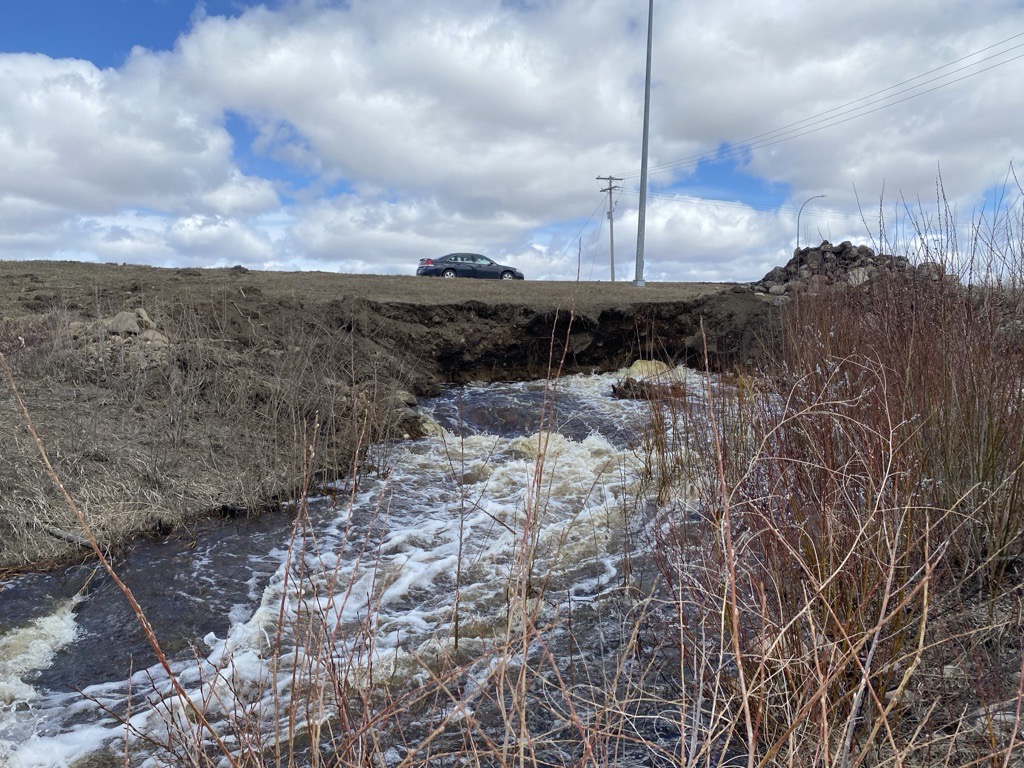
The closure of primary arterial highways in Saskatchewan due to spring runoff is not a weather event; it is a predictable failure of the province’s culvert-heavy hydraulic architecture when faced with rapid thermal transitions. When snowpack melts faster than the underlying soil can thaw, the resulting overland flow exceeds the design capacity of traditional drainage systems, transforming secondary roadbeds into unintended dams. The subsequent structural compromise of these highways follows a distinct mechanical progression: saturation, pore-pressure elevation, and eventual embankment failure. Managing this crisis requires shifting from reactive maintenance to a data-driven model of drainage resilience and logistical rerouting.
The Thermal Lag Bottleneck
The primary driver of highway closures in the Canadian Prairies is the delta between atmospheric temperature and soil frost depth. In a standard spring melt, if the air temperature rises rapidly while the ground remains frozen (concrete frost), 100% of the melt becomes surface runoff because the infiltration capacity of the soil is effectively zero.
Saskatchewan’s highway network relies on a vast inventory of corrugated metal pipes (CMPs) and reinforced concrete pipes (RCPs). These systems fail during high-velocity runoff due to three specific mechanical triggers:
- Orifice Flow Limitation: When the water level at the inlet exceeds the diameter of the culvert, the system shifts from open-channel flow to pressure flow. This creates a vortex at the intake, which can scour the surrounding soil and cause the road shoulder to collapse.
- Ice Jam Occlusion: Residual ice within the culvert barrel creates a physical blockage. Even a 20% reduction in cross-sectional area can lead to a 50% decrease in flow efficiency, forcing water to back up and eventually overtop the road surface.
- Hydrostatic Pressure Differential: When water pools on one side of a highway embankment but cannot pass through, the pressure differential forces moisture into the road’s sub-grade. This reduces the effective stress of the soil, leading to "soft spots" or full washouts once heavy freight vehicles apply load.
Structural Integrity and the Saturation Curve
Roadway failure during flooding is rarely instantaneous. It is a function of the saturation curve within the aggregate base. Saskatchewan highways are typically engineered with a sub-base of compacted glacial till or gravel. These materials maintain high shear strength when dry or partially saturated.
However, as the water table rises through the road prism, the buoyancy effect reduces the effective weight of the soil particles. The resulting loss of friction makes the embankment susceptible to slope failure. Highway agencies often close roads preemptively not because the water is deep, but because the weight of a 63,500 kg B-train truck would shear the saturated sub-grade, causing permanent structural deformation that requires a full rebuild rather than a simple patch.
The Economic Cost Function of Detour Logistics
A highway closure in Saskatchewan is a disruption to the mid-continent supply chain. Because the province serves as a transit corridor for potash, grain, and energy equipment, a 100-kilometer detour carries a quantifiable cost calculated through the following variables:
- Fuel Burn Variance: Increased consumption due to stop-and-go movement on lower-tier grid roads not designed for high-speed freight.
- Asset Utilization Decay: For every hour a truck sits in a detour, the carrier loses roughly $120 to $150 in revenue-generating time.
- Infrastructure Degradation Transfer: When heavy traffic is diverted from a primary highway (designed for 500+ daily ESALs - Equivalent Single Axle Loads) to a rural municipality grid road (designed for <50 ESALs), the secondary road suffers years of wear in a matter of days.
The total economic friction is the sum of these variables. When Highway 1 or other major arteries face restrictions, the regional economy experiences a temporary but sharp contraction in logistics efficiency.
Drainage Resilience Framework
To move beyond the cycle of seasonal washouts, Saskatchewan’s infrastructure strategy must evolve toward "Hydraulic Oversizing." This framework assumes that historical 1-in-50-year flood events are no longer accurate benchmarks for culvert sizing.
The Three Pillars of Drainage Hardening
- Upsizing to High-Density Polyethylene (HDPE): Replacing aging metal culverts with smooth-walled HDPE improves flow coefficients ($n$ values). A lower Manning’s $n$ allows more water to pass through the same diameter pipe with less resistance.
- Rip-Rap Armor and Headwall Stabilization: Many Saskatchewan washouts occur because the soil around the pipe inlet is unprotected. Installing large-diameter rock (rip-rap) and concrete headwalls prevents the "piping" effect, where water erodes a path along the outside of the culvert barrel.
- Real-Time Hydrographic Monitoring: Deploying ultrasonic water-level sensors at critical culvert locations allows the Ministry of Highways to identify rising water levels before overtopping occurs. This enables proactive steaming (using high-pressure steam to clear ice jams) rather than reactive road rebuilding.
Logistics Optimization During Inundation
When a stretch of highway is decommissioned by water, the immediate tactical priority is the preservation of the remaining network. This requires a tiered response:
- Load Restriction Implementation: Imposing weight limits on vulnerable detours prevents the total destruction of the gravel road network.
- Strategic Staging: Positioning emergency repair crews and aggregate stockpiles at "high-probability" washout zones based on topographical low points identified via LiDAR mapping.
- Dynamic Routing Communication: Moving beyond static "Road Closed" signs to integrated GPS data feeds that alert freight dispatchers to closures in real-time, preventing bottlenecks at the point of failure.
The systemic reliance on thin-surface highways in rural areas creates a permanent risk profile. The transition from frozen to liquid states in the Prairie spring is a mechanical stress test that the current infrastructure is frequently failing. Resilience is not found in faster repair crews, but in a fundamental reassessment of culvert diameters and embankment permeability.
Immediate operational priority must be given to the thermal clearing of culverts in the 72 hours preceding a forecasted temperature spike. Using historical washout data, crews should prioritize south-facing slopes and areas with high snow-to-drainage ratios. Long-term capital expenditure must shift toward replacing CMPs with larger-bore concrete box culverts at every intersection of primary freight routes and Class 1 watercourses. This is the only path to decoupling Saskatchewan’s logistical stability from the volatility of the spring melt.