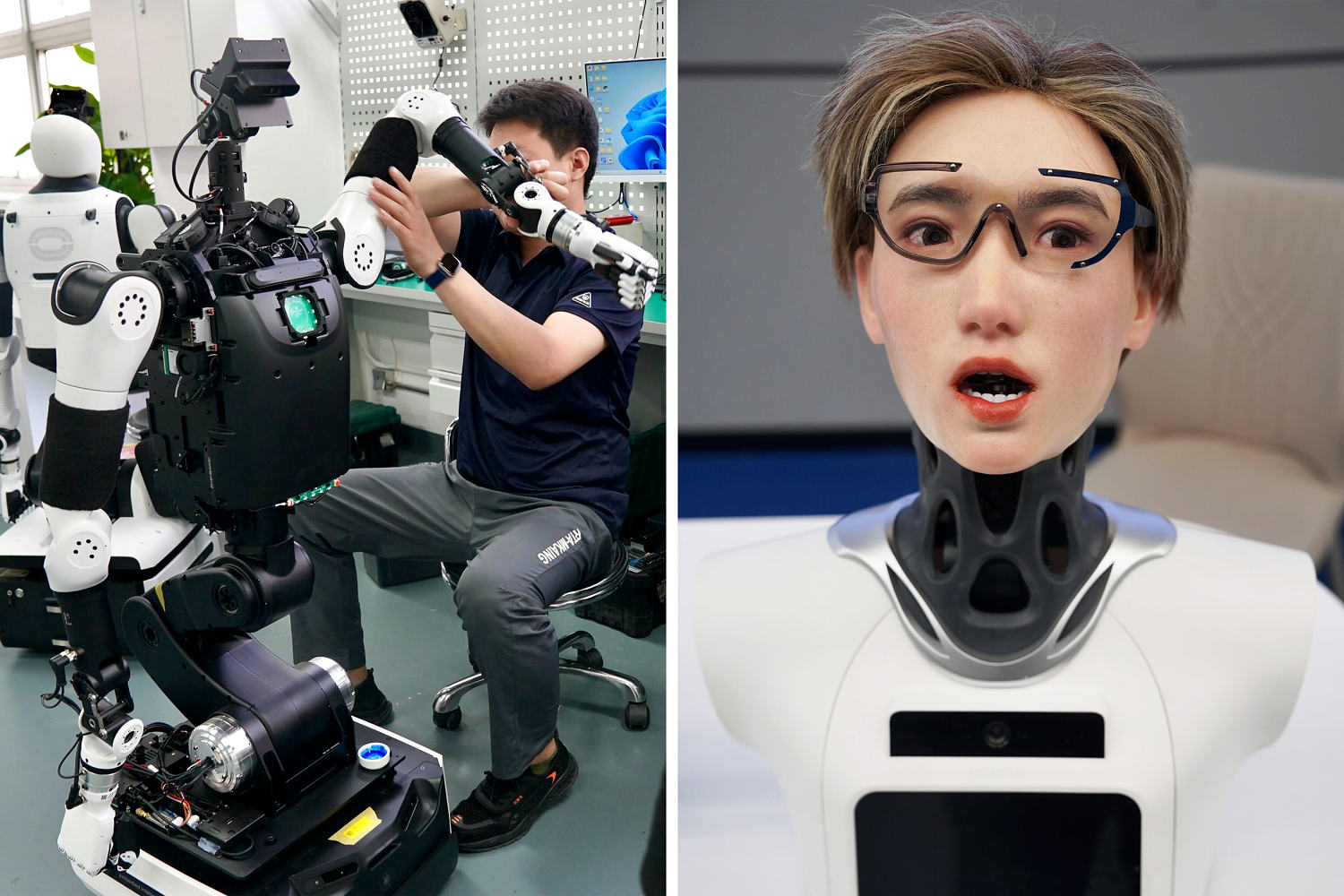
China shipped roughly 90 percent of the world’s humanoid robots in 2025, but the metric hiding behind that dominance is a stark warning. Only 23 percent of surveyed enterprise buyers report being satisfied with the hardware they purchased. The commercial market is choked with over 150 domestic companies chasing a domestic delivery pool that amounted to just 14,000 units last year.
What looks from the outside like an absolute monopoly is actually a volatile structural bubble. It is fueled by a one-trillion-yuan state fund, hyper-aggressive capital markets, and a local mandate to assemble hardware first and ask questions about utility later. While American firms like Figure AI command astronomical private valuations on low-volume, software-first deployments, Chinese manufacturers have industrialized the humanoid form factor before perfecting the brain. The result is a massive gap between production capacity and genuine commercial utility.
The Mirage of Peak Production
Walk through the robotics industrial parks of Shenzhen or Beijing and the manufacturing velocity is undeniable. Automated assembly lines can turn out a completed bipedal robot every 30 minutes. In 2025 alone, Chinese firms rolled out more than 300 distinct humanoid models. This explosion was catalyzed by the Ministry of Industry and Information Technology issuing standardized guidelines for embodied intelligence, turning cities into localized incubators with free land, heavy subsidies, and open testing environments.
The economics driving this hardware rush are brutal and volume-dependent. Unitree Robotics recently filed for a $608 million initial public offering on Shanghai’s STAR market, aiming for a valuation up to $7 billion. Its humanoid sales surpassed its legacy quadruped business for the first time, helping the company hit total revenues of roughly 1.71 billion yuan. Concurrently, AgiBot is pursuing a $6 billion listing in Hong Kong.
Yet, these multi-billion-dollar valuations rest on shaky ground. The units leaving the factory floor are not going into consumer homes or working shifts on third-party automotive lines. A significant portion of the recorded volume is being bought internally by the manufacturers themselves, or by state-aligned consortiums, for "training, verification, and environmental simulation." They are filling ghost factories. The hardware exists, but the paying customer base does not.
Rugged Hardware vs. Cognitive Deficiency
The physical execution of these machines is impressive. Chinese engineering has successfully solved structural problems that western developers have spent decades over-analyzing.
- Thermal Regulation: Integrated liquid cooling systems now prevent CPU and GPU throttling during high-intensity industrial labor.
- Power Continuity: Dual modular battery bays allow for a ten-second hot-swap, theoretically enabling 24/7 continuous cycles.
- Tactile Density: Hands like the OmniHand 3 Lite feature over 96 pressure contact points, permitting a 0.05mm manipulation accuracy capable of handling fragile glass and electronics components.
But these physical triumphs mask a fundamental software deficit. The hardware is rugged, cheap, and ready; the intelligence is not. A two-hour battery life means nothing if the robot spends ninety minutes processing how to identify a misaligned bolt on a moving conveyor belt.
American developers have largely treated humanoids as an artificial intelligence challenge wrapped in carbon fiber. Chinese firms have treated them as an automotive manufacturing challenge that happens to have legs.
While a Unitree G1 can be purchased for a staggeringly low $21,600, its out-of-the-box utility is limited to basic developer environments. It requires extensive programming to perform tasks that a human worker coordinates intuitively. The low cost opens doors for university laboratories worldwide, but it does not solve the high-stakes deployment realities of an industrial assembly line.
+-------------------+-----------------------+-----------------------+
| Metric            | Chinese Ecosystem     | Western Ecosystem     |
+-------------------+-----------------------+-----------------------+
| Base Unit Cost    | $5,900 - $45,000      | $150,000+             |
| Primary Bottleneck| General Intelligence  | Supply Chain Scaling  |
| Subsidy Vector    | Direct Infrastructure | Venture Capital       |
| Manufacturing Focus| Mass Assembly Volume  | Bespoke Pilot Program |
+-------------------+-----------------------+-----------------------+
The Looming Demographic Collision
The state-driven pressure to force these robots into the economy is not born out of pure technological vanity. It is a race against a collapsing demographic curve. China’s manufacturing core is aging out, and the younger generation is actively rejecting repetitive factory labor. Policymakers view the humanoid robot as a direct substitute for the missing human hand.
This forced march has triggered serious domestic pushback. At the National People’s Congress, labor and social security experts voiced severe warnings. Replacing humans with mechanical labor at this scale threatens to gut social security contributions, which are anchored to human payrolls. Proposals have already emerged from domestic AI leaders to establish specialized unemployment insurance programs funded by robotics taxes to support human workers displaced by automated machinery.
The immediate bottleneck is not the social consequence, but the sheer lack of economic justification. For a Tier 1 manufacturer, deploying an array of humanoids requires an upfront infrastructure overhaul. The floor must be calibrated, the local wireless networks must be hardened against latency, and a team of specialized engineers must be hired just to supervise the fleet. When those hidden operational expenses are factored in, a human worker or a traditional, single-purpose robotic arm remains significantly more cost-effective.
The Pivot to Care and Service
Recognizing the industrial bottleneck, several prominent players are shifting their strategies toward softer targets. Fourier Intelligence, which spent a decade developing medical rehabilitation systems, has repositioned its pipeline around the GR-3 Care-Bot. Rather than competing for heavy automotive assembly contracts, they are targeting healthcare facilities, eldercare, and public service venues.
This strategy leans heavily on complex degrees of freedom and full-body tactile sensing designed for safe human interaction. It avoids the rigid precision demands of precision manufacturing by focusing on compliance, mobility assistance, and basic logistical tasks in hospital corridors.
We are also seeing early international incursions. Unitree and UBTech recently initiated ground-handling tests at Tokyo’s Haneda Airport, taking over freight and logistics tasks.
It is a striking geopolitical reversal. Japan, home to legacy industrial giants like Fanuc and Yaskawa, long dominated the robotics landscape. However, Japanese manufacturers remained fiercely dedicated to traditional, stationary industrial arms. By treating the humanoid form factor as an impractical novelty, they left a vacuum in urban public service and commercial logistics. Chinese firms, backed by relentless state capital, stepped directly into that void.
An Imminent Market Correction
The National Development and Reform Commission has already begun issuing uncharacteristic public warnings about the sector, pointing directly to a massive capital bubble. The government sees the danger of 150 different entities building identical bipedal platforms with nowhere to sell them.
The upcoming listings for Unitree and AgiBot will serve as a referendum on the entire industry. If regulatory scrutiny forces a correction, the market will contract violently.
Survival will not depend on who can build the cheapest biped or who can make a prototype perform a martial arts routine for state television. The winners will be the select few companies that stop building for internal validation and figure out how to integrate their hardware seamlessly into existing industrial workflows. Until that software and integration gap is closed, the hundreds of new models appearing in trade shows are simply high-tech inventory waiting for a market that doesn't yet exist.