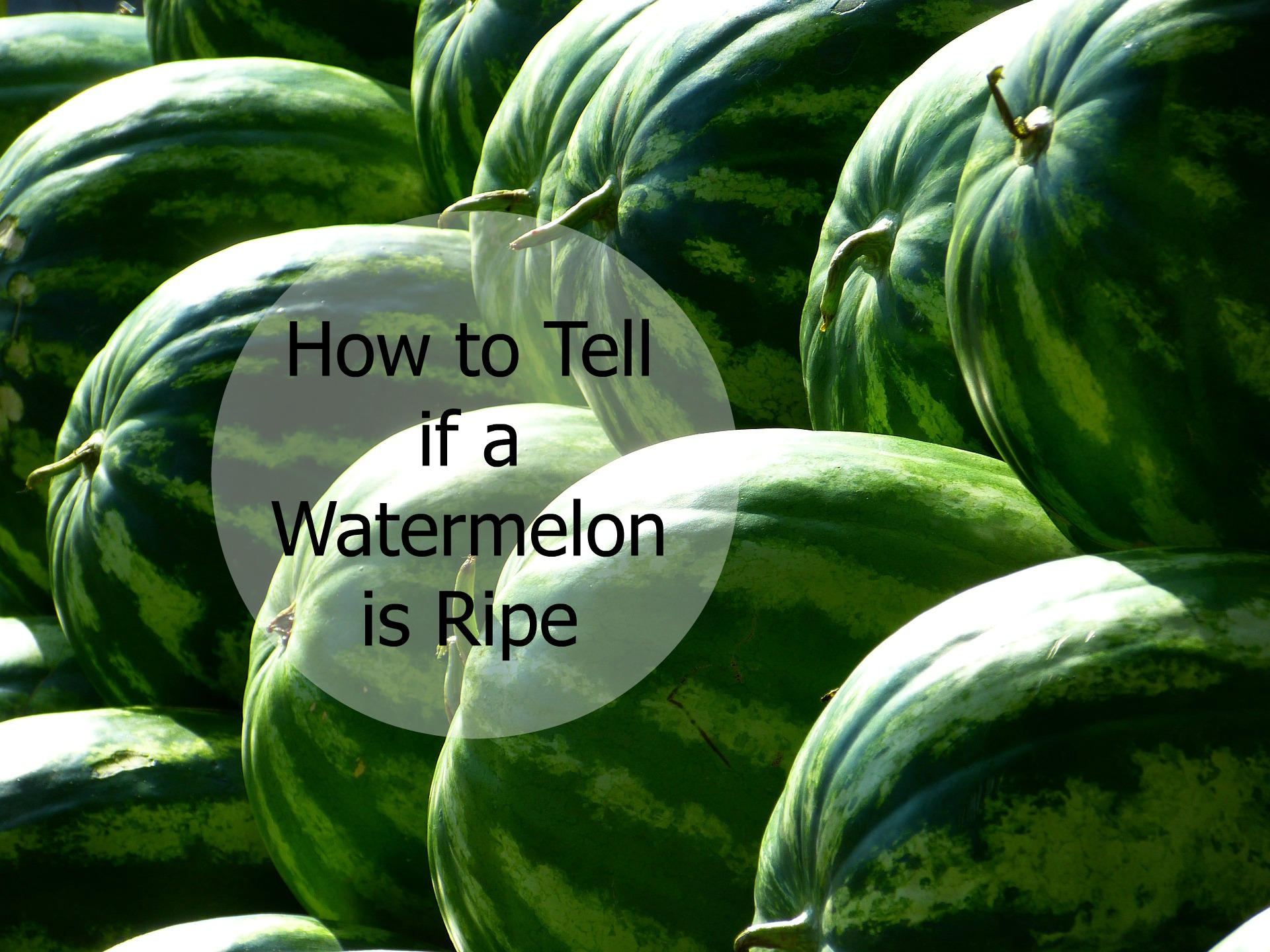
You’re standing in the middle of a grocery store produce aisle, staring at a giant bin of green spheres. It’s hot outside. You want that specific, sugary crunch that only a perfect summer melon provides. But here’s the problem: you’ve been burned before. We all have. You lug a ten-pound fruit home, slice it open with high hopes, and find a mealy, pale pink interior that tastes like crunchy water. It’s a tragedy. Honestly, learning how to tell if watermelon is ripe feels like a dark art, but it’s actually just physics and botany.
Farmers don't guess. They know exactly when the vine has finished its job. The trick is learning to see what they see. Most people just thump the thing and hope for the best, but sound is only one piece of a much larger puzzle.
The Yellow Belly Is Your Best Friend
Forget the "perfect" look. If a watermelon looks like it belongs in a cartoon—flawless, uniform green, no marks—it’s probably not ready. You want to see the "ground spot" or "field spot." This is the patch where the melon sat on the dirt, shielded from the sun.
If that spot is white or greenish-white, put it back. That fruit was picked too early. A white spot means the sugars haven't fully developed. What you’re hunting for is a creamy, buttery yellow. Some even call it "lemon-gold." That color is a biological signal that the watermelon spent enough time attached to the vine to convert its starches into fructose. According to the National Watermelon Promotion Board, this is the single most reliable indicator of internal ripeness.
But wait, there's more to the skin than just that yellow patch. Look for "bee stings." Have you ever seen those weird, brown, web-like patterns on the rind? They look like scars or dirt. A lot of shoppers avoid them because they want "pretty" fruit. That’s a mistake. Those webbed lines are actually "sugar scarring." They happen when bees pollinate the flower; the more pollination that occurred, the sweeter the fruit tends to be. It’s basically nature’s barcode for sugar content.
Weight, Density, and the Thump Myth
Pick it up. No, really, pick up three or four of them. A ripe watermelon is about 92% water. If it feels heavy for its size, that’s a great sign. It means the interior is dense and full of juice. If it feels light or hollow, the water has started to evaporate, which leads to that grainy, mealy texture nobody likes.
Then there’s the thump.
Everyone does it. Most people do it wrong. You aren't just hitting the fruit to look like you know what you’re doing. You are listening for a specific frequency. A dull, heavy "thud" usually means the melon is overripe and starting to turn to mush inside. A high-pitched "ping" or "tang" means it’s underripe and hard. You want a "tenor" sound—a hollow, ringing "spong" that vibrates back into your hand. If you feel the vibration in your opposite palm holding the melon, you’ve found a winner.
The Stem Tells the Truth
If you’re at a farmer's market, look at the tail. If the stem is still attached and looks green and fresh, the melon was likely harvested too soon. A green stem means the plant was still feeding the fruit when it was cut. Ideally, you want a stem that is dried out, brown, and brittle. This indicates that the watermelon reached its peak and the vine naturally started to disconnect. It "died" on the vine, which is exactly what you want for maximum sweetness.
Why Variety Matters More Than You Think
Not all watermelons are built the same. If you’re buying a Sugar Baby, those small, dark green personal melons, the ground spot might be less pronounced than on a massive Crimson Sweet or an Allsweet variety.
Then there's the whole "male vs. female" watermelon myth. You’ve probably seen the viral posts claiming "male" melons are tall and watery while "female" melons are round and sweet. Botanically speaking, that’s total nonsense. Watermelons come from a plant that has both male and female flowers on the same vine, but the fruit itself doesn't have a gender. The shape—round or oval—is determined by the variety and the consistency of watering during growth. Don't let a Facebook infographic trick you into thinking a round melon is inherently better than an oval one. Focus on the ground spot and the weight instead.
The Science of the "Internal Pressure"
When a watermelon ripens, the cell walls inside begin to change. Dr. Penelope Perkins-Veazie, a plant physiologist at North Carolina State University, has spent years studying the lycopene and sugar content in these fruits. Her research highlights that watermelons are non-climacteric.
That’s a fancy way of saying they don’t ripen after they are picked.
Unlike a banana or an avocado, which you can buy rock-hard and wait out, a watermelon is as sweet as it’s ever going to be the second it’s cut from the vine. If you buy a "dud," it will stay a dud until it rots. This is why knowing how to tell if watermelon is ripe before you leave the store is so vital. You can't fix a bad melon with time.
Shiny vs. Dull Rinds
If the watermelon is shiny, it’s a teenager. It’s still growing, still developing that waxy outer coating. You want a melon that has a duller look to the rind. A matte finish indicates that the fruit has finished its growth cycle. If it's reflecting the grocery store fluorecents like a mirror, keep looking.
What To Do Once You Get It Home
So you found the perfect one. It’s heavy, has a buttery yellow belly, a dry stem, and sounds like a drum. Now what?
- Don't refrigerate it immediately. If it's whole, keep it on the counter. Studies have shown that watermelons kept at room temperature actually continue to develop more antioxidants (like lycopene and beta-carotene) than those put straight into the fridge.
- Wash the rind. This is a safety thing. When you slide your knife through the rind, it drags any bacteria from the outside directly into the flesh. Give it a quick scrub first.
- The 5-day rule. Once you cut it, the clock starts. Keep it tightly wrapped or in an airtight container. It’ll stay crisp for about five days. After that, the cell walls collapse and it gets slimy.
Troubleshooting Common Problems
Sometimes you do everything right and still hit a snag. If you open a melon and see a giant crack in the middle—a "hollow heart"—don't panic. It’s not a disease. It’s usually caused by irregular pollination or weather shifts during the early growing stages. Interestingly, "hollow heart" melons are often the sweetest because the plant focused all its sugar into the center.
If the flesh is mealy, it’s likely overripe or was stored at temperatures that were too high. Watermelons are sensitive to ethylene gas (which apples and pears give off), so if you store your melon next to a bowl of ripening apples, it might go soft faster than you expect.
Actionable Steps for Your Next Trip
Next time you’re at the store, follow this specific flow to ensure you never bring home a boring melon again:
- Step 1: The Visual Scan. Ignore the shape. Look for the yellowest ground spot in the bin. If you see white, move on.
- Step 2: The Weight Test. Compare two melons of similar size. Pick the one that feels like a lead weight.
- Step 3: The Scratch Test (Optional). Use your thumbnail to lightly scrape the rind. If it's ripe, the green skin will come away easily, revealing a pale, yellowish-white underneath. If it's hard to scratch, it's underripe.
- Step 4: The Sound Check. Give it a firm rap with your knuckles. Listen for that hollow, reverberating "thump" rather than a solid, flat "clunk."
By shifting your focus from "how pretty is this fruit" to "how much did this fruit struggle on the vine," you'll start picking winners every single time. The best watermelons are the ones that look a little beat up, have a big yellow patch, and feel way heavier than they look. That is the secret to a perfect summer.
Storage Tip: If you end up with too much, don't throw it away. Cube the leftovers and freeze them. Frozen watermelon chunks are the perfect base for margaritas or smoothies, and the texture change from freezing doesn't matter once it's blended.
Safety Note: If the flesh of your watermelon feels slimy or has a sour, fermented smell when you cut it open, toss it. Watermelons can ferment inside the rind if they sit in the heat too long, and eating fermented fruit can lead to a very unpleasant afternoon.
Final Check: Look for the webbing. Those "bee stings" or brown lines are the ultimate "pro tip" that most shoppers ignore. They are the hallmark of a high-sugar melon. Combine that with a deep yellow field spot, and you are basically guaranteed a perfect slice.