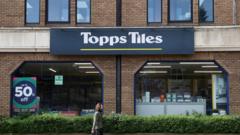
The air inside a DIY warehouse has a specific, chalky scent. It is the smell of ambition. It’s the dust of ceramic being scored by a diamond blade, the damp earthy musk of bags of adhesive, and the chemical promise of a fresh start. For decades, Topps Tiles has been the cathedral for the British weekend warrior. You walk in with a cracked bathroom floor and a sense of defeat; you walk out with a stack of "Antic White" porcelain and a vision of a better life.
But lately, that cathedral has grown quiet.
The news broke with the sterile precision of a financial ledger. Topps Tiles is closing 23 stores. To a city analyst, this is a "strategic rationalization." To a shareholder, it is a necessary pruning to protect the dividend. But to the person behind the counter in a quiet retail park in the Midlands, it is something else entirely. It is a ghost story.
Consider a hypothetical manager named Sarah. She has spent twelve years helping couples argue over shades of grey. She knows that "elephant breath" is different from "urban pebble," and she knows how to gently tell a first-time buyer that they are going to need more grout than they think. For Sarah, the store isn't just a unit of a PLC. It’s a community hub where she’s watched families grow from their first flat to their forever home.
When the lights go out on 23 of these locations, the silence carries.
The Gravity of the Invisible Penny
The retail industry is currently being crushed by a thousand tiny weights. It isn't one single catastrophe that closes a shop door; it is the relentless, compounding pressure of the everyday. Topps Tiles reported a pre-tax loss of £10.5 million, a staggering swing from the previous year’s profit. Why? Because the ground beneath our feet—the very thing they sell—has shifted.
Electricity prices aren't just numbers on a corporate bill. They are the reason the showroom feels a little dimmer. Business rates aren't abstract taxes; they are the high cost of existing in a physical space when the world is moving to a digital one. When the cost of keeping the heaters on exceeds the margin on a pallet of Victorian-style splashbacks, the math stops working.
Inflation is a thief that works in shadows. It doesn't just make the tiles more expensive to manufacture in Spain or Italy; it makes the petrol for the delivery truck more expensive. It makes the coffee the tiler buys on the way to the job more expensive. Eventually, the homeowner looks at their slightly chipped kitchen floor and decides they can live with it for another year.
Discretionary spending hasn't just slowed down. It has frozen.
The Psychology of the Unfinished Room
There is a profound emotional weight to a home improvement project. We don't tile a kitchen because we like ceramics; we do it because we want to feel in control of our environment. A renovation is an act of optimism. It’s a bet on the future.
When a major retailer like Topps Tiles retreats, it signals a broader withdrawal of that optimism. We are entering the era of "making do." The "don't move, improve" mantra of the early 2000s has been replaced by a more hesitant "don't move, don't touch anything."
The 23 stores being shuttered aren't just failing businesses. They are the casualties of a high-interest-rate environment that has squeezed the middle class until their knuckles are white. When mortgage payments jump by hundreds of pounds a month, the dream of a walk-in shower becomes a luxury that feels almost irresponsible.
The struggle is also internal. Topps Tiles has been locked in a bitter, public spat with one of its major shareholders. While the boardrooms were filled with arguments about "strategic direction" and "governance," the world outside was changing. Pure-line competitors—the lean, digital-first retailers who don't have to pay for 300 physical storefronts—have been nibbling at the edges of the empire.
It is the classic tragedy of the incumbent. You have the history, you have the expertise, but you also have the overhead.
The Weight of the Last Box
Walking through a closing store is a haunting experience. The discounts are heavy—30, 50, 70 percent off—but the atmosphere is light on joy. You see the gaps on the shelves where the popular lines used to be. You see the "Sold" stickers on display units that were never meant to be moved.
There is a specific kind of exhaustion in the eyes of the staff. They are the ones who have to answer the phone and tell long-time trade customers that their local branch won't be there next month. These tradespeople—the tilers, the plumbers, the builders—rely on these stores for more than just supplies. They are places for advice, for a quick tea, and for the physical tactile reassurance of seeing a product before you commit your reputation to it.
You cannot feel the texture of a hand-glazed tile through a smartphone screen. You cannot judge the true weight of a natural stone slab on a tablet.
The move toward "Topps Tiles Pro" and their digital expansion is a logical business pivot. It is smart. It is necessary. But it also represents the thinning of the human experience. We are trading the messy, dusty reality of the shop floor for the clinical efficiency of a warehouse delivery.
The Ripple in the Grout
When a store closes, the local economy feels it in ways that don't appear on a balance sheet. The sandwich shop next door loses twenty lunch orders a day. The delivery driver’s route becomes longer and less efficient. The retail park loses a reason for people to visit, leading to a slow, creeping decline that eventually claims the shoe shop and the electronics store.
Topps Tiles is still a market leader. They still hold a massive share of the UK sector. This isn't an obituary for the company, but it is a eulogy for a certain type of British retail experience.
The "rising costs" cited in the headlines are often treated as an act of God, like a storm or an earthquake. In reality, they are the result of a million tiny fractures in the global supply chain and the local economy. We are living through a correction. It is cold, it is calculated, and it is indifferent to the people wearing the branded aprons.
The real story isn't the number 23. It isn't even the £10.5 million loss.
The real story is the quiet that settles over a neighborhood when a landmark of "getting things done" disappears. It’s the realization that the era of easy credit and cheap home flips has been boarded up.
Someday soon, someone will walk past one of these empty units. They will see the faint outlines on the floor where the display racks used to stand. They might notice a single, stray spacer left in a corner or a dusting of grout on a windowsill. They will remember when this was a place where they planned a new beginning.
Now, it’s just a room with an echo.
The house is still standing, but the finish is gone.
The lights go out not with a bang, but with the soft click of a lock that won't be opened tomorrow morning.