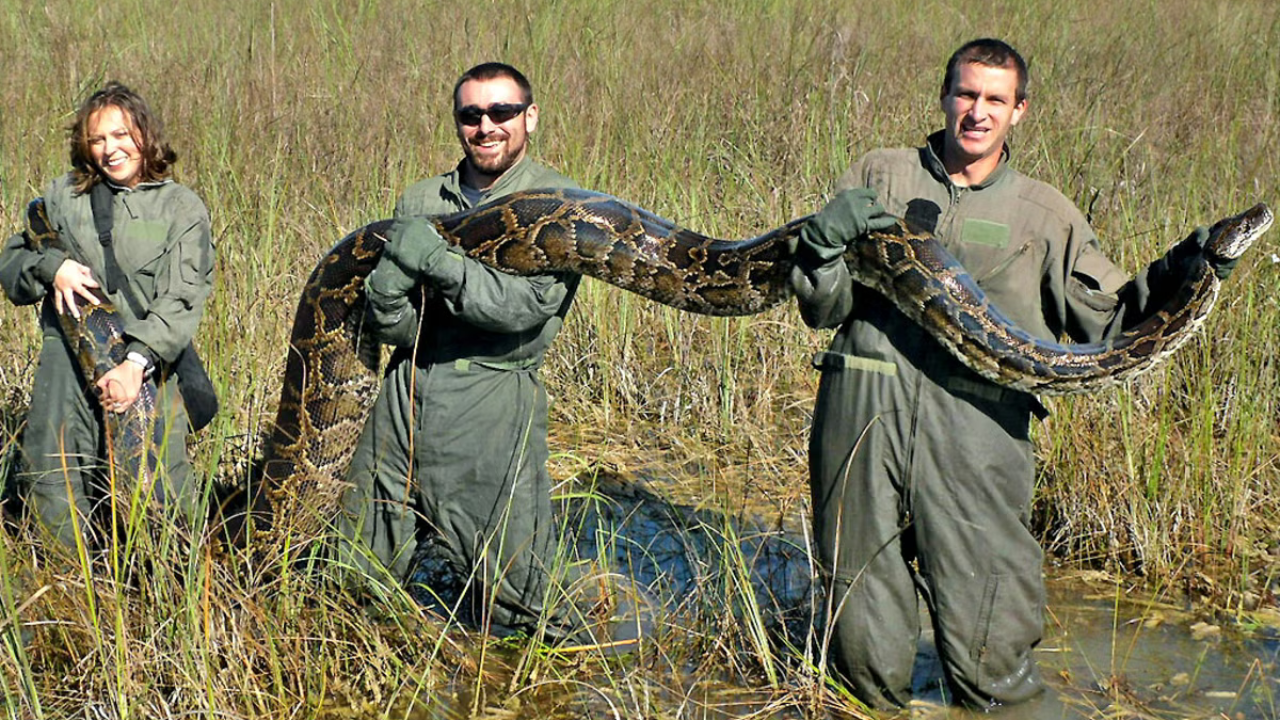
The humidity in the Florida Everglades does not just sit on your skin. It weighs you down, thick and smelling of decaying vegetation, brackish water, and the sharp, mineral tang of limestone. If you stand still long enough in the thigh-high sawgrass, the silence reveals itself as an illusion. You begin to hear the rustle of apple snails climbing the reeds, the sudden, wet slap of a gator’s tail half a mile away, and the steady, rhythmic drone of millions of mosquitoes.
For decades, the story of this wilderness has been told through a lens of loss.
We measured the collapse of the River of Grass by what was missing. We noted the eerie absence of marsh rabbits, the plummeting numbers of foxes, and the eerie, quiet nights where the calls of raccoons used to be constant. Everyone knew the culprit. The Burmese python, an apex predator introduced by the exotic pet trade and unleashed by hurricanes, had rewritten the food web. It was a simple, brutal equation: snake eats mammal, mammal disappears, ecosystem suffers.
But ecosystems are rarely simple. They are tangled, chaotic webs of unintended consequences.
A few months ago, I joined a research crew tracking a radiotagged female python deep within the marsh. The water was waist-deep, hiding jagged limestone shelves that can slice through a rubber boot in seconds. When we finally located the animal, she was coiled beneath a canopy of native bushes, nearly fifteen feet of muscle and patterned scales camouflaged perfectly against the mud. She was terrifyingly beautiful.
As the biologists secured the snake, my eyes drifted to the ground where she had been resting. There, scattered in the muck beneath her belly, were clusters of small, pale seeds. They had passed entirely through her digestive tract, intact and ready to grow.
That was the moment the old narrative dissolved. The invading monsters are no longer just consumers. They have become creators. They are planting the future of the Everglades, one mile at a time.
The Secret Gardeners of the Marsh
To understand why a snake eating a bird and pooping out a seed is a crisis, you have to understand how the Everglades builds itself. This is a landscape shaped by micro-topography. A difference of just a few inches in elevation determines whether a patch of land becomes a deep-water slough, a wet prairie, or a tree island.
Tree islands are the biodiversity crowns of the Everglades. These small, elevated hummocks of hard ground provide refuge for deer, nesting sites for wading birds, and a foothold for native trees like the strangler fig, the wild coffee, and the native persimmon. Historically, these plants relied on mammals and birds to spread their seeds. A raccoon would eat a native fruit, wander to a nearby ridge, deposit the seeds, and a new patch of forest would take root.
But the pythons ate the raccoons. They ate the opossums. They ate the marsh rabbits.
In large swaths of the southern Everglades, the mammalian seed-dispersal network was completely wiped out. Scientists worried that without these animals, the native forests would become stagnant, unable to march across the changing landscape or recover from fires and storms. The trees were stranded.
Then, the pythons stepped into the vacancy.
Consider the mechanics of a python's digestion. Unlike mammals, which process food within hours or days, a large constrictor operates on a glacial timeline. A fifteen-foot python can swallow a large bird or a small deer whole, then spend weeks digesting it. During that time, the snake doesn’t stay put. It swims through the deep sloughs, slithers across mudflats, and crawls up onto distant tree islands.
When the snake finally defecates, it may be miles away from where it took its last meal. And inside that waste are seeds that survived the journey.
Biologists analyzing python digestive tracts have discovered viable seeds from a variety of native plants, including the native persimmon and various species of wild berries. The snakes have accidentally adopted the ecological role of the very animals they drove to near-extinction. They have become the primary long-distance seed dispersers in the southern marsh.
The Distortion of the Forest
This is not a feel-good story about nature finding a way. It is a glimpse into a deeply distorted future.
When a raccoon disperses seeds, it behaves like a mammal. It stays within a relatively small home range, moving between known food sources and established shelters. It deposits seeds in predictable, localized patterns that have shaped the Everglades for thousands of years.
Pythons do not respect those boundaries. They move differently, live longer, and travel vast distances through deep water where a raccoon would never venture. By taking over the job of planting the forest, the pythons are changing where the trees grow. They are scattering seeds in random, unprecedented locations, effectively rewriting the botanical map of the wetland.
There is also the dark side of the menu. Pythons do not discriminate between native fruits and highly invasive weeds.
The Everglades is already locked in a desperate battle against invasive plants like the Brazilian pepper and the Old World climbing fern, which choke out native vegetation and turn complex habitats into impenetrable monocultures. These weeds produce millions of tiny, resilient seeds. When a python swallows a bird that has been feeding on invasive berries, the snake becomes a highly efficient vector for the spread of ecological disease.
The snake moves faster than our management strategies. It carries the seeds past the containment lines, past the fences, deep into the heart of the protected wilderness areas where humans cannot easily go.
The Weight of What We Cannot Fix
Walking back from the marsh that afternoon, the weight of the python in the crew's transport bag felt different. It wasn’t just the physical mass of the reptile; it was the realization of how deeply embedded these creatures have become in the machinery of the wild.
For years, the public narrative around python management has been framed as a war. We hold annual python challenges. We hire bounty hunters. We design specialized traps and deploy infrared cameras. We talk about eradication as if it is a goal just over the horizon, a matter of enough funding, enough boots on the ground, or the right technological breakthrough.
But standing in the mud, looking at those seeds, that wartime rhetoric felt hollow.
You cannot easily wage a war against an enemy that has woven itself into the very fabric of the soil. If we were somehow able to wave a magic wand and disappear every Burmese python from the state of Florida tomorrow, we would inherit a broken botanical engine. The mammals are gone, and the snakes are currently holding the keys to the forest's regeneration. We are caught in a trap of our own making, where the predator is both the destruction and the survival of the ecosystem.
The Everglades has always been a place of transformation, shaped by water, fire, and time. But the change happening right now is happening at hypersonic speed, driven by an animal that shouldn't be here, doing a job it was never meant to do.
The sun began to drop below the sawgrass line, turning the water into a sheet of liquid copper. A great blue heron rose from the shallows, its heavy wings catching the evening breeze as it flew toward a distant tree island. It was impossible not to wonder what seeds were traveling with it, what was waiting in the grass below, and what this landscape would look like when the trees planted by the snakes finally grow tall enough to block out the sun.


