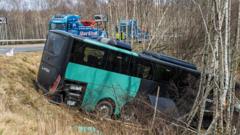
The headlines are predictable. A bus leaves a remote Highland road, two people go to the hospital, and the public outcry for "better infrastructure" begins like clockwork. We treat these incidents as failures of engineering or lapses in oversight. We demand more barriers, wider lanes, and a sanitization of the wild.
You are being sold a lie about safety that is destroying the very soul of the north.
The "lazy consensus" surrounding Highland road incidents suggests that every accident is a tragedy preventable by a fatter government budget. It assumes that "safe" equals "modernized." This mindset is not just wrong; it’s an existential threat to the geography of Scotland. When we sanitize the A82 or the A835 to meet the safety expectations of a suburban commuter, we don't just spend millions—we erase the necessity of driver agency.
The Paradox of Risk Compensation
Safety professionals often ignore a psychological reality called risk compensation, or the Peltzman Effect. Named after economist Sam Peltzman, the theory suggests that when you introduce safety measures—like massive steel barriers and wide, forgiving asphalt—drivers subconsciously adjust their behavior to maintain a specific level of perceived risk.
If you make a road feel like a motorway, people will drive like they are on a motorway. The Highland roads are dangerous precisely because they look dangerous. That visual threat is a feature, not a bug. It forces a level of hyper-vigilance that disappears the moment you install a million pounds of crash-rated fencing.
In the case of the recent Highlands bus crash, the immediate reaction focuses on the embankment. "Why wasn't there a barrier?" The more uncomfortable, more accurate question is: "Why was the driver in a position to need one?"
I have spent decades navigating these arteries. I have seen the "safety" upgrades firsthand. What actually happens is that the locals, who know the bends, speed up because they feel protected. The tourists, lulled into a false sense of security by the improved tarmac, stop paying attention to the weather. When the rain turns horizontal and the wind hits 60mph, that sense of security becomes a death trap.
Infrastructure is a False Idol
The Highlands are not a theme park. They are a complex, shifting environment where the geology literally tries to reclaim the road every winter.
Traditional reporting suggests that the "dangerous" nature of these roads is a flaw. It isn't. The narrowness, the steep drops, and the unpredictable camber are the only things keeping the average speed below lethal levels. If we "fix" the roads to the standards demanded by the vocal minority after every minor incident, we create high-speed corridors that invite high-speed fatalities.
Let’s look at the data the mainstream media ignores. According to Transport Scotland’s own historical statistics, a significant portion of "accidents" on rural routes involve single vehicles or local drivers who have become overconfident. The road didn't jump out and grab the bus. The environment provided a set of conditions that were ignored.
Imagine a scenario where we replace every Highland road with a straight, four-lane highway.
- The aesthetic value of the North Coast 500 vanishes.
- The speed of impact in the inevitable collisions triples.
- The maintenance cost bankrupts the local councils within a decade.
By demanding a "hospital-grade" road system in the wilderness, we are asking for the destruction of the wilderness.
The Tourism Industrial Complex
We have a bus problem, but it isn’t about the bus falling down a hill. It’s about the fact that we are cramming massive, 50-seater coaches onto single-track roads and 18th-century cattle paths.
The industry wants to maximize "throughput." They want to move as many bodies as possible from Inverness to Skye with minimal friction. This friction—the narrow turns, the necessity of reversing into passing places—is what keeps the ecosystem alive. When a coach crashes, we blame the road because blaming the scale of the vehicle would hurt the bottom line of the tour operators.
True safety isn't found in a budget increase for the Department of Transport. It is found in scaling down. Smaller vehicles, lower volumes, and a return to the understanding that driving in the Highlands is a skill, not a right.
Why Your "Safety First" Mentality is Flawed
People often ask: "Shouldn't we do everything possible to save a life?"
It sounds noble. It’s actually cowardly. "Everything possible" usually means turning the natural world into a padded cell. We see this in the way the media covers Highland travel. They treat every incident as an anomaly rather than an inherent risk of moving through a mountain range.
If you want zero risk, stay in the city.
The moment we prioritize absolute safety over the integrity of the landscape, we lose the Highlands. We get a series of bypasses that look like the outskirts of Slough. We lose the connection between the driver and the terrain.
The Cult of the Barrier
There is an obsession with crash barriers. To the layperson, a barrier is a life-saver. To an engineer, it’s a hazard. Barriers are rigid. They have "ends" that can spear vehicles. They require constant maintenance in a salty, wet environment where steel rots.
More importantly, barriers encourage the "ping-pong" effect. In a collision on a narrow road, a barrier can bounce a vehicle back into oncoming traffic rather than letting it dissipate energy in a controlled (albeit scary) slide down a peat bank.
The bus that went down the embankment near the Highlands didn't just "fall." It left the paved surface. The focus on the embankment is a distraction from the reality of vehicle weight and tire grip on Highland chip-seal surfaces.
Brutal Honesty for the Modern Traveler
We need to stop apologizing for our roads.
The "State of the Highlands" reports usually lament the potholes and the lack of dual carriageways. I argue that the potholes are the best speed bumps we have. They are organic, self-generating traffic calming measures. They demand respect.
If you cannot navigate a Highland road in its current state, you shouldn't be driving on it. This isn't elitism; it's a survival requirement. The "lazy consensus" wants to lower the bar so that the least capable driver can navigate the Quiraing at 50mph. That is a recipe for a massacre.
The Actionable Truth
If we actually cared about those two people in the hospital, we wouldn't be talking about steel and concrete. We would be talking about:
- Mandatory Highland Endorsements: Why do we allow people who have only ever driven on flat, gritted motorways to rent a motorhome and drive a cliffside pass in a gale?
- Vehicle Weight Limits: Hard caps on coach dimensions for specific routes. If the bus is too big for the road, the bus is the problem, not the road.
- Decentralized Rescue: Investing in the local mountain rescue and volunteer crews who actually handle these scenes, rather than pouring money into "consultancies" for road widening.
We have spent years trying to engineer the danger out of the Highlands. All we have managed to do is engineer the competence out of the drivers.
The bus crash isn't a signal to build more walls. It’s a reminder that the Highlands are indifferent to your travel plans. They are big, they are steep, and they are dangerous.
Stop trying to fix the road. Fix your expectations.
If you want the view, you have to accept the drop. Anything else is just suburban delusion dressed up as public safety. The Highlands don't need "improved" infrastructure; they need drivers who realize that they are guests in a landscape that doesn't owe them a safe arrival.
The road is fine. The bus is too big. Your fear is the only thing that needs an upgrade.
Respect the edge, or stay off the hill.