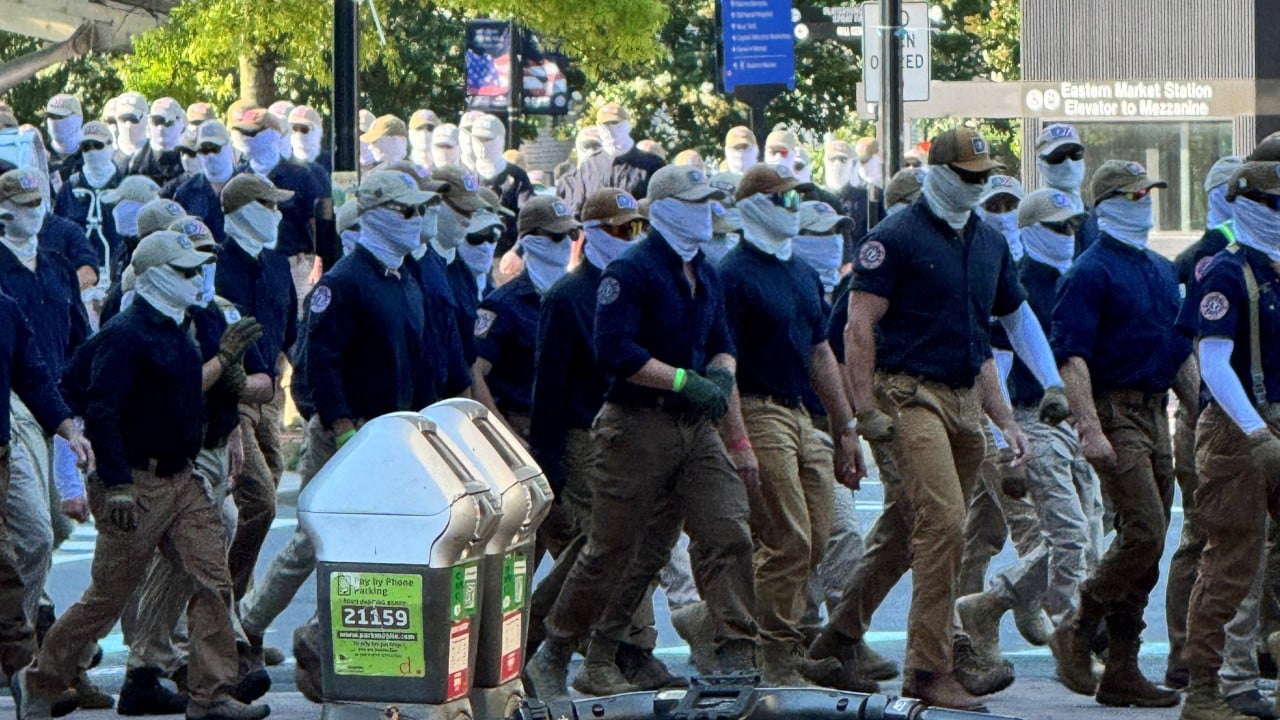
The heat on the National Mall in July does not just shimmer; it heavy-coats the back of your throat. It smells of baked asphalt, melting ice cream, and the exhaust of idling tour buses. On the Fourth of July, this strip of dirt and grass between the Lincoln Memorial and the Capitol becomes the nation’s front porch. Families unpack lawn chairs. Children wave tiny, plastic-stick flags. It is an exercise in collective belonging.
Then come the boots. You might also find this related coverage useful: The Real Reason Pakistan is Losing Control of Its Own Side of Kashmir.
They move in a synchronized, thudding cadence that instantly alters the air. Dozens of men, their faces obscured by white cloth masks, carrying shields and flags that feel stripped from a darker century, march past the monuments. To the families watching, the sudden intrusion feels like a physical blow. The immediate, human reaction is a demand for someone to stop it. We look to the authorities, the park rangers, the police, the government officials sitting in air-conditioned offices nearby, and we ask a simple question: How is this allowed on our nation's birthday?
When the United States Interior Secretary addressed this very question, the response was not the emotional condemnation many craved. It was a cold, unyielding recitation of constitutional law. The march, the secretary noted, counts as free speech. The government cannot deny a permit based on the ugliness of the ideology. As highlighted in recent articles by The Washington Post, the results are significant.
This is where the neat lines of legal textbooks collide violently with human emotion.
Consider a hypothetical onlooker named Marcus. He brought his teenage daughter to Washington to see the monuments, to connect her with the grand promises of the American story. Suddenly, he is forcing his body between her and a line of masked men chanting slogans designed to deny their very humanity. For Marcus, this is not an abstract debate about the First Amendment. It is a moment of acute vulnerability. His heart races. His palms sweat. The grand promises of freedom feel hollow when that same freedom protects the people who wish he did not exist.
The tension lies in the mechanics of the law itself. The Department of the Interior, through the National Park Service, manages the public spaces where these demonstrations occur. Their mandate is logistical, not moral. When an organization applies for a permit to march on the National Mall, the government is legally blindfolded. It cannot look at the group's website, shudder at their beliefs, and stamp the application "Denied."
If the state acquires the power to censor the ideas it finds abhorrent today, it gains the power to censor the ideas you hold dear tomorrow.
It is a agonizing equation. The Supreme Court has established for decades that speech cannot be restricted merely because it is offensive, hateful, or deeply unpopular. The threshold for intervention is incredibly high, requiring a direct incitement to imminent lawless action. A hateful march, no matter how repulsive, does not clear that bar simply by existing.
This reality leaves a bitter taste. It requires citizens to endure the sight of hatred parading through the symbolic heart of their democracy. The anger felt by those who witness these marches is not a misunderstanding of the law; it is a profound understanding of the human cost of that law.
But the real problem lies elsewhere, far from the legal briefs and administrative permits.
The true test of this system is not whether the government can tolerate the march, but whether the community can survive the psychological fractures it leaves behind. When the masked men pack up their banners and disappear back into the suburbs, the fear they planted remains in the soil. The success of their strategy relies on the silence that follows. They use the openness of the democratic system to broadcast a message of exclusion, relying on the very laws they despise to shield them from consequence.
The administrative defense of free speech can feel like a betrayal to those on the receiving end of hatred. It asks the marginalized to bear the weight of preserving a liberty that feels weaponized against them.
On the evening of the Fourth, after the chants have faded and the police lines have dispersed, the cleanup begins. Sweepers move across the grass, collecting the discarded soda cans and forgotten programs. The physical traces of the day are easily erased. The monuments stand unchanged, illuminated against the night sky, towering over the empty paths.
The sidewalk remains open to anyone who wishes to walk it tomorrow.