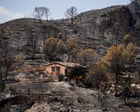
The air in the hills of Almería does not just warm you; it wraps around you like a heavy, dry blanket. For decades, this rugged corner of southern Spain has acted as a sanctuary for those seeking a slower, quieter existence. Retiring expats from across Europe bought old stone villas in villages like Bédar, drawn by the promise of endless blue skies, cheap red wine, and a climate that felt like a permanent embrace. They planted bougainvillea, learned to tolerate the midday siesta, and watched the sun dip behind the Sierra de Los Filabres mountains every evening.
But summer has changed. The sun is no longer just a welcoming host. Lately, it has begun to feel like an adversary.
On a Thursday evening in July, that dry heat transformed from a pleasant luxury into a roaring, living monster. Within hours, a fast-moving wildfire ripped through the scrubland and pine forests of Andalusia, leaving behind blackened earth, hollowed-out stone homes, and a devastating human toll. Thirteen people lost their lives in the hills. Twelve of them were foreigners who had come to the region to build their dream lives. Instead, they found themselves trapped in a terrifying, unfamiliar nightmare.
Among them were Pete and Fran Gillam.
The Sunset That Never Arrived
To understand how a dream curdles into a tragedy, you have to understand the geography of Almería. It is a dry, semi-arid terrain, dominated by steep ravines and vast stretches of esparto grass. When a heatwave hits, this vegetation does not just dry out; it becomes highly combustible tinder.
Fran Gillam was like many who settled in Bédar. She loved the peace of the village, the way the light hit the whitewashed walls in the late afternoon. On Thursday, as the smoke first began to plume over the distant ridges, she did what any parent would do. She reached for her phone. At around seven in the evening, she sent a brief text message to her daughter, Danielle Gillam-Kirton, back in the United Kingdom. They were preparing to evacuate, she wrote.
It was the last message Danielle would ever receive from her mother.
When the wind shifted, it did so with a sudden, violent force. In the Mediterranean, these winds can turn a manageable brush fire into an unstoppable firestorm in minutes. The flames did not creep; they leaped across canyons, swallowing roads and cutting off the tiny, winding paths that connect these mountain villages to the safety of the coastal highway.
For the families waiting in the UK, Belgium, and France, the hours that followed were defined by a agonizing silence. Calls went straight to voicemail. WhatsApp messages remained frozen with a single grey tick. In the age of instant communication, there is no greater terror than a screen that refuses to update.
The Fatal Instinct of Escape
When the fire descended on the outskirts of Bédar, panic took hold. It is a primal, human instinct to run when the air turns to ash. But in these rugged mountains, running is often the most dangerous choice you can make.
Emergency officials had issued clear instructions to residents in the path of the blaze: shelter in place. Inside a stone or concrete home, with wet towels under the doors and the shutters drawn, there is often a shield against the passing front of a wildfire. But the psychological toll of watching a wall of fire approach your sanctuary is immense. It requires a cold, unnatural discipline to stay inside a house while the world outside burns.
Several groups of residents decided they could not wait. They loaded their cars, threw their pets into the back seats, and fled into the smoke.
But the mountain roads of southern Spain are a maze of sharp bends, blind curves, and narrow passes. As the smoke thickened, turning the afternoon sky into a pitch-black midnight, drivers could no longer see the road ahead. Some abandoned their vehicles entirely, choosing to flee on foot through the steep, rocky terrain.
They ran directly into a trap.
Consider the layout of the Andalusian hills. Between the ridges run deep, dry riverbeds known as ramblas. For most of the year, they are dusty paths lined with dry reeds and scrub. To a panicked person fleeing a fire, a wide, open rambla looks like a natural escape route—a flat highway leading down to the valley floor.
It is a deadly illusion.
A dry riverbed acts as a chimney. When fire enters a ravine, the heat rising up the slopes sucks air from below, creating a powerful draft. The fire does not just burn down a rambla; it races through it with the speed of a freight train, fueled by the thick vegetation lining the banks.
"The decision to look for another way out through a ravine was a real trap," Antonio Sanz, Andalusia’s health and emergencies minister, would later explain to reporters.
Seven people who abandoned their cars and tried to walk out through the rugged terrain perished there. Another four were found inside a single car. When emergency workers finally reached the vehicle on the road leading out of Bédar, they immediately noticed something telling: the steering wheel was on the right side. It was a British car, registered to tourists or expats who had tried to drive to safety, only to be overtaken by the fast-moving wall of heat.
The Cold Weight of the Aftermath
By Friday morning, the immediate danger had passed, leaving behind a scarred, smoking wasteland. More than 3,200 hectares of forest and farmland lay in ruins. The picturesque village of Bédar was spared from total destruction by the heroic efforts of some 150 firefighters and over 200 military emergency soldiers, but the surrounding hills were unrecognizable.
Then came the grimmest task of all: identification.
The fire had been so intense, the heat so absolute, that physical identification of the victims was impossible. The regional president of Andalusia, Juan Manuel Moreno Bonilla, described the bodies as severely burned. To give the families closure, the Spanish Civil Guard had to set up a temporary center in the nearby coastal town of La Garrucha to collect DNA samples from grieving relatives who had rushed to the scene.
The final toll of the disaster reflects the deeply international character of this quiet corner of Spain. Of the thirteen victims, eight were women and five were men. Only one was a Spanish citizen. The rest were foreigners who had made Almería their home: seven Britons, three Belgians, one French citizen, and one American.
For Danielle Gillam-Kirton and her family, the agonizing days of searching and hoping ended in the worst possible way. Over the weekend, police confirmed that Pete and Fran Gillam had not survived the escape from Bédar.
"We are heartbroken," Danielle wrote in a public message, thanking those who had prayed for her parents during the days they were missing. Their story is a reminder that behind every dry statistic of a natural disaster is a lifetime of memories, a family shattered, and a dream of a peaceful retirement cut tragically short.
The New Reality of the Mediterranean
We often treat wildfires as sudden, unpredictable acts of God. But the tragedy in Almería is part of a much larger, predictable pattern.
Europe is currently warming at a rate twice as fast as the global average. The dry, hot winds that blow across the Mediterranean are no longer occasional seasonal anomalies; they are the new baseline. When we travel to these beautiful, sun-drenched corners of the world, we carry with us an expectation of safety that may no longer exist.
The mountains of Andalusia are beautiful precisely because they are wild and untamed. But that wildness comes with a cost. When the land is parched by successive heatwaves, the margin for error disappears. A single spark, perhaps from a fallen power line or a discarded cigarette, can trigger a disaster that defies comprehension.
For those who survive, the silence of the charred hillsides is deafening. The whitewashed houses of Bédar still stand against the blue sky, but the community has been permanently altered. The empty terraces, the quiet cafes, and the blackened scars on the ridges serve as a stark reminder of the day the sun turned on the paradise it had helped to build.