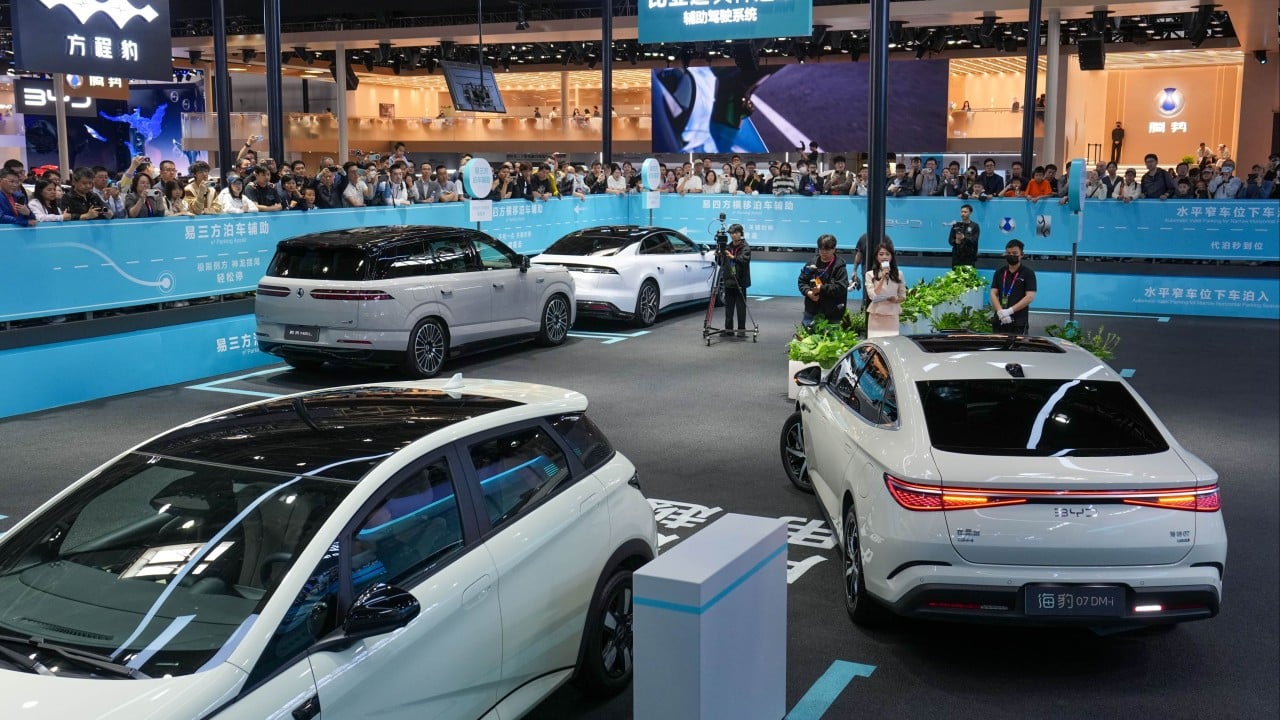
BYD recently signaled a shift that should rattle every supply chain manager from Shenzhen to Detroit. By raising prices on its high-end driving-assistance packages, the Chinese titan isn't just seeking better margins; it is reacting to a fundamental shift in how hardware costs dictate the future of transportation. For years, the narrative around Electric Vehicles (EVs) focused on battery chemistry and lithium prices. That was a distraction. The real bottleneck has moved into the dashboard and the trunk, where the skyrocketing cost of memory and high-performance computing is creating a new kind of "silicon tax" that threatens to make advanced driving features a luxury gatekept for the wealthy.
The math is simple and brutal. As cars transition from simple machines to mobile data centers, the demand for High Bandwidth Memory (HBM) and specialized storage has exploded. A modern Level 2+ or Level 3 autonomous system requires an immense amount of data throughput to process lidar, radar, and camera feeds in real-time. This isn't the cheap, commodity silicon found in a microwave. This is the same high-grade memory currently being sucked up by the artificial intelligence boom. BYD’s price hike is the first public admission that the automotive industry can no longer outbid Big Tech for the components it needs to survive. Meanwhile, you can find related developments here: Why Irans Shadow Banking Matters More Than the Headlines Say.
The Memory Squeeze Behind the Dashboard
Automakers are currently locked in a losing war with AI server farms. When companies like NVIDIA or AMD produce high-end chips, the memory required to make them functional—often DDR5 or HBM—is in finite supply. In the past, the automotive sector relied on older, "mature" nodes. Those days are gone. If you want a car to navigate a complex urban intersection without human intervention, you need the same processing power found in a high-end gaming PC or a mid-range server.
The price of this silicon has historically been a small fraction of the vehicle’s Bill of Materials (BOM). Now, it is becoming a dominant factor. When the cost of a memory module jumps by 20 or 30 percent due to global shortages, an automaker has two choices. They can eat the cost and watch their stock price crater, or they can pass it to the consumer. BYD chose the latter, and they won’t be the last. To explore the bigger picture, check out the recent article by CNBC.
Why Smartphones Are the Canary in the Coal Mine
The consumer electronics market felt this pressure first. We saw the "premiumization" of smartphones over the last three years, where base models stayed stagnant while "Pro" and "Ultra" versions climbed toward the $1,500 mark. That price gap was largely driven by the cost of high-capacity storage and RAM.
Automobiles are essentially giant smartphones with wheels, but with one critical difference: the safety requirements. A memory chip in a phone can fail, and you just reboot the device. A memory chip in a car’s braking system or vision stack cannot fail. This "automotive grade" requirement adds a layer of testing and validation that makes these chips even more expensive and harder to source than those found in a handheld device. When the baseline price for memory rises, the premium for automotive-grade silicon rises exponentially.
The Software Defined Vehicle Trap
Every major manufacturer is currently chasing the "Software Defined Vehicle" (SDV) dream. The idea is to sell a car at a slim margin and then reap high-margin subscription revenue for the next decade through software updates. It’s a brilliant business model on paper. In reality, it requires over-engineering the hardware on day one.
To sell a "Full Self-Driving" subscription in 2027, the car you build in 2025 must have the memory and processing overhead to handle software that hasn't been written yet. This creates a massive upfront hardware cost. If memory prices stay high, the "base" hardware becomes too expensive to give away for free. BYD’s price increase on its "God’s Eye" driving system proves that the industry is struggling to subsidize this future-proofing. They are realizing that you cannot sell a digital future using hardware that is priced like a rare earth metal.
The Hidden Cost of Redundancy
Safety isn't just about better code; it’s about redundant hardware. To reach higher levels of autonomy, cars often require twin systems running in parallel. That means double the memory. If a single vision-processing unit required 16GB of specialized RAM three years ago, a redundant, safe system today might require 64GB or more across multiple modules.
When you multiply that across a fleet of millions of vehicles, the numbers become staggering. We are looking at a scenario where the computing stack in a car could eventually rival the cost of the electric motor itself. This isn't a hypothetical problem. It is a structural wall that the industry is hitting at full speed.
Geopolitics and the Silicon Shield
There is a secondary layer to this crisis that most analysts are ignoring: the concentration of memory production. While China dominates the battery supply chain, the high-end memory market is controlled by a handful of players in South Korea, Taiwan, and the United States.
For a company like BYD, which prides itself on vertical integration, this is a glaring vulnerability. They can make their own batteries, their own motors, and even their own seats. But they cannot easily spin up a world-class semiconductor fab to produce high-bandwidth memory. This dependency creates a price floor that they cannot control. As trade tensions fluctuate and export controls tighten, the cost of the "brains" of the car becomes a geopolitical lever.
The Counter-Intuitive Shift to Less Tech
We may be entering an era of "hardware regression." For the last decade, the trend was to add more screens, more sensors, and more features. If the silicon tax continues to rise, expect to see a new class of "analog" EVs. These will be vehicles that prioritize range and basic transport over digital bells and whistles.
We are already seeing this in certain European and Japanese markets, where manufacturers are stripping back complex infotainment systems to keep the MSRP under control. The "iPad on wheels" aesthetic is losing its luster when the iPad alone adds $5,000 to the sticker price.
The Efficiency Myth
Engineers will tell you that software optimization can solve this. They claim that better algorithms can reduce the load on the hardware, allowing for cheaper chips. This is largely a fantasy in the context of autonomous driving. Neural networks, by their very nature, are data-hungry. You can optimize a spreadsheet, but you cannot "optimize" the massive amount of raw visual data required to identify a pedestrian in a rainstorm without significant memory buffers.
The reality is that as the AI models governing these cars get more "intelligent," they require more parameters, not fewer. More parameters require more memory. More memory costs more money. There is no magic trick to bypass the physical requirements of data processing.
The Impact on the Used Car Market
This hardware volatility creates a massive headache for resale values. If a 2024 BYD or Tesla has a hardware suite that is suddenly "under-specced" because the manufacturer couldn't afford enough RAM during a supply crunch, that car will depreciate faster than its better-equipped counterparts.
We are creating a fragmented secondary market where the "vintage" of the silicon matters more than the mileage on the odometer. This is a nightmare for traditional dealers and leasing companies who rely on predictable depreciation curves. If the hardware can't support the latest safety updates because it was built during a price spike, the car becomes a liability.
A Fork in the Road for Traditional OEMs
Legacy automakers like Ford, GM, and Volkswagen are watching BYD closely. They have spent billions trying to catch up to China’s EV lead. Now they find that even the leader is feeling the pinch. If BYD, with its massive scale and internal efficiencies, has to raise prices to cover technology costs, the traditional OEMs are in even deeper trouble. They don't have the same margins to play with.
These companies are now forced to decide: do they continue the "arms race" for high-end autonomy, or do they pivot back to being "dumb" hardware providers? The latter is safer but leaves them vulnerable to being disrupted by tech-first companies. The former might lead them to bankruptcy if memory costs don't stabilize.
The End of Cheap Autonomy
The era of expecting "more for less" in automotive technology is over. For twenty years, Moore’s Law made us believe that computing power would always get cheaper and faster. But Moore’s Law didn't account for a global AI gold rush and a fractured geopolitical landscape.
The price of a car is no longer just a reflection of steel, rubber, and labor. It is a reflection of the global demand for silicon. BYD’s move is a signal that the floor has risen. If you want a car that can drive itself, you are going to have to pay the silicon tax, and it is a tax that shows no signs of being repealed.
Manufacturers who fail to secure their silicon pipelines or fail to communicate these rising costs to their customers will find themselves holding the bag for an expensive digital future that nobody can afford. The "God’s Eye" is watching, but it turns out that keeping those eyes open is the most expensive part of the car.
Stop looking at the battery and start looking at the chips. The bottleneck isn't the fuel; it's the brain.