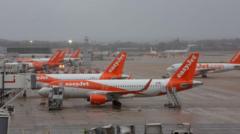
When summer thunderstorms roll across southeast England, the public narrative follows a predictable script. Passengers crowd terminal floors at Heathrow and Gatwick, flight boards light up in amber and red, and airline press offices issue statements blaming the heavens. But the rolling chaos that grounds hundreds of flights during British summer storms is not an inevitable act of God. It is the direct consequence of a hyper-optimized, under-staffed, and structurally fragile aviation system operating at the absolute limit of its physical capacity. The weather is merely the trigger that reveals how thin the margins of safety and efficiency have become.
To understand why a localized cell of lightning and heavy rain can paralyze the UK travel network while similar weather systems in Atlanta or Chicago cause manageable disruptions, one must look beneath the clouds. The breakdown occurs at the intersection of rigid infrastructure, decades of regulatory underinvestment, and an airline business model that leaves zero room for error. When capacity is permanently set at 98 percent, a single flash of lightning behaves like a wrench thrown into a high-speed engine.
The Illusion of Capacity
Heathrow and Gatwick are the most heavily utilized pieces of tarmac on earth. Heathrow operates its two runways at nearly full capacity throughout the day. Gatwick holds the title of the busiest single-runway airport in the world during peak seasons. This intense utilization is celebrated as a triumph of operational engineering, but it leaves the entire system without a buffer.
In normal conditions, aircraft land and take off with clockwork precision. The spacing between planes is calculated down to the mile and the second, based on wake vortex separation and runway occupancy times. This works perfectly when the skies are clear. However, air traffic management is entirely dependent on predictability. The moment a convective weather system appears over the English Channel, that predictability vanishes.
A thunderstorm is not a uniform blanket of bad weather. It is a shifting maze of cumulonimbus clouds, severe updrafts, microbursts, and lightning. Pilots cannot fly through these cells; they must fly around them. When fifty incoming aircraft all need to deviate ten miles to the left or right of their standard arrival routes, the carefully structured highways of the sky collapse into a chaotic bottleneck.
Air traffic controllers must rapidly increase the spacing between aircraft to ensure safety. This reduction in the arrival rate is known as a flow regulation. If Heathrow's normal arrival capacity is forty-eight aircraft per hour, a severe thunderstorm can cut that number in half. Because there are no empty slots later in the day to absorb the delayed flights, the impact cascades. A delay at 09:00 spreads across the network, causing cancellations by 18:00 as flight crews hit their legal duty limitations.
Inside the Swanwick Bottleneck
The responsibility for managing this complex puzzle falls on NATS, the public-private partnership that controls UK airspace. The nerve center of this operation is the London Area Control Centre at Swanwick in Hampshire. Inside this high-security facility, controllers monitor the most congested airspace in Europe.
The underlying architecture governing British skies dates back to design principles established decades ago. While hardware and software updates occur regularly, the fundamental structure relies on fixed corridors that funnel traffic into narrow geographic sectors. When storms block these sectors, controllers face an extraordinary cognitive load.
[Standard Route] ----> [High Density Sector] ----> [Airport Stack]
                             |
                   (Thunderstorm Blockage)
                             |
                             v
[Tactical Deviation] -> [Sector Overload] -> [Ground Delay Issued]
The system relies on a process called Air Traffic Flow Management, coordinated through Eurocontrol in Brussels. When a storm reduces capacity, NATS issues ground regulations. Planes bound for London are held at their departure airports across Europe rather than being allowed to take off and clog the holding stacks over southern England. This is why a passenger sitting in a plane on the tarmac in Madrid or Frankfurt is told they cannot leave because of bad weather in London, even though the sun might be shining at their current location.
Holding planes on the ground is safer and more fuel-efficient than holding them in the air, but it shifts the economic burden onto the airlines and the emotional burden onto consumers. The true vulnerability at Swanwick is not the technology, but the human resource. The UK faces a chronic shortage of fully qualified, valid air traffic controllers, a deficit exacerbated by a hiring freeze during the pandemic and the lengthy training cycles required to certify staff for the intense London sectors.
Training a controller for the London Terminal Control sector takes up to three years, and the failure rate is high. When convective weather strikes, the sheer volume of tactical rerouting requires more staff to split sectors into smaller geographic units to manage the workload. If the staff are not available on the roster, the sectors cannot be split. The only remaining option is to reduce the number of aircraft allowed into the sky.
The Broken Math of the Twenty Minute Turnaround
The architecture of modern short-haul aviation leaves no room for systemic friction. Low-cost carriers have built their empires on the principle of maximum aircraft utilization. A single airframe is scheduled to fly six sectors a day, with tight turnarounds at the gate.
During these brief windows, passengers must disembark, the cabin must be cleaned, baggage must be swapped, fuel must be loaded, and a new cohort of passengers must board. This sequence depends on every component arriving precisely on time. If the first flight of the morning faces a thirty-minute delay due to a thunderstorm over the Pyrenees or the Channel, the schedule for the rest of the day is compromised.
Flight 1 (06:00) -> Delayed 30 mins by weather
Flight 2 (08:30) -> Delayed 45 mins (Cascading delay + gate congestion)
Flight 3 (11:15) -> Delayed 70 mins
Flight 4 (14:00) -> Cancelled (Crew hits legal duty hour limit)
By the afternoon, that thirty-minute delay has snowballed into a two-hour deficit. Airlines are forced to make brutal calculations. Should they delay three subsequent flights, or should they cancel one entirely to reset the schedule for the evening? Often, cancellation is the cheaper option under passenger rights regulations, as it prevents the disruption from bleeding into the next morning.
The vulnerability is intensified by the physical design of the UK’s major airports. Gatwick operates its single runway at over fifty movements an hour during peak banks. Heathrow’s terminal structures mean that a delay to an arriving aircraft frequently blocks the gate for a departing aircraft, causing gridlock on the taxiways. The ground infrastructure is simply too small for the volume of traffic it is forced to support.
Why Continental Europe Fares Better
A comparison between the UK airspace performance and that of mainland Europe reveals distinct structural approaches to weather management. France and Germany possess larger geographic landmasses, allowing for wider tactical deviations. If a storm hits Frankfurt, air traffic control can reroute traffic across a vast domestic airspace network without immediately triggering severe capacity drops.
The UK enjoys no such luxury. Southern England is bordered by the busy airspace of France, Belgium, and the Netherlands. Rerouting an aircraft out of the London sector requires rapid, real-time coordination across international borders. While Eurocontrol facilitates this, the physical reality of the geography creates natural boundaries.
Furthermore, the funding model for airspace infrastructure differs significantly. The UK operates on a commercialized model where NATS charges airlines fees based on distance flown and aircraft weight. This model creates pressure to minimize costs and maximize efficiency during normal operations, but it does not incentivize the retention of expensive, redundant capacity or surplus staffing that remains idle until a storm hits.
The Physics of the Cloud
To fully grasp the complexity facing controllers during a storm, one must appreciate the atmospheric physics involved. Summer thunderstorms in the UK are frequently driven by cold fronts hitting warm, humid air masses moving up from the continent. This creates rapid convective lifting, generating clouds that can reach altitudes of forty thousand feet.
Modern commercial airliners cannot fly over these storms. They must navigate through the gaps between them. The onboard weather radar provides pilots with a visual representation of moisture density, colored green, yellow, and red. Pilots are legally and operationally required to avoid red zones, which indicate severe turbulence, hail, and extreme icing conditions.
[Convective Cell Core: Red Zone / Severe Hail]
       ^
   [Avoidance Margin: 10-20 Nautical Miles]
       ^
[Aircraft Path: Forced Tactical Deviation] -> Enters adjacent flight path
When multiple pilots request deviations simultaneously, the standard air traffic routes become irrelevant. Controllers must abandon the structured arrivals and switch to tactical separation. This demands constant radio communication, rapid vectoring, and immediate adjustments to speed. The capacity of the human brain to process these moving vectors is the absolute limiting factor. When that limit is approached, safety dictates that the inflow of traffic must be curbed at the source.
The Regulatory Gap
The economic regulation of UK airports and airspace is overseen by the Civil Aviation Authority. The regulatory framework prioritizes keeping costs low for passengers, which translates into intense pressure on airlines and infrastructure providers to cut fat from their operations.
This lean approach ensures cheap tickets during perfect weather, but it strips the system of resilience. There are no spare aircraft parked at the gates ready to rescue a delayed schedule. There are no backup crews sitting in airport lounges waiting to take over when a roster collapses. The entire ecosystem operates on a just-in-time delivery model that is fundamentally unsuited to the volatile reality of northern European weather patterns.
Airlines frequently complain about NATS' infrastructure, pointing to technical outages and staffing issues. Conversely, NATS points to the aggressive scheduling practices of the airlines, who pack more flights into the peak morning and evening periods than the infrastructure can comfortably bear. Both arguments contain truth, but neither addresses the core structural reality. The UK has built an aviation system optimized exclusively for optimal conditions, offering no cushion for environmental volatility.
The Path to Resilient Skies
Resolving the annual summer travel crisis requires a fundamental shift in how airspace and airport capacity are valued. True resilience cannot be achieved through minor software updates or superficial changes to airline ticketing policies.
- Redefining Peak Capacity Limits: The Civil Aviation Authority must reconsider the slot allocation models at Heathrow and Gatwick. Reducing peak utilization by a small margin would create an operational buffer capable of absorbing minor delays before they compound into systemic failures.
- Accelerating Controller Recruitment: NATS must restructure its financial and operational models to treat controller staffing not as a variable cost to be minimized, but as a critical national infrastructure asset. This means over-indexing on staff numbers to ensure adequate coverage during high-stress weather events.
- Airspace Modernization: The long-delayed Airspace Modernization Strategy must be accelerated. This initiative aims to utilize satellite-based navigation to replace the rigid, ground-based routes designed in the mid-twentieth century, allowing for more flexible, dynamic routing around weather systems.
Until these structural realities are addressed, the scenes of stranded passengers and chaotic terminal floors will remain a permanent fixture of the British summer. The system will continue to function on the edge of failure, waiting for the next inevitable line of dark clouds to cross the coast and expose the fragility hidden beneath the schedule.