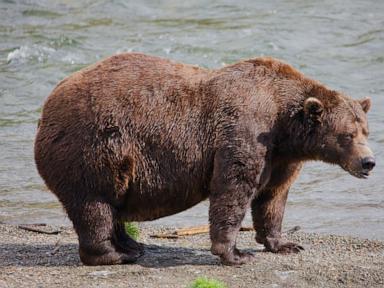
Every autumn, millions of internet users log on to vote in a bracket-style tournament that pits massive Alaskan brown bears against one another based entirely on their pre-hibernation waistlines. Fat Bear Week, hosted by Katmai National Park and Preserve alongside explore.org, draws hundreds of thousands of digital ballots for titans like 747, Grazer, Chunk, and Backpack. Yet beneath the viral memes, internet voting campaigns, and playful radio commentary lies a remarkably sophisticated biological indicator program. This annual contest functions as a public-facing ecological audit of one of the planet's last genuinely intact wild salmon ecosystems.
The core premise of the tournament is deceptively simple. Brown bears need to accumulate massive fat reserves to survive winter hibernation, a period during which they consume zero food or water and lose up to a third of their total body weight. At Brooks River in Katmai, the sockeye salmon runs are so colossal and sustained that bears can gorge themselves continuously from late June through October. When a bear reaches 1,200 pounds, it is not merely winning an online popularity contest; it is exhibiting peak physiological success in an environment operating at maximum ecological capacity.
To understand the weight behind the phenomenon, one must look past the tournament brackets and examine the historical shifts in the watershed. The competition started in 2014 as a modest local voter initiative conceived by former park ranger Mike Fitz. Fitz wanted a creative way to draw attention to the rich habitat of Bristol Bay. Over the next decade, the event scaled into a global phenomenon, driven largely by high-definition webcams that broadcast the river's daily drama directly to millions of home screens.
Viewers do not just see a random assortment of large animals. They track specific lineages, rivalries, and aging veterans over multi-year arcs. Former champions like Bear 480 Otis—known for his missing teeth, patient style, and signature office spot near the falls—demonstrated how older males could adapt their fishing strategies as their physical dominance waned. Others, such as the fiercely protective mother bear 128 Grazer or the colossal male 747, showed that dominance on the river takes entirely different forms, ranging from tactical intimidation to sheer gravitational mass.
This long-term observation creates a unique dataset for wildlife biologists. While park rangers and researchers monitor population health through traditional scientific methodologies, the public archive of tagged bears provides an extraordinary record of individual animal growth, reproductive success, and behavioral adaptation. When a subadult bear triples its weight over a single summer, or when a mature female successfully raises multiple cubs through a volatile salmon season, those milestones are heavily documented by both scientists and millions of digital observers.
Critics occasionally dismiss the tournament as anthropomorphic fluff, arguing that reducing apex predators to cartoonish comparisons trivializes wild animal management. That perspective misses the broader economic and political reality of conservation in modern America. Katmai National Park sits adjacent to the Bristol Bay watershed, a region perpetually menaced by large-scale industrial proposals like the proposed Pebble Mine. By turning remote Alaskan brown bears into household names, Fat Bear Week anchors public support for habitat protection in concrete, emotional familiarity. Millions of voters who might never read an environmental impact statement will passionately advocate for a watershed that guarantees Bear 89 Backpack or future generations of cubs can find enough sockeye to survive the frost.
The logistics of the event are unforgiving. Mother nature does not pause for internet brackets. In some years, late-season salmon runs falter, or fierce intraspecies combat alters the hierarchy before voting even begins. The annual contest has had to adapt to real-world tragedies, such as dominant bears clashing or unexpected demographic shifts along the riverbanks. These variables remind audiences that the cameras are not broadcasting a scripted television show, but rather an unfiltered, high-stakes wilderness where survival is entirely earned.
As the digital ballots close and the winning heavyweight is crowned each October, the bears shuffle off toward their dens to sleep away the dark months. They leave behind a temporary vacuum on the live feeds, but the cultural footprint remains permanent. Fat Bear Week proves that public engagement with wildlife does not require simplifying science into dry abstracts. It thrives when people are invited to witness the raw, heavy reality of wild animals performing what they have done for millennia: eating, growing, and enduring against the odds.


