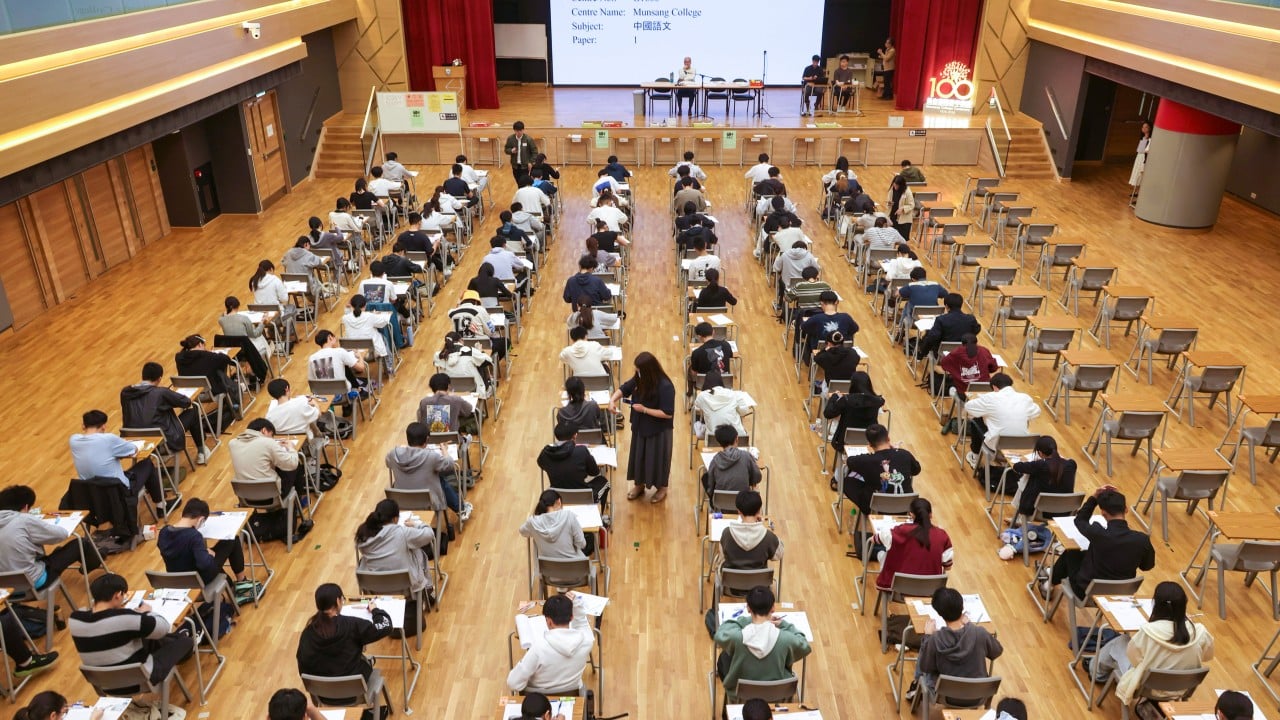
The air inside the classroom always smells the same on results day. It is a suffocating mix of floor wax, stale air conditioning, and the metallic tang of cold sweat.
Mei held her breath. Her fingers rested on the edge of a desk she had sat at for six years, watching the wood grain slowly warp under the humidity of Hong Kong summers. Around her, thirty other teenagers waited for a single piece of paper to dictate the trajectory of their adulthood. This is the Hong Kong Diploma of Secondary Education, the DSE. It is not just an examination. It is a cultural crucible, a national sorting mechanism that sifts the population into neat tiers of societal validation.
Then came the numbers.
On this particular morning, the city woke up to a startling contradiction. Twenty-four. That was the magic number flashing across news broadcasts and smartphone screens. Twenty-four individual students had achieved the impossible—perfect scores across the board, securing the coveted title of "super-top scorers." It was a historical record, a pinnacle of academic achievement that the city’s elite tutoring schools would plaster across billboards for the next twelve months.
But outside the glare of the flashmobs and television cameras celebrating those twenty-four anomalies, a much quieter, harsher reality was unfolding.
The university eligibility rate had dipped.
While the ceiling had never been higher, the floor had suddenly dropped. Thousands of students who had sacrificed sleep, sanity, and their youth found themselves staring at a narrowing doorway. The gateway to higher education, and by extension the traditional path to a stable middle-class life, had shrunk.
Imagine standing in a room where the ceiling rises to magnificent new heights, but the floor tilts beneath your feet, sliding you backward into the dark. That is the psychological landscape of the modern DSE.
Let us look closely at Lawrence. He is a hypothetical composite of the twenty-four, but his reality is lived by flesh and blood every year. Lawrence did not sleep the night before the results. His eyes were bloodshot, his skin pale from months of avoiding the sun. When he received his transcript, the row of maximum grades looked almost alien. The cameras swarmed him. Journalists thrust microphones into his face, asking if he wanted to study medicine or law, because in Hong Kong, those are often treated as the only two options for genius.
He smiled for the lenses. But beneath the desk, his hands were shaking. He knew the truth. To achieve perfection, he had systematically erased everything else that made him human. Music, friendships, the simple joy of an afternoon wasted staring at the harbor—all of it had been traded for exam rubrics. He had memorized marking schemes until he could recite them in his sleep. He had learned exactly how many bullet points were required to satisfy an anonymous examiner.
He had won. But victory felt like a narrow ledge.
Now consider the other side of the ledger.
Mei did not get a perfect score. She did well, or at least, she did what any reasonable society would consider well. She passed. She studied late into the night while the neon signs of Mong Kok flickered outside her window. She drank lukewarm ginseng soup her mother left by her door, a silent offering of love and anxiety.
Yet, as the eligibility rate contracted, her hard work suddenly wasn't enough. The mathematical reality of the dip meant that thousands of students who cleared the baseline requirements were still left stranded without a university place. The goalposts had moved while the ball was in mid-air.
The numbers don't lie, but they do hide the human cost. When the university eligibility rate drops, it isn't just a statistic on a government press release. It is a series of quiet conversations in cramped apartments. It is a father looking at his daughter and wondering if he should have worked more overtime to afford better cram schools. It is a mother quietly putting away the celebratory dinner she spent all afternoon preparing.
This system creates a profound illusion. It convinces us that success is a simple equation of merit. If you work hard enough, you score the points. If you score the points, you get the life.
But what happens when the equation breaks?
When a society celebrates twenty-four gods of academia while silently shutting the door on a larger percentage of the population, it fosters a deep, unspoken cynicism. The message sent to the younger generation is brutal: perfection is the only shield against obscurity. If you are merely good, you are vulnerable.
The pressure behaves like a hydraulic press. It pushes down from the top, forcing schools to transform into exam factories. Teachers are no longer mentors guiding young minds through the wonders of literature or the elegance of calculus; they become quality control managers ensuring the assembly line produces high-yield results. True curiosity is a liability in a timed exam. It causes you to linger on a question, to wonder why, when you should be writing down the pre-packaged keywords that trigger the mark.
We must question what we are building.
The city cheers for the twenty-four. Their faces will be bright, hopeful, and entirely deserving of praise. They worked for it. They bled for it. But as they step into the elite lecture halls of their chosen universities, they carry the weight of an entire generation's anxiety on their shoulders. They know how easily they could have fallen.
As the sun sets over Victoria Harbour, the news cycle moves on. The television screens turn to other stories, other crises. The billboards will go up, featuring the smiling faces of the perfect scorers, used as marketing tools to entice the next batch of sixteen-year-olds into the grueling cycle.
Mei walked out of the school gates that afternoon, the crisp white envelope tucked firmly into her backpack. She did not look at the cameras gathering around the main entrance. She walked down to the waterfront, where the green Star Ferries cut through the water, oblivious to the human drama unfolding on the shore.
She took a deep breath of the salty, humid air. For the first time in years, she had nothing to study. The future was unwritten, terrifyingly open, and entirely disconnected from the numbers on her page. She looked down at her hands, clear of ink stains at last, and realized that the system had tested everything except her capacity to survive it.