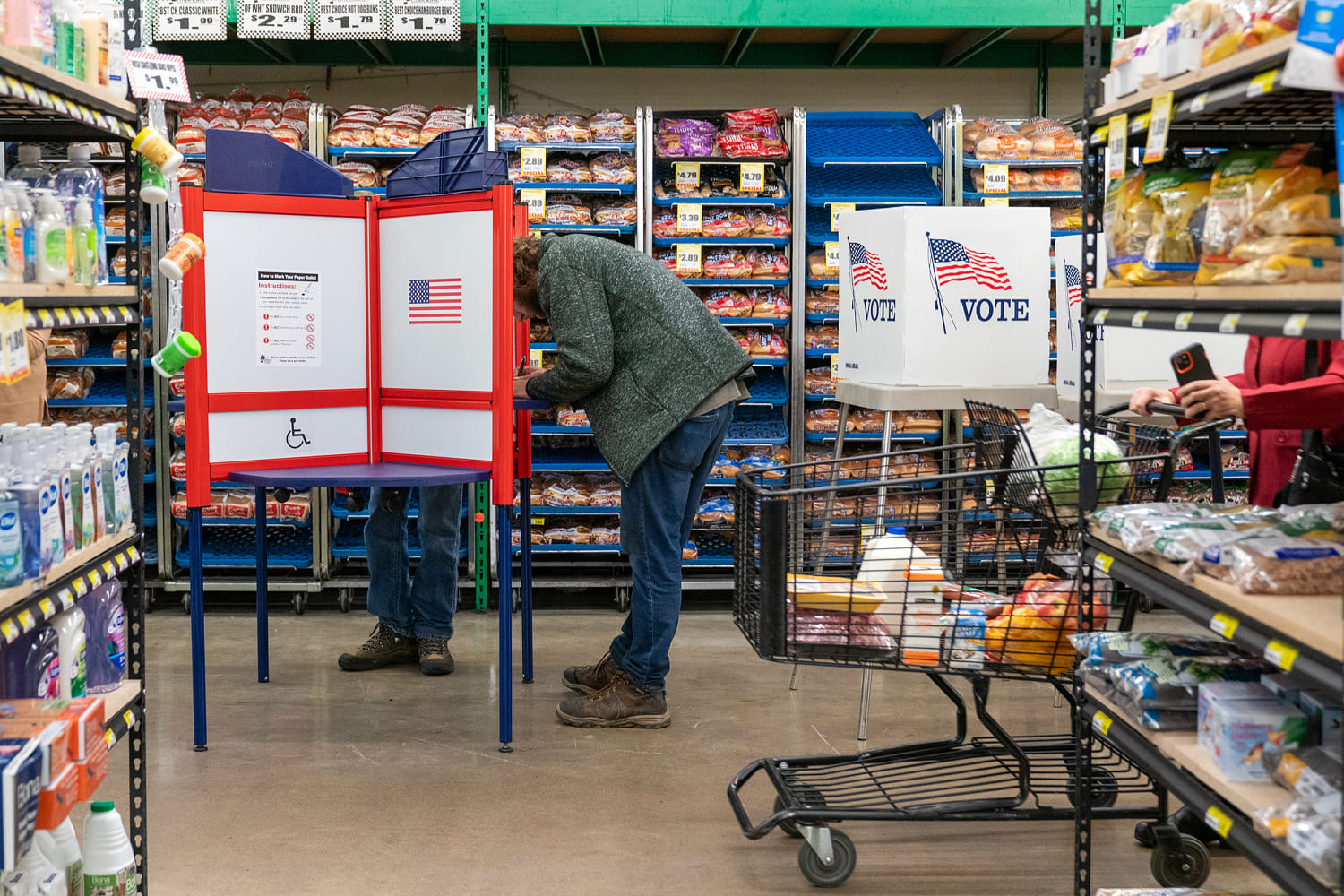
The fluorescent lights in a precinct gymnasium in Fulton County hum at a frequency you only notice at 11:45 PM. By then, the adhesive on the "I Voted" stickers has mostly given up, curling off fleece jackets and stuck to the rubber soles of tired sneakers.
For decades, that hum was the soundtrack of a very specific kind of American exhaustion. It was the sound of waiting for a glass ceiling to crack, only to realize the ceiling wasn't glass at all. It was reinforced concrete, poured in 1788, and nobody had handed out the jackhammers. For a more detailed analysis into this area, we suggest: this related article.
History rarely announces itself with a brass band. Usually, it smells like lukewarm coffee in a Styrofoam cup and feels like the ache in your lower back after standing on linoleum for fourteen hours.
When Keisha Lance Bottoms became the first Black woman elected governor of a U.S. state, the headlines flashed across glowing screens in red and blue banners. They reduced a tectonic shift in American politics into a tidy, digestible bullet point. First Black woman. United States governor. Georgia. Historic. For additional context on the matter, detailed analysis is available on BBC News.
Read those words again. They are accurate, sterile, and entirely incapable of capturing the weight of the room when the final county tallies locked in.
The Architecture of an Unwritten Rule
To understand why a single gubernatorial race in the American South carried the voltage of a live wire, you have to look at the sheer, stubborn math of the executive branch.
Since the ratification of the United States Constitution, more than two thousand men have served as governors of the fifty states. Dozens of women have held the title, starting with Nellie Tayloe Ross in Wyoming back in 1925. Black men have walked into the governor's mansion—from P.B.S. Pinchback during the brief, fragile promise of Reconstruction in Louisiana to Douglas Wilder in Virginia, Deval Patrick in Massachusetts, and Wes Moore in Maryland.
Yet, across nearly two and a half centuries of American democracy, the intersection of Black and woman remained an empty chair at the head of every state table.
Think of the American governorship not just as a political office, but as the ultimate executive proving ground. Senators debate; governors sign. Representatives propose; governors deploy the National Guard, commute sentences, veto budgets, and set the moral weather for millions of citizens. For generations, an unspoken consensus lingered in the air of donor banquet halls and party backrooms: a Black woman could organize the vote, knock on the doors, run the city, and deliver the state, but she could not hold the ultimate pen.
Consider a hypothetical voter—let’s call her Evelyn, a sixty-eight-year-old retired schoolteacher living in a brick ranch house south of Interstate 20. Evelyn’s life maps cleanly onto the modern civil rights timeline. She remembers drinking from separate water fountains as a child. She remembers the bruised optimism of the 1960s, the bruising realities of the 1980s, and the intoxicating high of 2008. Over the decades, Evelyn had cast ballots for countless candidates who looked like her for city council, for Congress, even for the White House. Every four years, she heard the same quiet advice from pundits on her living room television: Be realistic. A statewide race in the South is too hard. The coalition isn't ready.
Evelyn didn't need a political science degree to understand what "electability" actually meant. It was a polite synonym for fear.
The Crucible of 2020 and the Long Shadow
Keisha Lance Bottoms did not arrive at that historic victory as an untested idealist. Anyone who lived through the summer of 2020 in Atlanta remembers the surreal, breathless tension of those nights.
I remember walking down Peachtree Street that June, the air thick with humidity and the sharp, metallic tang of spent tear gas canisters. Plywood covered the storefront windows like crude armor. The city—the cradle of the Civil Rights Movement, the self-proclaimed city too busy to hate—was burning with grief and fury over the deaths of George Floyd, Breonna Taylor, and Ahmaud Arbery, and then Rayshard Brooks right in an Atlanta Wendy’s parking lot.
At the center of that storm stood Bottoms, then the 60th Mayor of Atlanta.
Her speech during the height of the unrest wasn't a polished teleprompter performance. It was raw, maternal, and fiercely protective. She looked into the cameras and spoke as a mother of four Black children, pleading with protesters to go home not because their rage was unjustified, but because she feared for their survival in the streets. It was a moment that drew fire from every conceivable angle. Activists accused her of being too sympathetic to law enforcement; conservative critics attacked her for losing control of the city; the sitting president took aim at her on Twitter.
In politics, surviving a crossfire like that usually leaves a candidate too scarred for higher office. The conventional wisdom in Washington and Atlanta was that her decision not to seek a second term as mayor in 2021 marked the quiet twilight of her electoral career. She went to the White House as a senior advisor to President Joe Biden, stepping away from the daily grind of municipal crisis management into the rarefied air of federal policy.
Most observers filed her name under past tense.
They misread the trajectory. Stepping out of City Hall wasn't a retreat; it was an incubation. Governing a major American metropolis during a global pandemic and a historic racial reckoning acts like high-pressure forging on steel. You either shatter under the heat, or you come out dense enough to withstand anything a statewide campaign can throw at you.
What Happens When the Ground Shifts
When Bottoms entered the race for Georgia’s governor’s mansion, the skepticism returned on cue. The state had become the ultimate purple battleground—a place where margins are measured in fractions of a percentage point and every suburb from Gwinnett to Cobb is a trench war.
Critics pointed to the ghosts of races past. They brought up Stacey Abrams’s razor-thin loss in 2018 and her steeper defeat in 2022, treating those campaigns not as proof of a growing coalition, but as cautionary tales of an insurmountable ceiling. The narrative was already pre-written: Georgia was changing, sure, but not that fast.
Let’s look at what those narratives missed.
Demographic data is cold until you walk through the neighborhoods it describes. Over the past fifteen years, metro Atlanta didn't just grow; it transformed into an economic magnet that pulled young professionals, tech workers, film crews, and retirees from across the country. Counties that had voted reliably red since the Reagan administration flipped blue, then stayed blue. Meanwhile, rural Black voters in the state’s agricultural belt—places like Dougherty, Macon, and Hancock counties—maintained a civic discipline that rivaled any urban political machine.
Bottoms ran a campaign that refused to choose between the boardroom and the barbershop.
Having grown up in Atlanta as the daughter of R&B legend Major Lance, she possessed an effortless fluency in the city’s cultural DNA. Yet she had also worked as a magistrate judge, a corporate attorney, and a senior White House official. When she spoke to business leaders in Buckhead about maintaining Georgia’s status as the top state for commerce, she sounded like an institutionalist who understood bond ratings and port logistics. When she stood in a sanctuary in Savannah on a Sunday morning talking about maternal mortality rates—a crisis that kills Black women in Georgia at nearly three times the rate of white women—she spoke with the urgency of someone whose own neighbors were buried too young.
To understand the mechanics of her victory, imagine a bridge built from two opposite banks of a wide river. For years, Democratic campaigns in the South built furiously from the urban bank, hoping the span would somehow reach the other side before running out of steel. Bottoms’s team obsessed over the pilings on both shores—investing early in rural field offices, funding local radio in small towns, and treating voter protection not as an Election Day scramble, but as a year-round infrastructure project.
The Weight of the Pen
There is a temptation, whenever a barrier falls, to treat the victory itself as the finish line. We love the photograph of the raised hands, the confetti falling on the stage, the tearful embrace on election night. It makes for clean television.
Reality is messier, heavier, and far more interesting.
Winning the governorship of Georgia is not a ceremonial coronation. It is an immediate collision with a state legislature that often holds wildly different priorities, a massive state budget that demands ruthless trade-offs, and a constituency divided right down the middle on everything from reproductive rights to Medicaid expansion to how history itself should be taught in public classrooms.
As governor, Bottoms steps into an office built on an intricate web of statutory power. In Georgia, the governor appoints hundreds of members to state boards and commissions—the people who regulate utilities, oversee universities, and set environmental standards. She holds the line-item veto, a surgical tool that allows an executive to strip specific spending out of a bill without killing the entire budget.
For decades, those levers were pulled by men whose lived experiences rarely intersected with the working-class families riding MARTA buses before dawn or waiting hours in underfunded rural emergency rooms.
Now, consider what changes when the person holding the line-item veto has personally navigated the anxieties of raising Black sons in America, has balanced a municipal budget during an economic shutdown, and understands how state policy lands on a kitchen table in Southwest Atlanta.
Policy isn't abstract when you have lived inside its consequences. Expanding healthcare access stops being an ideological talking point and becomes a math problem about keeping rural hospitals open so a mother in Macon doesn't have to drive ninety miles while in labor. Public education funding stops being a budget line and becomes the difference between a crumbling roof and an air-conditioned classroom in July.
The Silence Before the Oath
If you want to know what this election actually felt like on the ground, don't look at the cable news panels. Look at the mothers who brought their daughters to the early voting sites in DeKalb and Clayton counties.
I watched a woman in her late thirties stand in line outside an elementary school gymnasium on a rainy Saturday afternoon. She had a toddler on her hip and an eight-year-old girl holding onto her coat pocket. The line wrapped around the brick building twice, moving at the pace of a glacier. The eight-year-old was restless, kicking at puddles, asking every five minutes when they could go home.
Her mother didn't hand her a phone to keep her quiet. She knelt down on the wet concrete, eye-level with her daughter, and pointed toward the glass doors of the polling place. She explained that for the entire history of the country, nobody who looked like the two of them had ever been allowed to run a whole state. Not once. Not anywhere.
The little girl didn't fully grasp the constitutional powers of the executive branch. She didn't know what a line-item veto was, or how the Electoral College worked, or what the polling averages said in the Atlanta suburbs. She just looked at her mother’s face, saw the fierce, quiet certainty in her eyes, and stood up a little straighter in the rain.
When the results finally came in—not in a sudden landslide, but in the slow, agonizing drip of absentee ballots counted through the night—there was no single moment of explosion. Instead, there was a long, collective exhale that seemed to roll out from the center of Atlanta, across the red clay hills of the Piedmont, all the way down to the coastal marshes of Brunswick.
A velvet curtain that had hung across the doorway of American executive power for two hundred and thirty-seven years didn't tear down in a dramatic flash. It simply parted. And on the other side, waiting at the desk with the heavy brass lamp and the stack of unsigned bills, was a woman who already knew how to get to work.