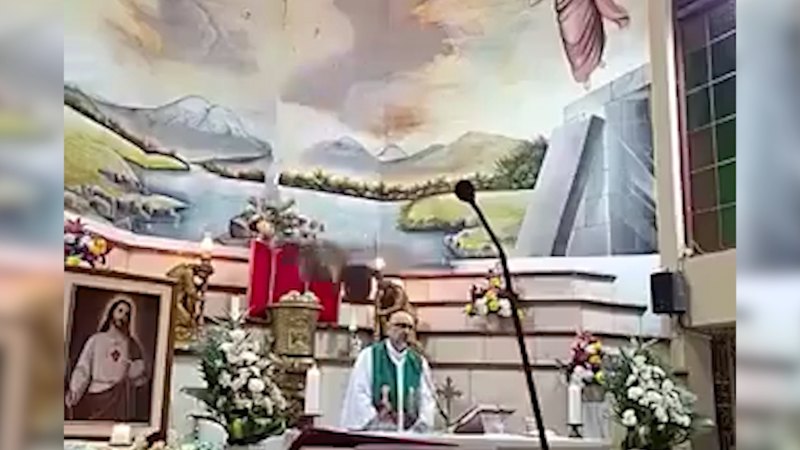
In October 2026, Redemptorist Father Patricio Alfredo Sánchez Molinari died after a large crucifix detached from a wall and struck him during a livestreamed Mass at Our Lady of Perpetual Help Church in Guayaquil, Ecuador. News reports focused immediately on the shock of the livestream and the parish's grief. What most coverage missed is the mundane mechanical failure behind tragedies like this: decades-old wall anchors, uninspected heavy liturgical mounts, and deferred building maintenance inside historic or high-ceilinged houses of worship.
A falling crucifix sounds like a freak accident. In structural terms, it rarely is.
The Physics of Overhead Sanctuary Loads
Large wooden, bronze, or plaster crucifixes suspended above altars or mounted high on sanctuary walls carry far more stress than a casual observer assumes. Gravity pulls straight down, but cantilevered torque multiplies the strain on upper fasteners whenever a heavy object tilts forward or is mounted slightly off-plumb. A crucifix that weighs eighty or a hundred pounds does not merely exert a static downward pull on a wall anchor. If its center of gravity sits even a few inches away from the mounting plane, the top fastener experiences outward tensile pull-out force while the bottom acts as a fulcrum.
Walls inside older parishes complicate the math. Many sanctuaries combine brick masonry, hollow tile, lime plaster, or aging concrete with thick decorative finishes. An anchor that held securely when installed thirty or fifty years ago can lose grip gradually through micro-vibrations, thermal expansion, moisture intrusion, or subtle settling of the building shell. Wood shrinks and swells with humidity changes. Metal brackets corrode out of sight behind heavy frames.
Livestreaming has only made these moments more visible to the public. Cameras trained on the altar record every second before and after a failure, turning a local structural lapse into an international headline within hours. The camera captures the aftermath, not the slow fatigue in the steel or plaster that preceded it.
Deferred Maintenance and Blind Spots in Parish Oversight
Houses of worship operate under constraints that set them apart from commercial office buildings or public arenas. Many congregations rely on tight operating budgets, volunteer committees, and rotating clergy. When a parish has limited funds, money naturally goes toward roof leaks, electrical hazards, or active water damage rather than inspecting a fixture that has hung quietly over the sanctuary for decades.
Out of sight usually means out of mind. Sanctuary crucifixes, suspended lighting rigs, sound baffles, and heavy statues often sit well above standard ladder reach. Checking their structural integrity requires specialized lifts, time when the building is empty, and someone willing to ask uncomfortable questions about liability and aging hardware.
When a fixture has hung undisturbed for thirty years, familiarity breeds a dangerous assumption of permanence.
Even when tragic incidents occur—such as the October 2026 death in Guayaquil or other documented cases of falling architectural and liturgical elements around religious structures—official statements often emphasize prayer and mourning while leaving mechanical causes unexamined in public view. That silence is understandable in moments of acute grief. Yet without transparent inspection protocols, neighboring parishes rarely learn what type of anchor failed or what warning signs existed beforehand.
Hypothetical Inspection Scenario
To see how easily a preventable hazard hides in plain sight, consider a hypothetical example involving a mid-sized parish church built in the 1960s. Above the main altar hangs a carved hardwood crucifix roughly seven feet tall, secured to a plastered brick wall by two steel lag bolts driven into lead shields. Over six decades, seasonal humidity swings loosen the timber slightly at the mounting cleat, and minor moisture seeping from an upper roof flashing dampens the masonry behind the plaster. Nothing creaks loudly enough to alarm anyone during Sunday services. One evening, a single anchor pulls free under combined shear and tension, the top of the cross pitches forward, and the remaining fastener shears off under sudden impact load. No earthquake occurred. No one touched the fixture. Physics simply collected a debt that had been compounding for years.
Gray Areas and Practical Trade-Offs
Fixing structural vulnerabilities in sacred spaces is not always straightforward. Historic preservation rules or aesthetic standards may restrict visible bracing, secondary safety cables, or invasive masonry testing. Drilling new anchor points into aged brick or decorative plaster can crack surrounding surfaces if done without care.
There is also a real cost trade-off for smaller parishes. Hiring a structural engineer or a commercial rigging inspector is expensive, especially for rural or underfunded congregations. A rigid mandate without financial or technical support from dioceses, denominations, or insurers can stall compliance before it starts.
Still, basic risk reduction does not require turning a sanctuary into an industrial warehouse. Practical steps include:
- Log every overhead load above six feet—including crucifixes, processional mounts, speaker arrays, and light fixtures—recording approximate weight, installation era, and mount type.
- Add secondary tethers using concealed stainless-steel aircraft cable rated well above the fixture's weight so a primary anchor failure results in a controlled shift rather than a free fall.
- Schedule annual visual checks with magnification or lift access to spot rust streaks, sagging brackets, cracked plaster around fasteners, or forward tilt.
- Prioritize high-occupancy zones such as altars, pulpits, choir lofts, and main aisles where people stand or sit directly beneath heavy hardware.
Tragedy rarely announces itself with a warning siren; it usually arrives at the exact moment an old assumption gives way. Every parish leader and facilities manager who walks past an uninspected overhead mount today holds a straightforward choice: wait for gravity to test the hardware, or inspect the anchors before the next service begins.