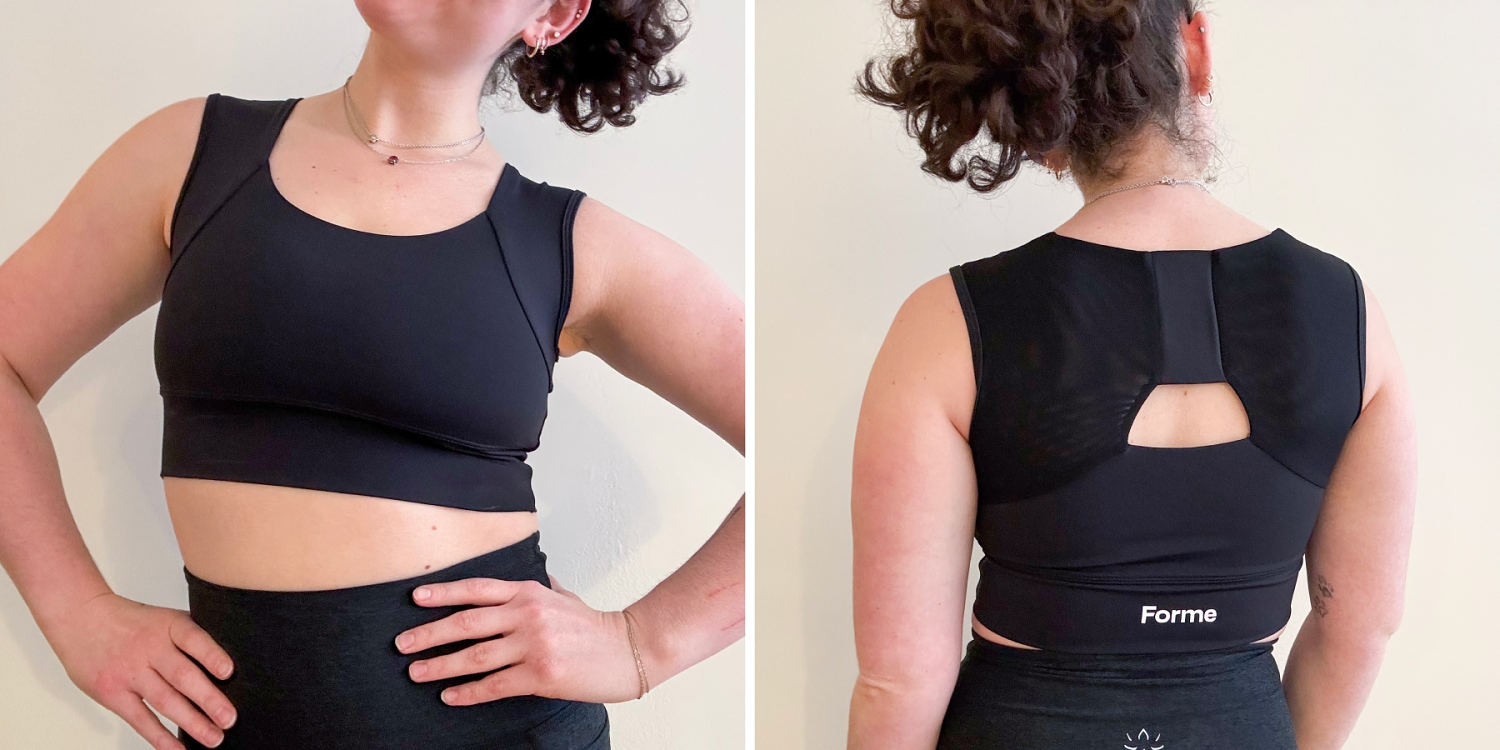
By two o’clock on a Tuesday afternoon, the ache usually starts right between the shoulder blades. It is a dull, radiating throb that slowly climbs the back of the neck until it anchors itself firmly behind the eyes. For years, I assumed this was just the tax of modern life. It was the price of sitting in an office chair, of staring at a laptop, of growing older. We blame our posture. We buy ergonomic mousepads and scheduled massage appointments.
We rarely look at the elastic and underwire digging into our ribcage. Learn more on a connected subject: this related article.
The average woman will spend thousands of dollars over her lifetime on a garment she can’t wait to rip off the second she walks through her front door. It is an bizarre ritual. We come home, kick off our shoes, and reach under our shirts to pull out a contraption made of harsh nylon and stabbing metal, tossing it aside with a sigh of pure relief. We have accepted discomfort as a baseline condition of womanhood.
Then a piece of fabric comes along that costs $178. Further reporting by Cosmopolitan highlights similar perspectives on this issue.
Not a silk dress. Not a pair of Italian leather boots. A bra.
When you first hear that price tag, your brain recoils. It sounds like a marketing scam designed to exploit our deepest insecurities. But the frenzy surrounding high-end luxury lingerie—specifically the engineering-first brands that have turned support into a science—isn't about vanity. It is about a desperate search for relief.
The Engineering Failure on Your Chest
To understand why a piece of underwear could ever justify triple-digit pricing, we have to look at the math of the human body. Think of a bridge. A suspension bridge doesn't hold its weight from the cables alone; the entire structure distributes the load down into concrete pillars anchored deep in the earth.
Most bras on the market are bad bridges.
They rely almost entirely on the shoulder straps to do the heavy lifting. When you wear a cheaply constructed garment, eighty percent of the weight pulls directly down on your trapezius muscles. This constant, unyielding downward pull compresses the nerves in your neck and shoulders. It causes tension headaches. It alters how you stand, how you breathe, and how you carry yourself through the world.
Let us trace a hypothetical but entirely real scenario. Sarah is a software engineer who wears a 34D. She buys mid-tier bras from mall brands because, like most of us, she thinks sixty dollars is already a lot of money to spend on something nobody sees. Every morning, she straps herself in. By noon, the straps are cutting red trenches into her shoulders. To compensate for the pulling weight, she subtly hunches her shoulders forward. Her lung capacity drops slightly because her chest cavity is constricted. By 5:00 PM, she is irritable, exhausted, and popping ibuprofen.
The real problem lies elsewhere, though. It is not in the straps. It is in the band.
In a properly engineered bra, the band around your ribs should provide ninety percent of the support. It should act as that solid concrete pillar. But creating a band that anchors perfectly without slipping, without choking the wearer, and without stretching out after three washes requires an entirely different level of textile technology.
Standard manufacturing uses cheap, two-way stretch elastics that degrade rapidly under heat and friction. High-end intimate apparel uses four-way stretch Italian microfibers and bonded, stitchless seams. These materials don’t just hold things up; they distribute weight horizontally around your entire core. The difference feels less like being lifted and more like being weightless.
The High Cost of Cheap Elastic
We live in a culture that readily spends two hundred dollars on running shoes to protect our knees, yet we scoff at spending the same amount to protect our spines.
Consider what happens next when we look at the lifecycle of a typical wardrobe. A cheap bra has a shelf life of roughly six months before the elastic begins to slacken and the underwire starts its inevitable, painful journey through the fabric to stab you in the armpit. You buy four of them a year. You spend over two hundred dollars annually on a rotating cycle of mediocre support and localized torture.
The $178 price tag is a psychological barrier, not an economic one.
When you look closely at the craftsmanship of true luxury utility wear, you are paying for the invisible details. You are paying for ultrasonic welding that eliminates chafing seams. You are paying for memory foam cups molded at specific temperatures to mimic the natural density of breast tissue. You are paying for custom-plated hardware that won't twist or snap when you twist your torso.
More than that, you are paying for the pattern-making. Cheap brands take a single pattern designed for a size 34B and simply scale it up mathematically to create a 38G. But bodies do not grow linearly. Volume changes shape as it increases. True luxury brands build entirely separate patterns for every single cup and band combination, testing them on real women of all shapes and sizes rather than plastic mannequins.
They design for movement. They design for the way a body expands when it inhales deeply.
The Psychological Shift
There is an undeniable emotional weight to what we wear closest to our skin. When a garment is constantly reminding you of its existence through a pinch, a scratch, or a slip, it drains a fraction of your mental energy. It is a quiet, persistent hum of dissatisfaction that follows you into boardrooms, onto airplanes, and through dinner dates.
I remember the first time I tried on an obsessively engineered bra. The feeling wasn't one of restriction or hyper-sexualized lifting. It was the feeling of neutrality. For the first time in my adult life, I went an entire afternoon without adjusting a strap, pulling down a band, or shifting my weight to alleviate back pain. I simply forgot I was wearing it.
That is the true luxury. It isn’t lace, and it isn't a prestigious label. It is the total absence of discomfort.
When we ask if a piece of underwear can genuinely change your life, we are asking the wrong question. A piece of fabric cannot alter your destiny. But it can eliminate the low-grade physical exhaustion that colors your entire day. It can change the way you stand when you walk into a room, shifting your posture from a protective hunch to an open, confident stance.
We have been conditioned to believe that beauty requires suffering, or at the very least, that comfort is a secondary luxury we don't deserve to invest in. We relegate our self-care to external, visible things that others can validate. We buy the expensive coat, the designer handbag, the statement jewelry. Meanwhile, underneath it all, we are held together by fraying elastic and broken promises.
The next time you pull off your armor at the end of a long day and look at the red marks etched into your skin, ask yourself what those marks are costing you in presence, in comfort, and in health. The investment isn't in the product. The investment is in the quiet, radical belief that your daily physical ease is worth paying for.
Somewhere in a bedroom right now, a woman is getting ready for work. She fastens a band that fits like a second skin, slips her arms through straps that feel like nothing at all, and catches her reflection in the mirror. She isn't thinking about the price tag. She is simply breathing deeply, standing tall, and stepping out into the world entirely unburdened.