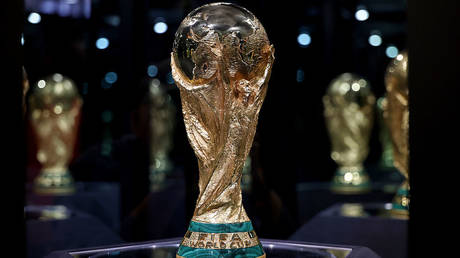
The air inside the media center is always too cold, smelling of stale coffee and the frantic, collective sweat of three hundred journalists typing against a deadline. On the television screens lining the wall, pundit after pundit sits under the unforgiving glare of studio lights. They smile. They gesture with perfectly manicured hands. They look at sheets of data, expected goals (xG), historical trends, and tactical heat maps, and they tell the world exactly who is going to win the World Cup.
They make it sound like a math problem.
France has the depth. Brazil has the lineage. England has the generational talent meeting its peak. The logic is pristine, locked tightly inside the vacuum of a television studio.
But football does not happen in a vacuum. It happens on a patch of grass in front of eighty thousand screaming human beings, under the crushing weight of national expectation, where a single patch of uneven turf or a split-second panic attack can turn a genius into a villain.
To truly understand who will lift the trophy, you have to look away from the spreadsheets. You have to look at the invisible weights pulling at the jerseys of the men on the pitch.
The Burden of the Beautiful Game
Every four years, we witness a collective delusion. We believe that because a team is the best on paper, they will be the best on grass.
Consider a hypothetical player named Lucas. He is twenty-four years old, born in a favela outside São Paulo, and currently earns hundreds of thousands of pounds a week playing in Europe. He has won league titles and Champions League medals. He is, by all objective metrics, a seasoned professional.
Now, place him in the tunnel before a World Cup quarter-final.
The air is thick. The roar of the crowd outside is not a sound; it is a physical vibration that rattles the fillings in his teeth. Lucas looks down at the crest on his chest. He knows that back home, across a country of over two hundred million people, work has stopped. Factories are silent. Bars are overflowing. His grandmother is sitting in front of a flickering television, clutching a rosary. If Lucas misplaces a pass in the next two hours, if his calf muscle twitches a fraction of a second too late during a tackle, an entire nation will plunge into a mourning period that lasts for months.
That is not a tactical problem. That is an existential one.
When BBC pundits debate whether Brazil or France has the edge, they often treat players like chess pieces. They note that France’s midfield transition is superior, or that Brazil’s wingers press with higher intensity. What they miss is the emotional physics of the tournament.
The World Cup is an exercise in survival under pressure. The teams that win are rarely the ones with the prettiest data profiles; they are the ones that can carry the heaviest psychological load without breaking.
The European Machine Versus the South American Soul
For the past two decades, international football has been dominated by a specific brand of European corporate efficiency. The systems are rigid, the pressing triggers are automated, and the players are drilled until they function like clockwork.
It is effective. It wins tournaments.
But it lacks a soul, and when the system encounters chaos, it tends to shatter.
Think back to the moments that actually define World Cup history. They are rarely the result of a perfectly executed tactical plan. They are moments of pure, unadulterated human instinct—or human error. A moment of madness from a legendary midfielder who decides to headbutt an opponent. A goalkeeper who decides to dance on the goal line during a penalty shootout, breaking the psyche of the world’s most expensive striker.
The pundits favor France because France behaves like a machine. They have two world-class players for every position. If one gear breaks, another identical gear is slotted into place.
But machines do not feel inspiration. They also do not feel desperation.
On the other side of the Atlantic, the approach is different. The South American giants do not just play for a trophy; they play for redemption. For Argentina or Brazil, winning is a restoration of cosmic order. Losing is an international tragedy. This intensity creates a volatile chemistry. It can lead to the most breathtaking, free-flowing football on the planet, or it can lead to a spectacular, tear-soaked collapse.
When you predict a winner, you are choosing which force you believe in more: the machine that fears nothing because it feels nothing, or the artist who might create a masterpiece or burn the canvas to the ground.
The Myth of the Easy Group
We love to look at the draw and map out the path to the final. We write down names in brackets, confidently crossing off the underdogs before a ball has even been kicked.
"Group C is a formality," the studio experts say.
This is a profound misunderstanding of human nature. To a powerhouse nation, a match against a footballing minnow is a no-win scenario. Win by three goals, and you merely did your job. Draw or lose, and you are a national disgrace.
To the underdog, that same match is the opportunity of a lifetime. They are not playing under the weight of history; they are playing to create it. They run faster, tackle harder, and suffer longer because they have nothing to lose and immortality to gain.
I remember standing in a stadium mixed zone after a massive upset in a previous tournament. The defeated players walked past, eyes fixed on the floor, their faces pale, looking like men who had just survived a shipwreck. The victors ran through the corridor, singing, crying, smelling of sweat and cheap champagne, carrying their country's flag like a holy relic.
The data could not have predicted that result. The data did not account for the fact that eleven men were willing to die on the pitch for a draw, while the other eleven were trying not to get hurt before their next club match.
The Ghost in the Penalty Box
As the tournament progresses, the tactical tactical nuances begin to fade. Fatigue sets in. The humidity drains the oxygen from the lungs. The hamstrings tighten.
By the semi-finals, everyone is exhausted. Strategy matters less than sheer, stubborn will.
This is where the true contenders separate themselves from the pretenders. It is the moment where leadership becomes visible. You see it in the tunnel. One captain is looking at the floor, adjusting his captain's armband over and over again, a nervous tick betraying his anxiety. Another captain is standing tall, looking every single teammate in the eye, slinging an arm around a terrified twenty-year-old debutant, whispering something that makes the boy smile.
That is the intangible variable. You cannot quantify it. You cannot buy it in the transfer market.
When the pundits argue over who will win, they are looking at what the players can do with their feet. The real question is what they can endure in their minds.
The pressure builds until the quarter-finals, stabilizes in the semis, and then, in the final, it becomes an absolute vacuum. The pitch feels twice as large. The goal looks half the size. The ball behaves differently, feeling heavier, less cooperative. Every mistake is magnified a thousand times, destined to be replayed in slow motion for the rest of eternity.
The Final Chord
The studio lights eventually turn off. The pundits pack up their notes, step into their waiting cars, and go home to their comfortable lives. Their predictions are immortalized on websites and social media feeds, waiting to be proven brilliant or laughed at by millions.
But out on the pitch, under a night sky thick with humidity and the smoke of a thousand flares, twenty-two men walk out onto the grass.
They are not statistics. They are sons, fathers, and heroes, carrying the dreams of millions of people who will never know their names but will love or hate them based on what they do over the next ninety minutes.
The whistle blows. The tactics sheet burns. The human drama begins, and the only certainty is that someone is about to break.