Trust does not collapse like a bridge. It thins like ice.
You walk across it in October because you walked across it in August, and the person ahead of you made it to the other side, and the municipal sign at the trailhead still says the path is open. Then one morning your boot heel goes through with a dull, wet crunch, and you realize the water underneath has been moving faster than anyone admitted.
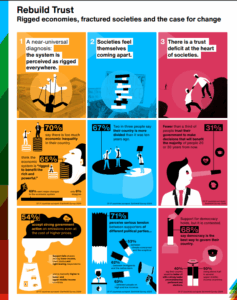
When surveys across countries report that a majority of people view the economic system as tilted toward the rich, the headline sounds like a cold ledger entry. A percentage point here. A cross-tabulation there. Yet behind that polled verdict sits a quieter, heavier reality: millions of people are looking at the rules that govern their daily survival and deciding the game is rigged.
Consider a hypothetical scenario to make the abstraction tangible. Imagine Marta, a composite figure standing in for tens of millions of working adults from Lisbon to Lima to Busan. Marta is thirty-eight. She works full time in logistics coordination, shows up before her shift starts, keeps her credit record clean, and reads the fine print on every contract she signs. Three years ago, she took a modest raise—four percent—only to watch her rent climb nine percent and her grocery bill creep upward every time she stepped through an automatic door. Nothing dramatic happened to her. No factory shuttered overnight. No bank foreclosed on her house, because she did not own one. Instead, every month ended with the same arithmetic hum: effort going in, margin vanishing before Friday.
Now introduce a metaphor, explicitly labeled as such, to see why Marta’s conclusion spreads so fast. Picture an evening board game where five players sit around a folding table. For the first few rounds, everyone plays by the printed card. Then one player, who started with three times the starting cash and a deed to the best corner lot, quietly swaps out the community chest deck for a thicker stack printed in paler ink. When another player asks why the rent on a basic street now costs two turns of income, the banker smiles and says the market has spoken. You can still roll the dice. You can still land on Go. You just cannot win unless the dice behave like a miracle.
That is the nerve exposed whenever majorities conclude the economic system favors the rich. People are not necessarily demanding identical wallets. Most adults understand that talent, risk, luck, and grit produce uneven outcomes. What corrodes belief is the suspicion that the rules bend toward whoever already holds the biggest stack—that wealth does not merely measure success, it buys exemptions.
When Suspicion Stops Being Envy
Critics of public skepticism often reach for a familiar dismissal: people call the system unfair because they resent those who have more. That explanation is tidy, convenient, and mostly wrong.
Envy wants what another person owns. Distrust questions how the ownership became automatic.
Look back to 1776, when Adam Smith published The Wealth of Nations. Smith was no enemy of commerce; he celebrated how division of labor and open exchange could lift ordinary households out of grinding scarcity. Yet he warned plainly that merchants and masters of manufacture possess an interest distinct from—and sometimes opposed to—the public good. Because a small group with concentrated capital has sharp, focused stakes, it organizes, lobbies, and shapes rules far more easily than millions of dispersed consumers or wage earners. Smith saw the hazard two and a half centuries ago: when economic power converts effortlessly into political and legal advantage, the system stops rewarding merit and starts rewarding proximity to leverage.
Trace the logic forward and you see why modern majorities reach the same verdict without ever opening an economics textbook. When income comes primarily from wages, your pay is tethered to productivity, bargaining power, and the clock on the wall. When income comes primarily from existing assets—real estate, equity portfolios, intellectual property, inherited stakes—returns compound without asking your knees or your back to show up at dawn. Over decades, even modest gaps in starting capital widen into canyons. A household living paycheck to paycheck cannot wait out a downturn by holding shares; it sells, borrows at high interest, or cuts essentials. A wealthy household buys the discounted asset on Tuesday.
From the outside, both households are participating in the same economic system. From the inside, they are standing on different floors of the building.
The Quiet Things Lost Inside Kitchens
A crisis of trust rarely announces itself with marching bands. Most days, it looks like a kitchen table after dinner.
Picture Marta again, still in our hypothetical composite sketch, sitting at a laminate table under a buzzing fluorescent tube. In front of her lies an itemized utility statement and a pharmacy receipt. She does the math twice because the second time feels like a trick. Her colleague in accounting makes more, yet spends half the week complaining about tax brackets; the owner of the regional distribution firm flying out of the local airport mentions in passing that his family office restructured its holdings last winter. Marta does not hate either of them. What eats at her is the creeping sense that her own prudence is being mocked. Why save for a down payment if house prices outrun savings by three to one? Why defer gratification when the goalposts keep jogging backward?
Listen to what happens next in millions of households when that question goes unanswered.
People delay having children, not always out of selfishness, but because stability feels rented rather than owned. Young adults stay in childhood bedrooms into their thirties, treating adulthood like a waiting room. Patients split pills or skip dental checkups because a single bill can wipe out two years of careful scrimping. Small business owners watch giant platforms undercut prices through scale and regulatory arbitrage, then wonder why they bothered taking the risk.
And beneath the financial strain sits a psychological bruise nobody measures in quarterly earnings: self-doubt mixed with anger. When the economic system is sold as a pure meritocracy, every setback whispers that you failed. When evidence piles up that the system favors the rich, that whisper curdles into cynicism. People stop believing politicians who promise a rising tide. They suspect regulators of auditioning for future board seats. They treat civic institutions—courts, agencies, public universities, newsrooms—as stage sets built to make inequality look like fate.
I have sat across from people who felt embarrassed to admit how lost they felt. Smart people. Hardworking people. People who kept spreadsheets and still woke up at three in the morning wondering if they had missed some secret instruction manual handed out to everyone else. There is nothing noble in pretending that confusion is harmless. When ordinary citizens cannot tell whether their struggle comes from personal misjudgment or structural tilt, confidence evaporates.
Why Patchwork Fixes Fail
Whenever survey data flashes red on economic fairness, familiar remedies roll off the assembly line. A one-time rebate check arrives in the mail. A blue-ribbon commission publishes a four-hundred-page report with pastel charts. A campaign speech invokes the dignity of work while leaving tax loopholes untouched.
None of that restores trust, because trust is relational. It depends on whether people see fair play in action.
Think about the political economist Albert Hirschman’s classic framework of exit, voice, and loyalty. When an organization or system stops delivering, people have three broad responses. They can voice their complaints, hoping reform works. They can stay loyal out of habit or affection. Or they can exit—mentally, civically, or economically. A majority concluding that the economic system favors the rich is standing right on the lip of mass exit. People may not pack suitcases for another country, yet they withdraw their faith in collective problem-solving.
Rebuilding that faith requires something sterner than soothing rhetoric. It starts with stripping away unearned privileges that masquerade as market rewards. When monopolies choke off competition, antitrust enforcement has to bite, not merely fine dominant players a fraction of one afternoon’s revenue. When tax codes let massive fortunes pay lower effective rates than nurses or electricians, closing those gaps is not class warfare; it is basic hygiene.
Equally vital is strengthening the public floor beneath everyday life. A society where healthcare, higher education, childcare, and basic housing are treated purely as speculative commodities turns every life milestone into a high-stakes gamble. When public services work reliably—when a local clinic is clean, a transit line runs on time, a public college opens real doors—citizens experience fairness directly. They see their contribution returning as shared capability rather than vanishing into private extraction.
Transparency matters just as much. Complexity is often the quiet bodyguard of privilege. When budgets, subsidies, corporate ownership chains, and bailout terms are buried in impenetrable jargon, ordinary people assume something is being hidden. Plain rules, openly debated and consistently enforced, do not guarantee equal outcomes, yet they make outcomes legible. You can accept losing a fair race. You cannot respect a race where the starting line moves for VIPs.
The Weight Left on the Table
Step back from the charts and listen to what a majority verdict actually says. It is not a demand for utopian perfection. It is a plea for a system that keeps its side of the bargain.
Work hard, play fair, build a life you can stand behind—that promise held nations together for generations precisely because enough people saw it come true in their own neighborhoods. When the majority looks around and sees the economic system favoring the rich, the bargain feels broken. Every delay in fixing it charges compound interest in alienation.
Picture a town square at dusk after the shops close. The streetlights flicker on one by one, casting pale circles onto cracked pavement. Somewhere behind a lit window, someone folds a bill in half, sets a pen beside it, and wonders whether tomorrow will reward honesty or only reward whoever already owns the street.