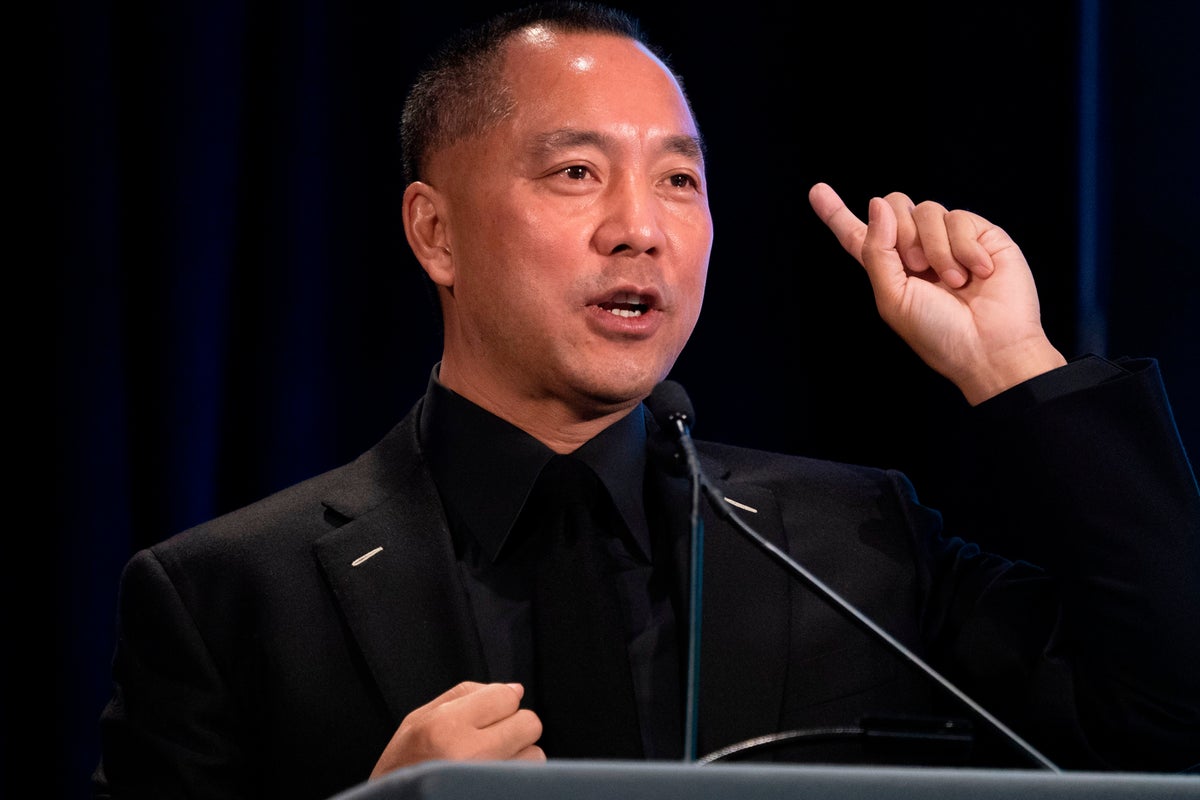
The mainstream financial press wants you to believe a comforting lie about the sentencing of exiled Chinese billionaire Guo Wengui. They want you to think his multi-billion-dollar fraud conviction is a victory for regulatory oversight. They want you to believe the Department of Justice just cleansed the system of a rogue actor, protecting everyday investors from a uniquely predatory mastermind.
That narrative is completely wrong. It misses the entire point of how modern financial influence operates.
Guo Wengui—also known as Miles Guo—was not a glitch in the global financial system. He was a mirror image of it. The lazy consensus portrays his sprawling network of cryptocurrency schemes, media companies, and luxury clubs as an unprecedented anomaly. In reality, Guo merely weaponized the exact same mechanics used by mainstream venture capitalists, political action committees, and sovereign wealth funds every single day. The only difference? He lacked the institutional protection to get away with it.
If you look closely at the mechanics of his empire, you realize that the outrage surrounding his case is entirely selective. The global financial system did not reject Guo Wengui because he dealt in illusions. It rejected him because he tried to run the illusion without paying dues to the established gatekeepers.
The Myth of the Sophisticated Crypto Scam
The primary charge against Guo is that he defrauded his followers out of over $1 billion through complex financial products, including a purported cryptocurrency ecosystem called the Himalaya Exchange and a digital coin named G-Coins. The media frames this as a hyper-sophisticated, high-tech deception that required elite federal investigators to untangle.
Let us be brutally honest about what actually happened. It was a affinity fraud wrapped in a flag.
Guo did not build an advanced financial engine. He built a cult of personality centered on anti-Chinese Communist Party (CCP) rhetoric. He targeted a highly specific, deeply passionate diaspora community that was desperate for a champion. He told them their money was safer in his closed-loop, unverified ecosystem than in standard banks.
In finance, we call this the monetization of tribalism. Having spent years tracking how capital flows through unregulated corridors, I can tell you that this happens at every level of the market. When an asset manager launches an ESG (Environmental, Social, and Governance) fund with exorbitant fees that holds the exact same tech stocks as a standard index, that is institutional affinity fraud. When a corporate executive uses a social media profile to artificially pump the valuation of a failing retail stock, that is systemic manipulation.
Guo’s real crime against the financial elite was not the creation of a closed-loop currency; it was the fact that he cut out the traditional intermediaries. He did not use Wall Street investment banks to underwrite his offerings. He did not pay tens of millions in compliance fees to legacy law firms to disguise his capital raises as legitimate enterprise. He used a smartphone, a livestreaming setup, and raw emotion.
Dismantling the Premise of Investor Protection
Whenever a massive fraud case concludes, regulatory bodies issue press releases claiming they are protecting the public. This raises a fundamental question that mainstream journalists refuse to ask: Who is responsible when the fraud is entirely public from day one?
The SEC and federal prosecutors argue that investors were misled by promises of massive returns and guaranteed stability. But a cursory glance at the structure of the Himalaya Exchange would have revealed to any baseline financial analyst that it lacked standard liquidity provisions, third-party audits, or verified custody arrangements.
The public did not buy into Guo’s ecosystem because they thought it was a secure, risk-mitigated investment. They bought into it because they wanted to participate in a political movement. They viewed their capital as ammunition in an ideological war.
When the state steps in to "protect" these investors after the collapse, it establishes a dangerous moral hazard. It suggests that individuals can throw money into obvious black boxes based purely on ideological alignment, and if the box breaks, the state will use taxpayer resources to hunt down the operator and attempt to recover the funds. This is not market regulation. It is state-sponsored risk mitigation for terrible decision-making.
The brutal truth nobody wants to admit is that you cannot legislate against greed and fanaticism. If an investor is willing to hand over their life savings to a man who streams from a $28 million yacht while claiming to be a bankrupt political dissident, no amount of regulatory paperwork will save that investor from themselves.
The Hypocrisy of Political Asylum and Capital Flips
To truly understand the hypocrisy surrounding the Guo Wengui saga, you have to look at how Western institutions treated him before his arrest. For years, he was the darling of right-wing political circles in the United States. He partnered with high-profile political strategists, hosted elites on his luxury vessels, and was viewed as a vital asset in the escalating geopolitical tension between Washington and Beijing.
During this period, the origin of his immense wealth was largely ignored. He was a billionaire who had fled China under a cloud of corruption allegations. Western institutions did not care whether that wealth was obtained through legitimate real estate development or backroom political deals in mainland China. As long as his capital was being deployed in alignment with Western political interests, he was granted a free pass.
This is a standard playbook. The global financial system regularly launders the reputations of foreign oligarchs, sovereign wealth fund managers, and political defectors, provided their money flows into the correct sectors. We see it in the London real estate market, in New York high finance, and in Swiss banking. Capital is neutral; it only becomes "corrupt" or "fraudulent" when the political utility of the person holding it expires.
Guo became a liability when his financial schemes grew so loud, so volatile, and so disruptive that they threatened to expose the sheer lack of oversight in the domestic digital asset space. The moment his legal exposure outweighed his political usefulness, the trap snapped shut.
The defense argued throughout his trial that his activities were part of a legitimate political movement aimed at exposing totalitarianism. The prosecution argued it was a textbook Ponzi scheme. The truth is that it was both simultaneously. Guo understood perfectly that in the modern attention economy, politics is the ultimate marketing funnel for financial speculation.
The Structural Failure of Digital Asset Governance
The conviction of Guo Wengui will do absolutely nothing to prevent the next iteration of this exact scenario. Why? Because the underlying architecture that allowed him to operate remains entirely intact.
The core promise of digital assets was decentralization—the removal of trusted thirds parties so that individuals could transact freely. What Guo proved is that the average market participant does not actually want decentralization. They want a centralized figurehead they can trust blindly. They want a savior.
He exploited this psychological vulnerability by building a synthetic ecosystem that possessed all the risks of a highly volatile cryptocurrency with none of the benefits of an open-source, public ledger. He controlled the platform, the pricing, and the exit ramps.
Consider the sheer scale of the assets seized or tracked by the government in this case: luxury vehicles, a 150-foot yacht, a New Jersey mansion, and hundreds of millions in bank accounts. This was not a subterranean operation hidden on the dark web. This was money moving through mainstream, Tier-1 global financial institutions.
If the current regulatory framework is as robust as the authorities claim, how did a heavily monitored, highly public political dissident move over $1 billion through traditional banking rails into luxury assets while actively running an unregistered securities empire?
The answer is simple: the banks were making money on the transactions. As long as the fees keep rolling in and the compliance departments can point to a checklist that satisfies the bare minimum of Know-Your-Customer (KYC) regulations, the system will look the other way. The system does not stop the crime in real-time; it merely acts as a historian after the collapse, picking through the ruins to allocate blame.
Stop Misunderstanding the Nature of Modern Wealth
If you are an investor trying to navigate the current global market, the takeaway from the Guo Wengui verdict should not be a sigh of relief that a fraudster is behind bars. The takeaway should be a profound skepticism of how valuation and legitimacy are manufactured in the modern world.
We live in an era where attention is the primary currency. The traditional metrics of financial stability—cash flow, debt-to-equity ratios, audited balance sheets—have been systematically devalued by a decade of ultra-low interest rates and speculative mania. Whether it is a meme coin backed by nothing but internet humor, a tech startup valued at tens of billions without a path to profitability, or a political defector’s private ecosystem, wealth is increasingly built on pure narrative.
Guo Wengui was simply a master narrator. He understood that if you tell a story that people desperately want to believe, they will hand you the keys to their bank accounts.
The downside to analyzing this case through the lens of a contrarian insider is recognizing that the line between a brilliant financial innovator and a convicted felon is often just a matter of timing and political coverage. If Guo had managed to convert his followers into a legitimate, institutionalized political lobby before his financial products unraveled, he would be sitting in a Washington think tank today rather than facing decades in a federal penitentiary.
Do not look at the 30-year sentence handed down to Guo Wengui as proof that the rule of law has triumphed over financial deception. Look at it as a warning of what happens when a rogue actor tries to play the financial elite's game without their permission, using their tools, and stealing their audience.
The house always wins. Not because the house is moral, but because the house writes the rules, controls the courts, and owns the cells.