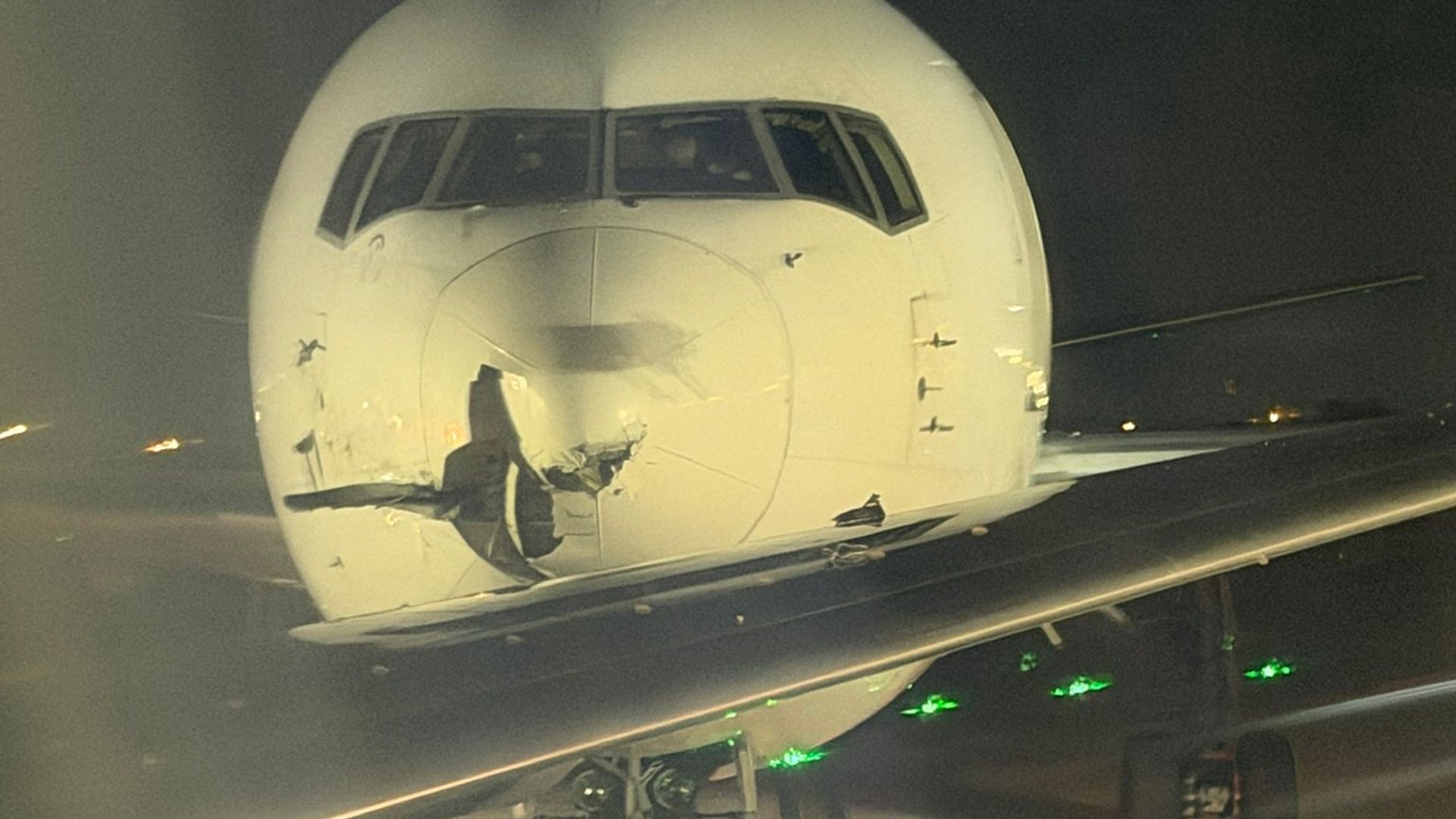
Ground collisions between commercial aircraft during taxiing operations represent a predictable failure of surface traffic coordination, spatial geometry, and human-machine interface limits rather than isolated bad luck. When two airliners make contact on the tarmac at Miami International Airport (MIA)—resulting in two minor injuries and immediate aircraft immobilization—the operational reality extends far beyond a localized fender-bender. This analysis deconstructs the systemic mechanics of airport surface incidents, the operational cascade triggered by a single wingtip or fuselage strike, and the structural vulnerabilities inherent in high-density hub taxiways.
The Anatomy of a Surface Excursion and Wingtip Strike
Standard aviation reporting treats taxiing collisions as anomalous, low-speed events with negligible human cost. In operational reality, a taxiway collision is the terminal node of a multi-variable failure chain involving spatial geometry, visual blind spots, and Air Traffic Control (ATC) surface sequencing.
Modern commercial aircraft are designed with extreme aspect-ratio wings to maximize aerodynamic efficiency at cruise altitudes. This design creates a persistent ground-handling liability: flight crews seated in the forward cockpit cannot visually verify the exact position of their own wingtips. On wide-body and stretched narrow-body jets, the wingtip sits dozens of feet behind and outward from the pilot's line of sight.
The Three Failure Vectors of Taxiway Collisions
- Spatial Compression and Wingspan Creep: Airport infrastructure—specifically taxiway centerlines and apron clearances—was frequently engineered decades ago for smaller fuselage footprints. As airlines upgauge fleets to higher-capacity variants with wider wingspans or raked wingtips, the margin for error between adjacent taxiways shrinks to mere feet.
- Cognitive Saturation During Surface Transit: The taxi phase demands high cognitive load. Pilots must simultaneously manage checklist execution, transponder configuration, weight-and-balance verification, and complex routing instructions across intersecting tarmac networks.
- Asymmetric Line-of-Sight and Surface Radar Gaps: While major hubs utilize Airport Surface Detection Equipment (ASDE-X) to track ground movements, radar updates operate on discrete polling intervals. During tight turns or congested pushback sequences at Miami International Airport, visual confirmation by ground crews (wing-walkers) and flight crews remains the primary defense against impact. When visual scanning breaks down under time pressure, collision becomes inevitable.
The physics of a low-speed ground impact still carry substantial kinetic energy. A commercial airliner weighing between 150,000 and 500,000 pounds moving at a standard taxi speed of 10 to 20 knots generates enough momentum to shear composite structural components, rupture fuel cells located within the wing box, or transmit violent lateral jolts through the cabin.
Injury Mechanisms in Low-Velocity Ground Impacts
When two minor injuries occur during a taxiway collision, the clinical mechanism is rarely direct impact trauma from intruding debris. Instead, injuries stem from sudden, unannounced deceleration forces acting upon unrestrained occupants.
During taxi operations, the operational state of the cabin is bifurcated. Passengers are generally seated with seatbelts fastened, though compliance varies before takeoff or immediately after landing. Conversely, cabin crew members are frequently standing, conducting safety demonstrations, securing galley equipment, or performing final cabin checks.
- Inertial Whiplash and Lateral Shear: A wingtip strike or tail-clip produces an abrupt yawing motion—a sudden rotational snap around the aircraft's vertical axis. Unlike braking, which applies linear deceleration along the longitudinal axis that passengers anticipate, lateral yaw throws standing crew members against hard bulkhead surfaces or galley carts.
- Overhead Bin Displacement: Sudden lateral shocks can unlatch improperly secured overhead compartments, turning carry-on luggage into falling projectiles.
- Emergency Egress Hazards: Even when an impact causes no immediate physical harm, the subsequent precautionary evacuation—if deployed via inflatable slides—historically generates a high rate of sprains, fractures, and friction burns. In the Miami incident, keeping passengers aboard for standard deplaning via airstairs or jet bridges prevented the secondary injury wave typically associated with emergency slide deployments.
The Operational Cost Function of a Tarmac Incident
A minor ground collision triggers an immediate, non-linear financial and logistical cascade for the operating carriers and the airport authority. While headline narratives focus on the absence of fatalities, airline operations centers measure the event through aircraft-on-ground (AOG) metrics and network propagation delays.
Direct and Indirect Financial Erosion
The direct repair cost of a composite wingtip, horizontal stabilizer, or fuselage skin puncture routinely reaches hundreds of thousands of dollars. Modern airframes utilize carbon-fiber-reinforced polymers (CFRP). Unlike legacy aluminum skins that display obvious denting upon impact, composite structures can suffer invisible internal delamination. Nondestructive testing (NDT), including ultrasonic scanning, is mandatory before the airframe can return to revenue service.
The indirect costs dwarf physical repair bills:
- Fleet Utilization Loss: Commercial aircraft generate revenue only when airborne. Removing a narrow-body jet from rotation at a high-yield hub like Miami forces immediate tail-swaps, disrupting four to six subsequent flight legs per day until maintenance spares are positioned.
- Taxiway Bottlenecks: Miami International Airport operates on a constrained footprint bordered by major highway infrastructure. When two aircraft lock together or halt on an active taxiway, they create an immediate physical choke point. ATC must reroute departing and arriving traffic onto secondary veins, inflating taxi-out times and burning excess jet fuel across dozens of unrelated flights.
- Crew Duty-Time Expirations: Federal Aviation Administration (FAA) regulations strictly cap flight crew duty hours. A two-hour tarmac freeze during post-incident investigation and aircraft towing frequently pushes flight and cabin crews past their legal duty limits, forcing flight cancellations even after replacement aircraft are secured.
Structural Vulnerabilities at High-Density Hub Airports
Miami International Airport serves as a primary North American gateway to Latin America and the Caribbean, creating unique surface traffic dynamics that elevate collision risk compared to domestic point-to-point airports.
Fleet Mix Heterogeneity
MIA handles an exceptionally diverse mix of aircraft sizes simultaneously. Super-heavy wide-bodies (such as Boeing 777s and Airbus A350s) share tight apron corridors with regional turboprops and narrow-body workhorses. Wake turbulence separation rules govern airborne spacing, but on the ground, this heterogeneity creates severe spatial mismatches. A wide-body aircraft executing a standard turn requires substantial wingtip clearance overhang, sweeping across adjacent taxilanes that appear clear from the cockpit window.
Terminal Concourse Geometry
Older concourse designs feature narrow cul-de-sacs (alleys) between terminals. Pushing an aircraft back from a gate into an active alley requires precise coordination between the tug driver, the wing-walkers, the flight deck, and ramp control. Unlike FAA-controlled movement areas (runways and primary taxiways), ramp and apron areas are often managed by airline-specific ramp towers or operate under non-radar visual rules. The transition zone where ramp control hands off an aircraft to FAA ground control represents the highest-friction boundary in airport surface operations.
Limitations of Current Surface Safety Technologies
Aviation regulators and airport operators rely on a layered defense model to prevent ground collisions, yet every current technological intervention carries distinct operational blind spots.
- ASDE-X and Surface Movement Radar: While effective at preventing runway incursions—high-speed collisions between landing/departing aircraft and crossing traffic—surface radar lacks the sub-meter resolution required to prevent low-speed wingtip clips on crowded aprons. Radar targets appear as electronic data blocks on a controller's screen rather than exact three-dimensional wireframes of an aircraft's wingspan.
- Cockpit Moving Maps: Electronic Flight Bags (EFBs) equipped with airport moving maps display the aircraft's own-ship position via GPS. However, standard GPS accuracy degrades near tall terminal structures due to multipath signal reflection, and these displays rarely broadcast the real-time wingspan dimensions of surrounding traffic.
- Human Wing-Walkers: Relying on ground personnel walking alongside wingtips is labor-intensive and vulnerable to human error. High ambient noise levels, heat exhaustion on the Miami tarmac, night glare, and radio frequency congestion frequently degrade communication between a wing-walker spotting an imminent collision and the tug driver or pilot applying the brakes.
Strategic Imperatives for Surface Risk Mitigation
Eliminating taxiway collisions requires shifting from reactive human vigilance to automated spatial enforcement. Airport authorities and commercial carriers operating in high-density hubs must execute three concrete structural adjustments:
First, airlines must mandate wingtip-mounted proximity sensors and optical camera systems on next-generation fleet deliveries, integrating real-time clearance alerts directly into the cockpit primary flight display rather than relying on external ground marshals.
Second, hub operators at constrained facilities like Miami International Airport must redesignate high-density ramp alleys as strictly one-way flow corridors during peak bank hours, eliminating opposing-traffic pinch points even at the cost of adding three to five minutes to average taxi times.
Third, FAA ground control and airline ramp operations must merge surface surveillance feeds into a unified, high-frequency ADS-B surface tracking grid that maps exact airframe geometry—not just center-point transponders—triggering automated visual and auditory warnings in both the tower and the flight deck whenever wingtip separation drops below a hard five-meter threshold.